


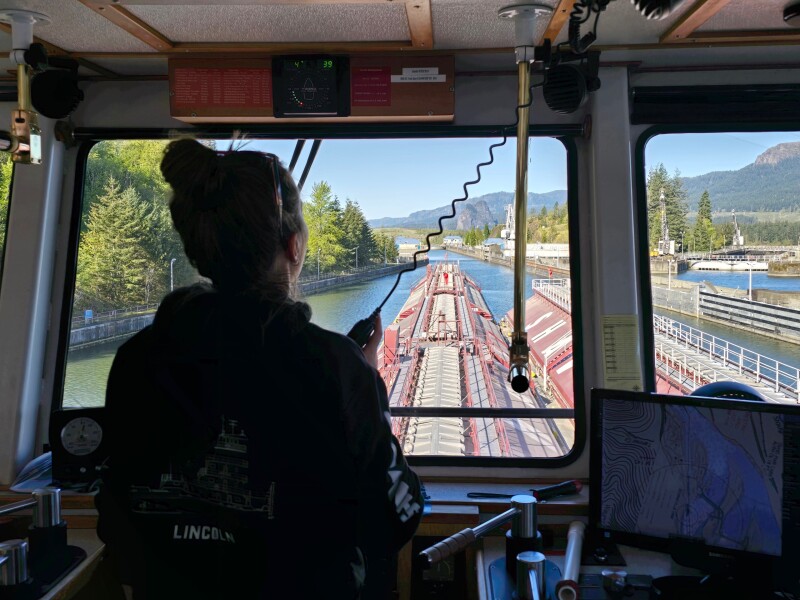
On the Columbia River, one of the most demanding stretches of commercial waterway in the American West, a small but growing group of women is quietly rewriting what the industry looks like.
The Columbia River Women’s Caucus, founded in March, is led by Capt. Sasha La Greide, president; Capt. Megan Emerson, treasurer and tug operator; Hannah Hill, secretary and deckhand/engineer; and Alyssa Taylor, director and deckhand/engineer. Together, the four women represent a cross-section of the Columbia River tug and towboat industry, from wheelhouse leadership to deck and engineering operations.
The Caucus began with little more than a dinner, a conversation, and a determination to make sure no woman working on the river ever has to go through the hard parts alone.
The organization grew out of a simple realization: there were very few women working aboard tugboats and towboats on the river, and even fewer opportunities for them to connect with one another.
“I know Megan, because I worked at Tidewater, so it was her and me, essentially, until about two years ago,” La Greide said. “And then I was out here doing a job, and I saw a little blonde girl on a Foss boat, and I thought, ‘I have to find out who that is, because there’s just so few of us.’”
After connecting with Hill and Taylor, the group began meeting informally before deciding to establish a nonprofit focused on workforce development, mentorship and industry outreach.
“We kind of realized how few of us there were,” La Greide said. “We decided to, I guess, take the bull by the horns and start spreading awareness, honestly, about the industry in general.”
What they found when they sat down together was what so many women in male-dominated industries discover: their experiences were nearly identical. The weird hours, the odd logistics of being the only woman in a small crew’s living quarters, the way doors opened, or didn’t, based on who you knew. All of it, shared.
“As we talk about our experiences, they’re all really similar,” La Greide said. “And we’re talking about trying to focus on the next generation. A lot of what I hear all the time is, ‘I wish I would have known about this industry sooner.’”
The caucus has already participated in career fairs, visited Job Corps programs and spoken with high schools and colleges about maritime careers. Members said many young people, especially women, simply do not know jobs aboard commercial vessels exist. Today, the group holds 501(c)(3) status, the ear of a congresswoman, and a clear-eyed mission: visibility, outreach, and support for the next generation.
Beyond workforce outreach, members said one of the Caucus’ most important functions has been providing a support network for women working in an industry where they are often isolated aboard small crews.
“It’s weird sometimes being the only female on a little boat with four or five other guys at a time,” Hill said. “Without the support of these women, I wouldn’t have been able to do that.”
La Greide said the group’s broader goal is ensuring future mariners entering the industry do not feel isolated.
“I realized that I can do the first step,” she said. “I can make sure that nobody ever has to go through what I’ve been through alone.”
THE BEGINNING
The founders initially figured the group would be modest, maybe enough to cover gas and transportation costs for volunteer outreach. Within a month of getting started, Representative Marie Gluesenkamp-Perez, who represents Washington’s 3rd Congressional District, reached out asking how she could help.
“I don’t think any of us expected it to be much more than, ‘We’ll start a 501(c)(3) so we can cover some of our costs,’” La Greide said. “And it’s turned into, very quickly, ‘Okay, we need to be very careful about handling this in a way that we can grow, without growing past what we’re capable of doing.’”
Operators’ unions and trades organizations have since expressed interest in supporting the group’s work. The Caucus also helped constituents draft letters to Congress during a recent government shutdown push for an extension. The support has surprised even its founders.
“It turns out people want to help the grassroots-type people. We’ve actually done the [maritime] work.”
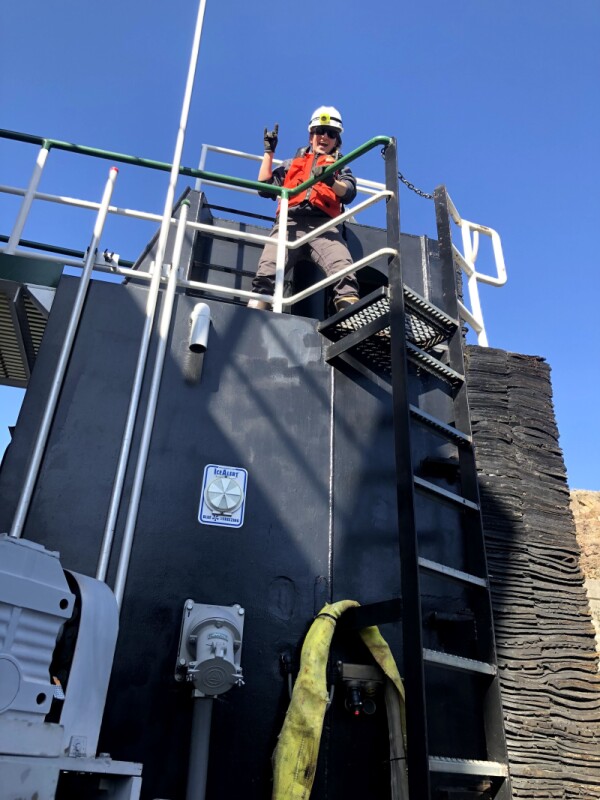
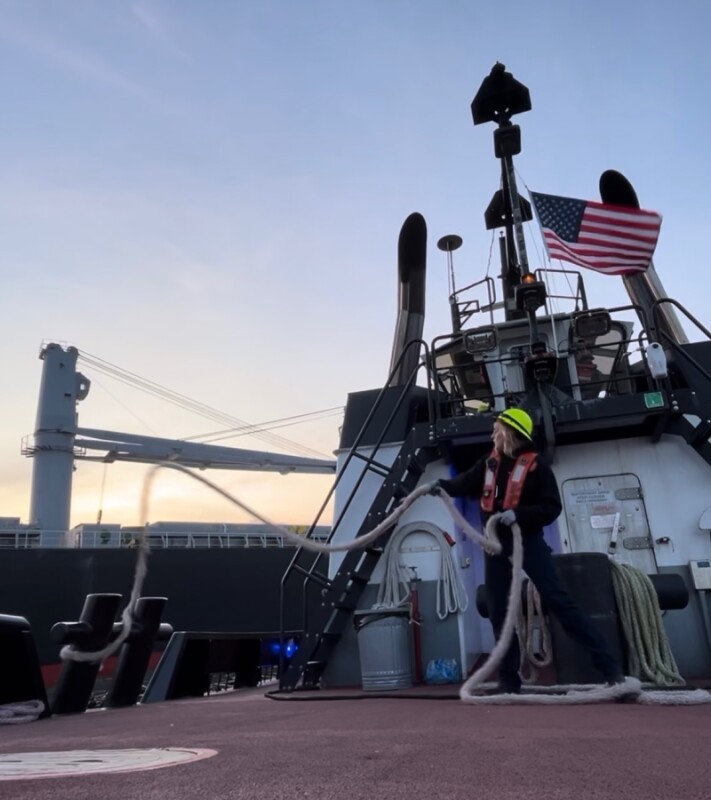
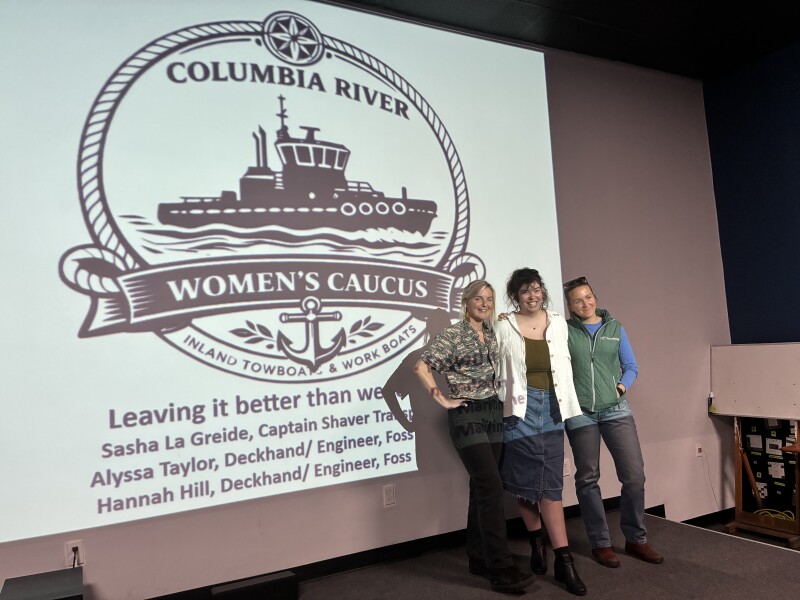
ON THE WATER, IN THE SCHOOLS
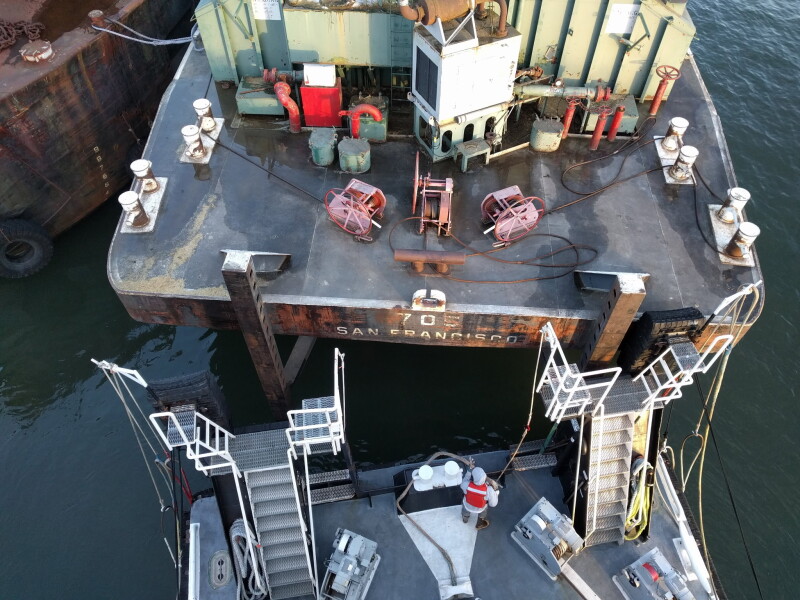
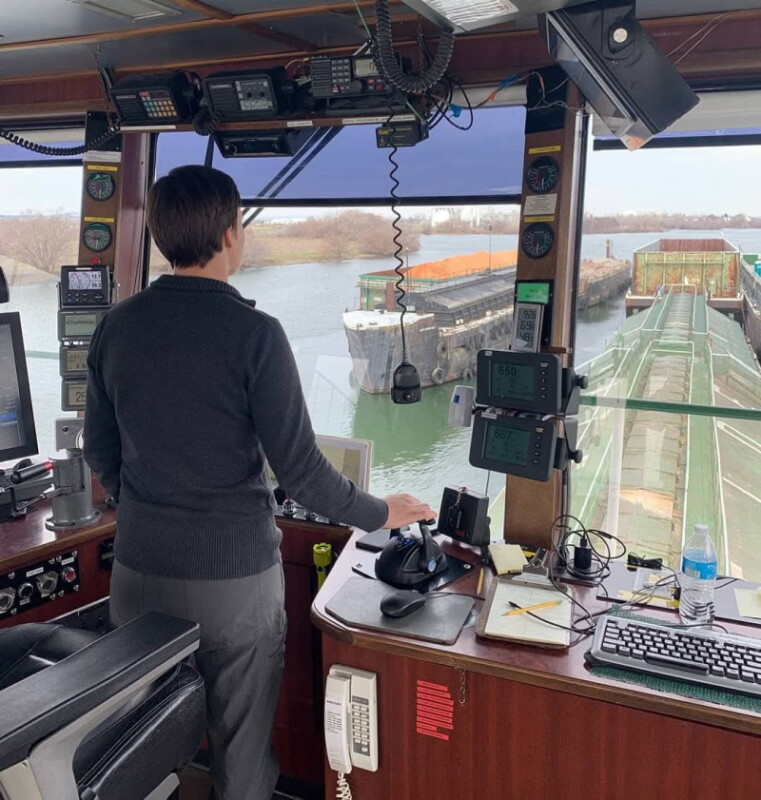
Part of what makes the Caucus’ outreach personal is that, on tugs and towboats on the Columbia, the members are the industry. To their knowledge, there are currently just four women working on tug and towboats on the river. The group is aware of female longshoremen in Portland, Ore., and a few women on dredges, pilot boats and passenger vessels. But on tugs specifically, they’re it.
That rarity carries weight. La Greide recalled coming into Bonneville Dam with pigtail braids and spotting a little girl, also in pigtails, watching from a lock wall with her school group.
“I said, ‘Hey, I like your braids!’ And she started jumping up and down and freaking out. And I thought, ‘Oh, this is a thing. These little girls have never seen this.’ If you see it, then you think it’s possible.”
Hill said watching La Greide and Emerson work had the same effect on her. “I’m the little girl in pigtails,” she said with a laugh.
One of the group’s most concrete near-term goals involves the maritime training program at Tongue Point Job Corps Center in Astoria, Ore., which is a federally funded program that, the Caucus says, has effectively blocked female students from accessing the same sea-term opportunities available to their male peers.
Students need real-world sea time to complete their training, and the program maintains a roster of companies willing to host them. But when the Caucus began advocating for female students to be placed with those companies, they were told the program didn’t want men and women in the same bunk room.
“They’re going to be on separate watches,” La Greide said. “And also, follow the law. You’re a federally funded program. You don’t get to say women are too naive to work on boats.”
The Caucus is working to educate program administrators and is also exploring a fund that could, in the short term, put female students in nearby hotels if the bunk-room concern is truly the sticking point.
“There’s a lot of low-hanging fruit,” Hill said. “Very low.”
SUPPORT
The Caucus is not the first women’s organization in the maritime industry. Sea Sisters, a national group the Caucus describes as a close partner, has been doing important work for years, and it’s where Emerson and La Greide first connected with Hill at a Sea Sisters retreat in 2022.
But the Columbia River is specific. It has its own culture, its own bar crossing, its own licensing ecosystem, and its own history. Most national organizations, however well-funded, can’t put someone in a room in Portland or dockside in Astoria. The Caucus can.
That local presence also means something for the informal support members provide each other, including texts at odd hours, the shared experience of being the only woman in a small crew, and the collective knowledge of which companies treat people fairly.
“Knowing that I’m not alone in it and I can call any of them anytime is awesome,” Hill said of staying in the industry through difficult times.
La Greide framed the mission with characteristic directness.
“For a lot of years, I thought I wanted to make it so that nothing bad ever happened to anyone again. I realized that wasn’t reasonable. But when we started this, I realized that I can do the first step: I can make sure that nobody ever has to go through what I’ve been through alone. And if I can do that, then the next step becomes more attainable.”
A RIVER WITH HISTORY
The Columbia has a longer history of women at the helm than most people realize. In the late 1800s, a woman named Minnie Mae Mossman Hill became the first licensed female captain on the river, having to travel to San Francisco to obtain her license because no local institution would grant one. She co-owned and operated steamships with her husband during an era when that was essentially unheard of.
In more recent decades, Ann McIntyre and Rebecca Henderson both served as Columbia River pilots — the elite corps of licensed specialists who board and navigate large vessels across the Columbia Bar. McIntyre’s successor, Rebecca, has been a visible mentor to younger women on the river, including La Greide, whom she took on ride-alongs and actively encouraged toward a pilotage career.
In terms of upriver tug operations, Emerson is believed to be the first woman ever to work as an operator on the Snake River within the last five years. The oral history of the river, as best as anyone can piece together, suggests there have been no others.
The Caucus is hoping to change what that history looks like fifty years from now.
WHAT’S NEXT
The group is being intentional about growth. A scholarship fund is on the longer-term roadmap. More outreach, more career fairs, more conversations with programs like Tongue Point are already underway. They want to be the connection that makes a career possible for someone who otherwise wouldn’t have had it.
“I couldn’t help somebody in San Francisco. We can be the connection here. And we can vouch for people — so it’s a little less nepotism-y.”
Or, as La Greide put it, borrowing a metaphor and then discarding it for something better:
“I’m not going to wait for a seat at the table. I’m going to build the chair.”
