


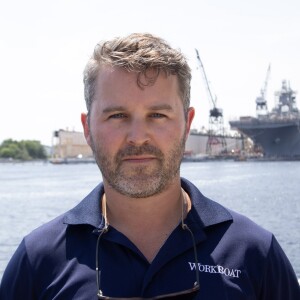
In August, WorkBoat visited Cook Inlet Tug & Barge LLC (CITB), Anchorage, Alaska, to get a closer look at what it takes to operate tugboats in one of the harshest marine environments in the U.S. Early in the conversation with CITB president Jeff Johnson, terms like “ice-shadowing” and “turtle-plated” tugboat hulls underscored just how unique and challenging working along Alaska’s rugged coastline can be.
“We work Anchorage year-round,” said Johnson. “All the ships and barges that come in here year-round we manage. Port of Seward as well. And seasonally, we work Western Alaska, pretty much Bristol Bay to Canada. And then we have three boats that remain in Prudhoe year-round.”
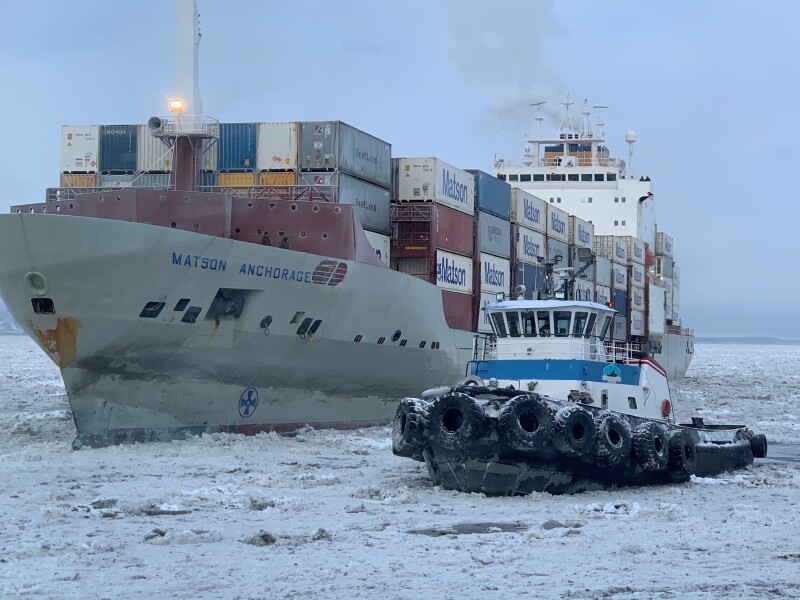
In Anchorage and Seward, CITB focuses on ship assist services and handles petroleum, bulk, container, railroad, and military movements. Johnson estimates around 400 ship calls annually at Anchorage, with about 300 of those being cargo vessels. The primary liner customers are Matson Inc., Honolulu, and TOTE Maritime, Jacksonville, Fla.
Prudhoe Bay
Outside of Anchorage, CITB’s tugs support oil and gas, mining, and village resupply. In Prudhoe Bay, above the Arctic Circle, the company stations three 64'x27' shallow-draft, triple-screw, 1,000-hp River-class tugs year-round. Built in the 1970s by Colberg Boat Works, Stockton, Calif., the tugs are paired with two deck barges and operate in just 3.5' of water.
“When we say shallow draft tug, and I go shopping for one in the Gulf, you know, four-foot draft with any suitable horsepower…there’s nothing out there,” Johnson said. “Prudhoe Bay is six to eight feet deep. You come in with a barge, it’s five feet. It’s critical, you could go miles offshore and still only be in 20 feet of water,” Johnson said.
The Prudhoe Bay tugs are “the same vintage as the Invaders,” said Ken Audette, CITB chief engineer. “Crowley built like five of them in the ’70s, as the first of the class when they were building the Trans-Alaska Pipeline. So, they were specifically designed for that area, with those barges, and we’re still operating them now, going on 55 years later. Everything’s very specifically different up here,” he said.
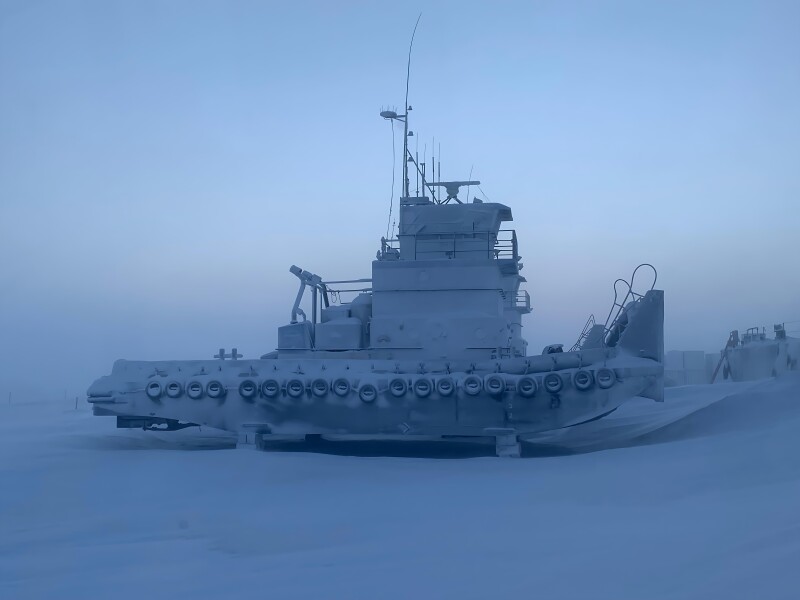
Prudhoe Bay tug maintenance is performed in late October, after which the River-class tugs are laid up on the beach for the winter. CITB also rolls its barges onto the beach using its own bags, while the tugs are craned ashore. “We just haul them out on the beach all winter,” Johnson said.
Also in Prudhoe Bay, CITB’s operations extend beyond commercial work to support indigenous communities with whaling projects and project logistics. The company is sometimes chartered to transport gear to Cross Island, running heavy equipment out to assist with beach landings. “Where we can help, we do,” Johnson said, noting that CITB often steps in to move equipment for other entities when needed.
At the time of discussion, the CITB team was screeding an area called Oliktok — in the Arctic Ocean near the Prudhoe Bay oil fields — to get it ready for project barge operations. Depending on the equipment, some barges can work off floats and lift cargo directly onto the beach, while others are designed to sink and roll heavy gear ashore.
Challenging Tidal Operations
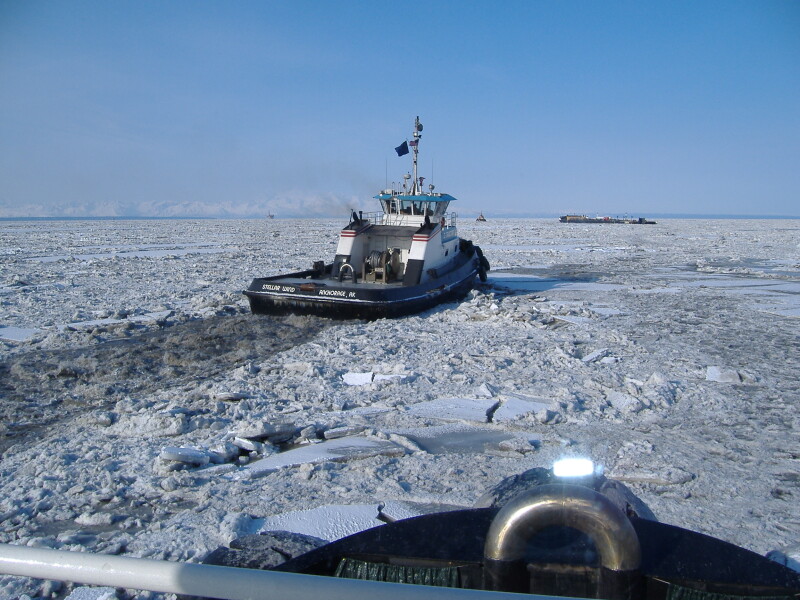
Back in Anchorage, while not icebreakers, CITB’s tug fleet is outfitted strictly for Alaskan conditions. “We work in ice, and through our experience, we’ve added stuff to these boats,” Johnson said. That includes steel covers over grid coolers, reinforced drive units, additional plating on bows, and structural half-frames to strengthen hulls, Audette told WorkBoat.
Winter temperatures in Anchorage can dip to 20 below zero, which means heating systems are also critical. Boilers circulate PEX tubing to heat decks and staterooms. “A lot of times, the engine rooms are hot enough, [and] we stay ice-free,” Johnson said. “But areas that aren’t ice-free, we’ll run PEX tubing.”
“We’ve added a bunch of extra steel framing. And then crazy turtle plating on the front… All of our tugs out here have some version of that. We have 5,000 horse [power] on tap if we want it. We’re gonna get through,” Audette said.
On days with thick ice, the crews often fall into a “momma and baby duck routine” depending on ice conditions. “You guys will have to come in the winter, it’s pretty gnarly… You can really tell the current when the ice is frozen. When you see that piece of ice going at six knots, you get a different perspective.”
Cook Inlet’s ice, fast currents, and tides that can swing 25' to 40' in six hours also demand a high level of precision. When docking cargo ships in the winter on an iced-out river, CITB crews perform a maneuver they call “ice-shadowing”, where, on a flood tide, a tug will nose against the dock, creating an “ice-shadow” while two higher horsepower tugs sweep ice pans away as the ship is guided into a cleared pocket.
“If ice re-enters between ship and dock, the approach resets — timing is tight against the tide window,” a crewmember explained. In harsh winters, when ice can reach 3' thick, CITB has run leapfrog escorts with two tugs to keep lanes open for oilfield supply vessels.
 - Copy.JPG.medium.800x800.jpg)
 2023-3 Cook Inlet frozen tug.jpg.medium.800x800.jpg)
CITB crews also battle relentless glacial silt. In the summer, the Army Corps of Engineers runs a small aluminum boat with a multibeam transducer for bathymetry work. “The mud just fills in constantly. All that stuff back there’s like a second project,” said CITB Capt. Wayne Humbert, pointing to the silt. “There’s a suction dredge that comes out here as soon as the ice leaves every year, and they just maintenance dredge the whole port. The company that has that contract right now is Manson,” he said.
When ice sets in, CITB’s boats step in to help maintain the channel, with two tugs that have a moon port in their bows. “They...put their multibeam transducer on there so we can go run the ice, do all the bathymetry for ’em. In the wintertime, it slows down. It’s not once a week. We do it roughly once a month.”
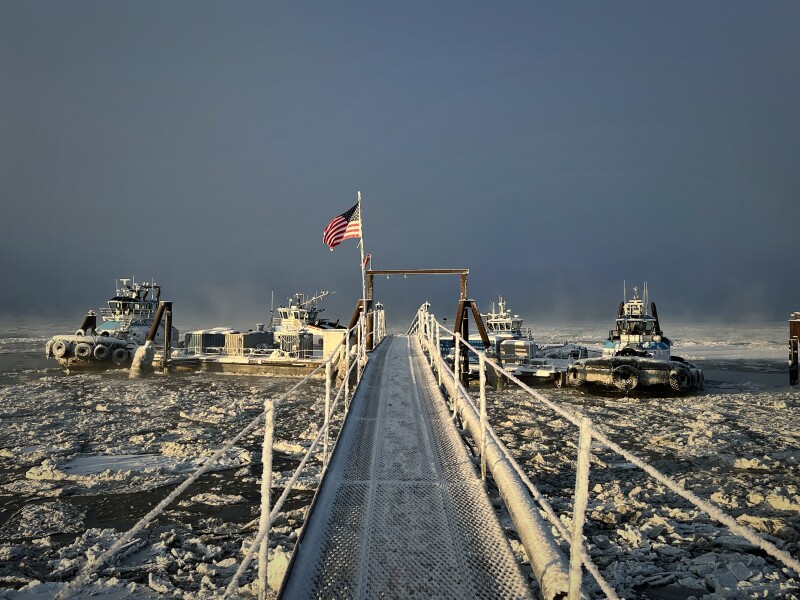
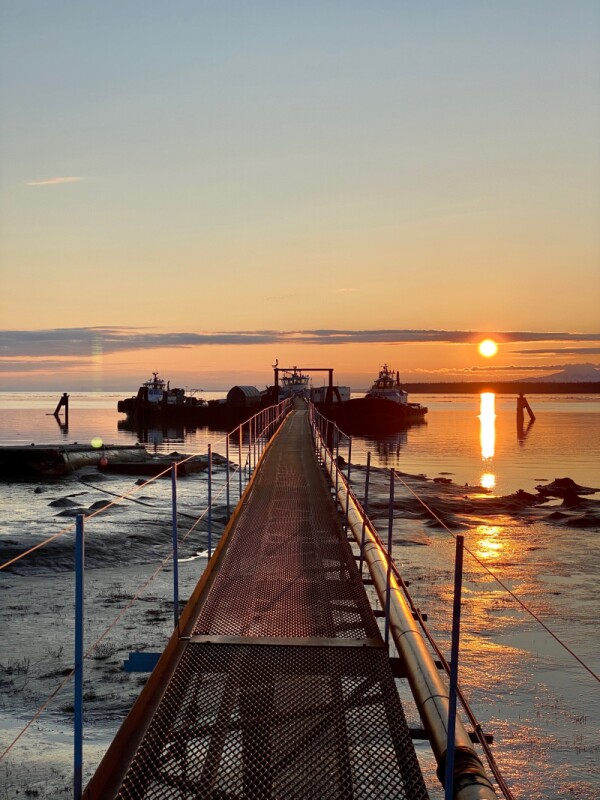
Winter ice can also threaten the company’s shoreside lifeline. “That’s the worst part of it right there, that Blue Mile,” Humbert said. “In the wintertime, all the beach ice slowly moves offshore. It’s like a glacier. So, you come out here and some mornings the catwalk will start to lean over,” he said. Crews maintain access by hand when ice presses in.
“We go up and we got an ice auger and a chainsaw with a long bar, go up around the pilings and basically just cut out all of the ice. On the average year, that beach ice around the pilings is about eight to 10 feet down. You’re just kind of stepping your way down to get to the bottom of the piling,” he said.
Speaking to the difficulty of operations and the experience of the crew, Johnson said, “There’s a thrill factor. There’s a professional challenge factor these guys really enjoy,” he said before joking, “versus looking at the side of a steel ship in Oakland.”
Blue Mile Causeway
Anchorage lacks a small-boat harbor, making it difficult for operators to establish a homebase for their fleet, so CITB built its own. “We built our own causeway,” Johnson said before noting that CITB leased tide land from the Alaska Railroad Corp., Anchorage, and began developing its own facilities, known as the Blue Mile.
“We’ve built our own floating facility that’s … ice-protected and put in a batter piling on each end of the facility,” Johnson said. “As the ice floes come and go, the diagonal pilings break up the ice floes before they hit the boats.”
CITB has operated in Anchorage since 1964, later rebuilding the Blue Mile facility in 2012 with new floating configurations. In 2021, the company acquired a flat deck freight barge from local contractor Brice Marine, Fairbanks, and outfitted it with pile clamps and UHMW-type sheathing that allow maintenance or even drydocking when needed. Johnson said that “safety is our number one value. And getting on and off boats is always tricky. Add ice, add currents, add wind, cold temperatures,” he said.
Major repairs and drydockings typically run through Highmark Marine Fabrication LLC, Kodiak, about a 24-hour transit, while the company completes as much routine maintenance in-house as possible.
Reliability is critical, as roughly 80% of Alaska’s goods move across Anchorage’s docks. “If Matson were to come in and we say, ‘We’re down’, there’s no one else,” Johnson said. “We’re excited to be here. We take what we do seriously, because customers and communities across the state depend on it.”
