



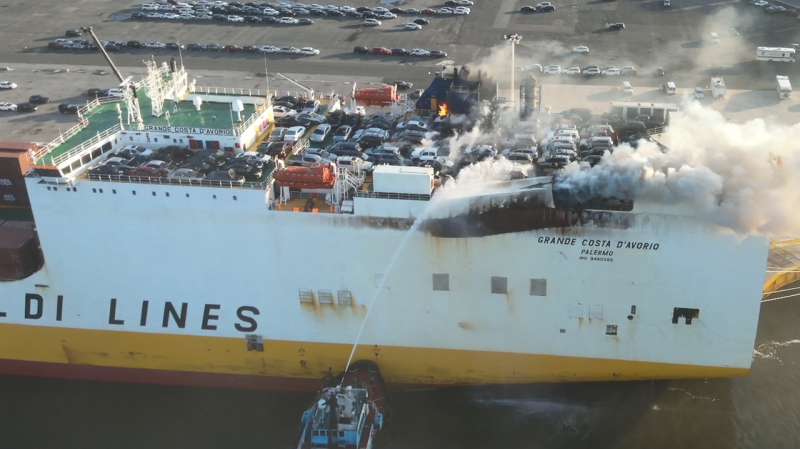
Land-based firefighters need greater awareness and training so they can effectively and safely fight fires aboard vessels in U.S. ports, the National Transportation Safety Board said in a new safety alert issued Sept. 10.
“Many land based firefighters lack the necessary training and familiarity with vessel layouts and fire protection systems to effectively fight in-port vessel fires,” NTSB experts wrote in a summary of the needs. “Combatting vessel fires—especially aboard large commercial vessels – requires different resources, skills, and tactics than fighting structural fires on land.”
The safety alert is a restatement of NTSB warnings issued soon after the 2023 fatal fire on the roll-on/roll-off container vessel Grande Costa D’Avorio in Newark, N.J., that killed two city firefighters trapped on a vehicle deck. It cites other vessel fires the NTSB has investigated that resulted in land-based firefighters injured due to the firefighters’ lack of training in vessel firefighting.
The safety board reports that “land-based firefighters often lack the necessary training and familiarity with vessel layouts and fire protection systems to effectively fight in-port vessel fires. They also may be unaware of how to use the structural fire protection built into most commercial vessels.”
With training, firefighters can “leverage the structural fire protection that is built into most commercial vessels,” the NTSB briefing paper says. “Structural fire protection uses passive design features, such as fire-resistant bulkheads and decks, to slow the expansion of a fire from one compartment to another. The fire-resistant bulkheads and decks also divide the ship into fire protection zones that can be sealed to starve a fire of oxygen.”
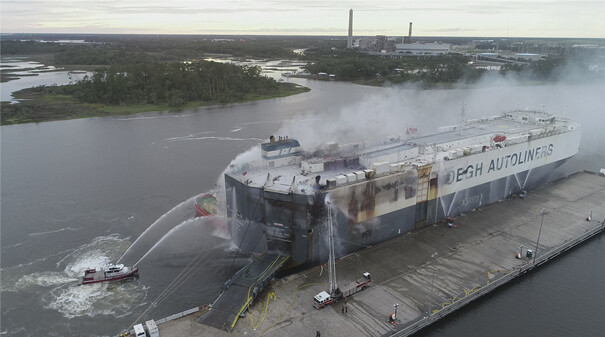
Firefighters need to be aware that many ships “have built-in fixed firefighting systems that use gas, such as carbon dioxide, in conjunction with a vessel’s fire protection zones, to displace oxygen and extinguish shipboard fires,” the NTSB brief says.
“The space in which these systems are activated must be sealed off: Opening the space too soon following the gas release can cause a reflash of the fire from the introduction of fresh air (oxygen).”
Once those fire suppression gases are released into the sealed area, the enclosed space can be extremely dangerous for firefighters.
During the Grande Costa D’Avorio fire, “Newark Fire Division leadership directed the firefighters to actively engage the fire in the fire protection zone where the carbon dioxide gas extinguishing system had already been activated, which allowed more carbon dioxide out and more oxygen in, increasing the severity of the fire,” according to the NTSB. “The NTSB found the Newark Fire Division’s lack of marine vessel firefighting training resulted in an ineffective response, led to the firefighter casualties, and contributed to the severity of the fire.”
The NTSB specifically recommends that local fire departments improve their members’ safety by:
- Developing training plans to ensure all firefighters understand how to fight vessel fires, including the resources needed, the best tactics, strategies and methods for communicating while on a vessel and with vessel crew, and vessel layouts.
- Identifying supplemental training areas and developing a training plan and operational procedures in reference to National Fire Protection Association publication 1405: Guide for Land-Based Fire Departments that Respond to Marine Vessel Fires, and NFPA 1010: Standard on Professional Qualifications for Firefighters (formerly NFPA 1005: Standards for Professional Qualifications for Marine Fire Fighting for Land- Based Fire Fighters).
- Working in advance with local ports to organize vessel familiarization tours and to coordinate vessel firefighting response preparedness and training in conjunction with the drills and exercises required for certain vessels.
- Coordinating with the U.S. Coast Guard on standard operating procedures during emergencies.
- Learning from the circumstances of other in-port vessel fires to improve contingency planning.
· The safety alert is available online.
