



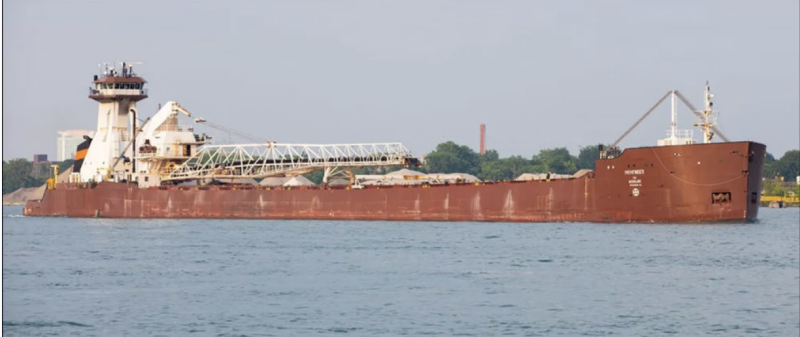
A Dec. 30, 2024 generator fire on the articulated tug and barge Dorothy Ann/Pathfinder, in Lake Erie near Cleveland, Ohio was probably caused by a loss of lubricating oil to one of the generator engine’s connecting rods, triggered by electrical problems, according to a report by National Transportation Safety Board.
The fire broke out in the generator space of the barge Pathfinder at 4:09 p.m. and the 16-member crew sealed the space and released the vessel’s fixed gas fire extinguishing system to extinguish the fire. There were no injuries, no pollution was reported and damages were estimated at $2.6 million, the NTSB reported.
“The probable cause of the diesel generator engine failure and resulting fire aboard the self-unloading barge Pathfinder was a loss of lube oil to one of the engine’s connecting rods, possibly due to its electrical generator experiencing a sudden block load beyond its design capability resulting from an electrical short in the generator,” NTSB investigators wrote in a report issued Jan. 13.
The 119.2’ welded steel tug Dorothy Ann was coupled to the 580.3’ Pathfinder, and operated together as an articulated tug and barge (ATB) in the ore and stone trades on the Great Lakes by the Interlake Steamship Co., Middleburg Heights, Ohio.
Onboard the Pathfinder was a 2,447 hp Caterpillar 3516B diesel engine-driven generator, called the “unloading generator,” providing electrical power. While anchored the unloading generator was running, supplying power to the barge.
When the fire broke out the first mate, who was on watch in the pilothouse of the Dorothy Ann, was notified by a call from a watchman on a handheld radio that the barge had lost electrical power. The first mate called the duty engineer in the tug’s engine control room and then the chief engineer and captain.
Crewmembers saw black smoke coming out from the open doors of the unloading generator space and ventilation ducts on the barge. “There was no fire detection system aboard the barge, nor was any required,” according to an NTSB narrative of the incident. “At the time, the bow thruster was idling. The first mate sounded the general alarm. The crew mustered on the stern of the tug and began donning firefighting gear; all crewmembers were accounted for.”
In a detailed report on the fire and post-accident damage, investigators noted “the most severe fire damage was about 5–10 feet from the damaged engine block near the no. 9 connecting rod, where internal components had forcefully exited the engine. “
In four minutes leading up to the discovery of the fire, the engine control room machinery automation system recorded a decrease of lube oil pressure while the engine was running at rated speed (1,800 rpm) before the engine stopped. “This loss of pressure (from 58–47 psi) was not severe enough to activate the low-pressure lube oil alarm, so the watchstanding crew was unaware of it.”
The report notes that company technicians inspecting the damage “attributed the engine failure to an electrical short on the generator side of the busbar that led to block loading of the attached generator. As the technicians’ report stated, block loading could have placed an excessive load on the diesel engine and ultimately caused the engine’s main bearing shells to rotate in their saddles.”
In its customary “lessons learned” postscript, NTSB investigators wrote:
“Vessel crews should familiarize themselves and train frequently on machinery, fuel oil, lube oil, isolation valves, and ventilation shutoff systems to quickly act to contain and suppress fires in machinery spaces before they can spread to other spaces and/or cause a loss of propulsion and electrical power.”
