



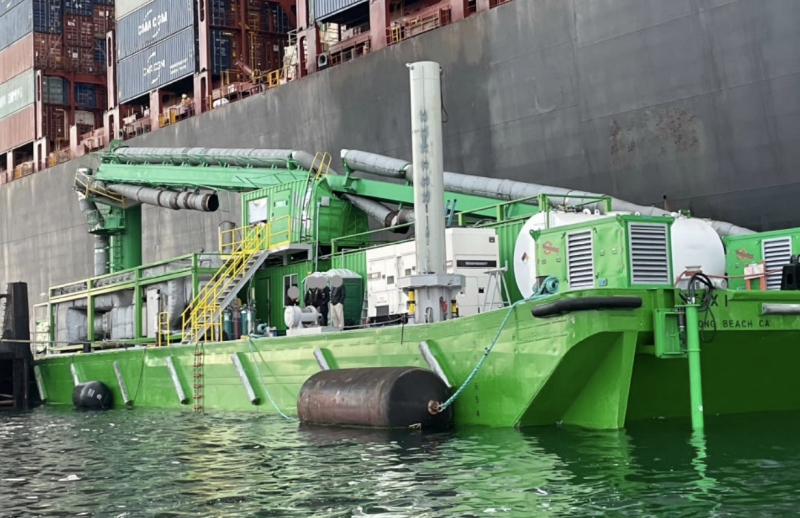
The articulated arm on the STAX 1 emissions control barge collapsed in a June 2024 accident at the Port of Los Angeles, when the shoreside operator of a container crane did not verify the clearance between the lowered crane boom an obstructions, the National Transportation Safety Board reported.
The 160’ STAX 1 was capturing emissions from the 623’ containership Erving around 4:49 p.m. at the Fenix Marine Services Container Terminal. A ship-to-shore container crane struck the barge’s capture and control articulated arm, collapsing it and dropping sections onto the barge, the Erving, and into the water pierside.
The arm’s hydraulic system released about 10 gals. of hydraulic oil onto the deck of the Erving and into the water. One person on board the STAX 1 received minor injuries. Damages were estimated at $3.2 million.
Originally built as a Navy tank barge in 1975, the STAX 1 was purchased in 2020 by STAX Engineering Inc., Long Beach, Calif., and extensively modified, adding an exhaust capture system comprised of an articulated arm.
The boom had a maximum elevated height of 279 feet, and two flexible exhaust ducts attached to capture emissions from vessel exhaust stacks.
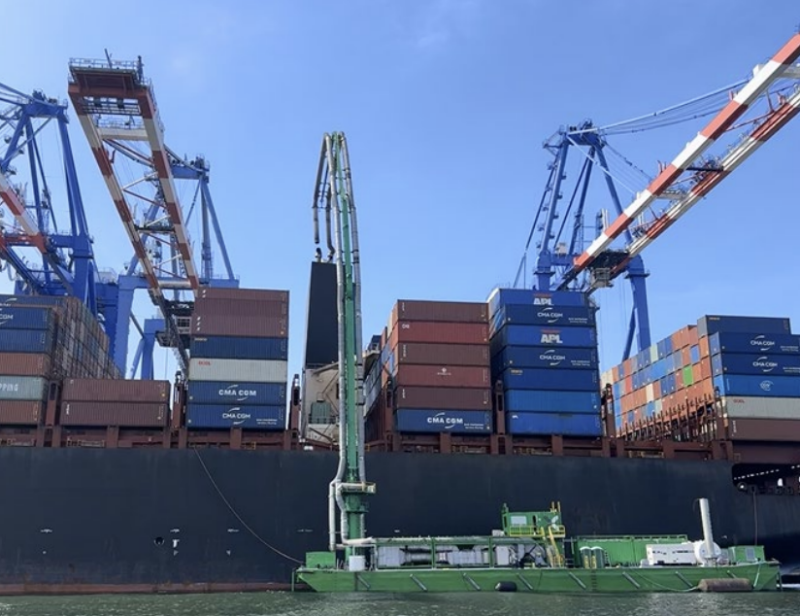
The Fenix Marine Services (FMS) Container Terminal had four 1,000’ berths with 16 Panamax ship-to-shore (STS) cantilever container gantry cranes, including eight Super Post-Panamax container cranes, along the berths.
Earlier on the day of the accident the STAX 1 was handling emissions for 11 hours without incident, the NTSB report noted. About 10 minutes before the casualty, the first FMS Container crane operator attempted to raise STS crane 16’s boom in preparation for the end of his shift.
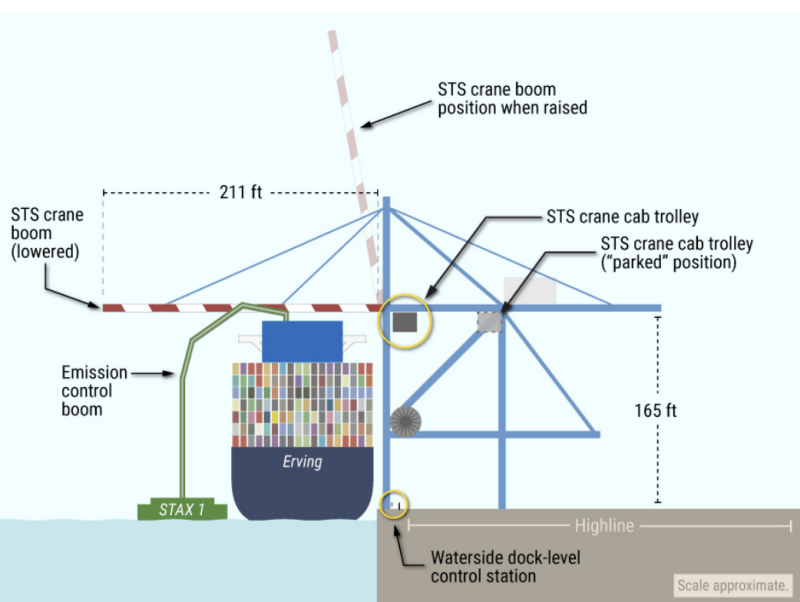
However, the boom would not rise. “After the casualty, a technician determined the boom would not rise because the crane’s trolley cab was not returned to the ‘parked’ position,” NTSB investigators found.
The second crane operator knew the boom was lowered and began moving the cranes along the track (gantrying relative to the docked Erving) using the waterside dock-level control station.
“Because STS crane 16’s boom remained in the lowered position, it was unable to clear STAX 1’s emission capture boom, resulting in the crane striking the boom,” the report states.
“The first-shift FMS terminal stevedore manager and operations manager were aware of the STAX 1’s planned operations… However, the flex-shift waterfront personnel, which included the second-shift crane operator 2 and shift boss 2, were not aware of the STAX 1 operations,” the report says.
“Shoreside waterfront operations personnel typically held a pre-shift planning meeting to discuss crane movements planned for the flex shift as well as other critical information, such as the location of the STAX 1 and its emission capture boom relative to the cranes,” the report says. But the planning meeting had not yet started and “had the crane operator waited for the pre-shift planning meeting and been aware of the STAX 1’s location, he may have opted not to move the crane.”
In its conclusion the safety board faulted the crane operator for “moving a ship-to-shore container crane without verifying the crane’s lowered boom had ample clearance over any obstructions, and the container terminal’s inadequate guidance for gantrying cranes.”
“To mitigate the risk of a casualty occurring, it is critical that crane operators be aware of such structures and maintain line of sight of obstructions visible from a crane cab,” investigators wrote.
“The use of a dock signal person can help to identify ground obstructions during crane movement. Including such obstructions in safety briefings or outlines of planned crane movements can improve awareness among crane operations personnel."
"Establishing and enforcing procedures regarding maintaining line of sight and using a dock signal person during crane operations can further mitigate the risk of a cranes triking a nearby object or structure.”
