


Traditionally, when a military branch orders a boat, it specifies what it wants, the manufacturer meets said specifications, and that’s where the buck stops. The boat is built and equipped the same way for the life of the contract.
In a new collaboration involving the Navy, Coast Guard, and manufacturer Silver Ships Inc., Theodore, Ala., the two military branches ordered a boat, the Naval Special Warfare Surface Support Craft (NSW SSC), which comes in five variants in 8-meter (about 26') and 11-meter (about 36') sizes. One version is specifically for the Coast Guard: the Special Purpose Craft, Law Enforcement-second generation (SPC-LE2).
The contract allows for making upgrades when newer updates of the vessel are required.
“They did something interesting and clever,” said Shawn Lobree, director of federal programs at Silver Ships. “All boat manufacturers will build a certain boat to a specification and get it in service. Then the operators and maintainers go to work operating the boat, maintaining the boat, and no matter who builds the boat, no matter how good it is, everyone always has ideas of the way the boat handles or the way the console is laid out.
“They say, for example, ‘We’d really like to make some changes. We’d like to move the throttle position; we’d like to change the angle of this display to make it easier for the guy in the back to see.’ They have ideas to improve the boats,” said Lobree.
The Navy and Coast Guard worded the contract for the NSW SSC and SPC-LE2 so that each agency could change the boat within reason after initial models were in service. “We built four boats for the Coast Guard in the first year. They evaluated them at four different stations with lots of different crews, operating them, having maintainers working on the boats, and they came up with, ‘Here’s what we’d like to do to change the boat, to make it even better, to better suit our needs and our mission.’”
Silver Ships received the changes through the Navy’s technical oversight team. “We went back and made those design changes, made sure the customers were happy and approved them,” said Lobree. “We went and incorporated those Coast Guard changes, so we call those the ‘Year Two Boat for the SPC-LE2.’ The Navy also made some design changes to their variant boats, which have been incorporated into the newer hulls.”
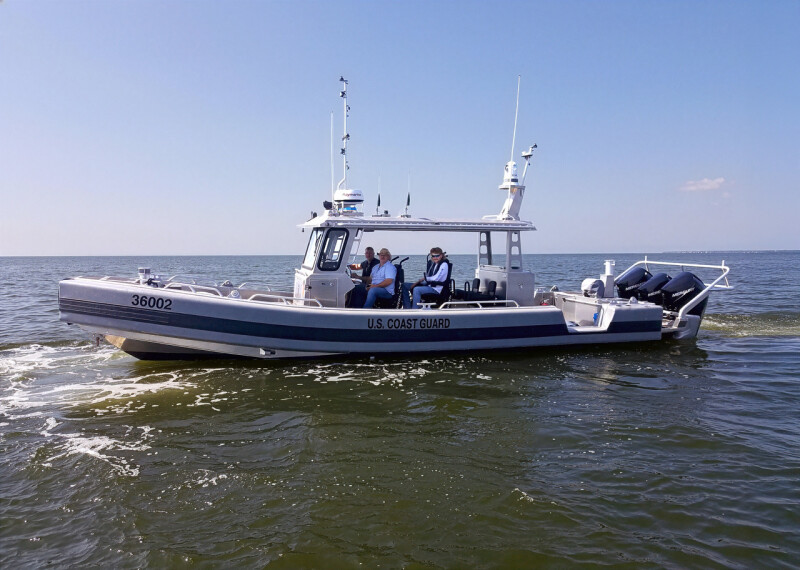
The SPC-LE2 is an 11-meter rigid hull inflatable boat that is a variant of Silver Ships’ Ambar series. The first boat was delivered in 2023 to Coast Guard Station Miami Beach and there are nine SPC-LE2s in operation currently. The Coast Guard has ordered 41 more and Silver Ships is building them at a rate of about one per month.
The Coast Guard version of the SPC-LE2 is an 11-meter center-console powered by triple 300-hp Mercury Verado outboards. It’s used primarily for high-speed patrol and law enforcement. Per the contract, the Navy can choose between an 8-meter or 11-meter boat in either a center-console or cabin layout. The 11-meter and 8-meter Navy versions are powered by twin 250-hp Suzuki outboards. All the boats have conventional V-hull designs.
“The Coast Guard is using it as what I like to call ‘a fighting boat,’” said Lobree. “It’s a special-purpose law-enforcement interceptor.”
The Coast Guard boat is built more robustly with a heavier-duty outboard bracket on the transom because it achieves a top speed exceeding 50 knots and is expected to run those speeds in less-than-ideal conditions. Silver Ships also had to beef up the structure that supports the boat’s T-top because it was stretched to provide shade to all six crewmembers while underway.
“We manufacture all the aluminum parts with the exception of the cleats at our yard in Alabama,” said Lobree. “The cleats are forged and we don’t run a forge operation.”
The boat has a machine gun mounted in the bow with weapon and ammunition storage in onboard custom lockers.
The Navy is using its boats for SEAL swimmer and dive training, as well as support missions like picking up parachutists. The Navy boats are kept on trailers and launched when needed. The Coast Guard boats stay in the water to keep them available on short notice. To repel corrosion, they are painted with the same antifouling coatings as the agency’s larger, oceangoing vessels.
Crews on both boats ride on Shockwave shock-mitigating seats that have rifle mounts integrated into the frame. For communication, the crew’s tactical helmets have the loud-hailer and radio integrated into them and the radio communications can be encrypted. The crew communication system is supplied by Invisio Communications. Because its mission does not require encrypted radios, the Navy uses a Standard Horizon marine VHF radio system and the David Clark crew communications system.
The Navy uses a Furuno navigation suite with radar and a multifunction display, while the Coast Guard selected a similarly equipped array of Raymarine equipment.
Shifting and throttling are controlled digitally with standard Mercury and Suzuki systems, while steering pairs components provided by the engine manufacturers with a Dometic SeaStar power-assist setup.
Because it has three engines and more extensive electronics, the Coast Guard version of the SPC-LE2 costs about $100,000 more than the Navy model. Lobree said Silver Ships is proud of the boat’s performance and reliability. “There has been a strong spirit of collaboration and teamwork between the government and boatbuilder on the project,” he said.
