




The Congressional Budget Office (CBO), the federal agency charged with forecasting costs for legislation, spending, revenues, and deficits, has published a report on the Navy’s new nuclear-powered battleship program and the Navy’s long-term shipbuilding plan spanning the years 2027-2056.
For the 15 Trump-class battleships, CBO estimates a total cost of around $275 billion, with the first ship costing about $23 billion and the average for the entire series hovering around $18 billion per vessel. To execute the Navy’s 2027 shipbuilding plan, CBO forecasts annual funding for large surface combatants will need to increase from around $11 billion to $19 billion.
Beyond just a snapshot of future funding needs, the report also lays out what the Navy would need from shipbuilders to realize the long-term plan to build the agency’s Golden Fleet.
“By 2035, the Navy’s 2027 plan would more than double the tonnage of large surface combatants that shipbuilders would need to produce,” the CBO report stated. “Overall, the tonnage of large surface combatants to be constructed would need to increase by 60 percent, while the tonnage of small surface combatants would decrease by about 40 percent. Accommodating such a sizable increase in the production of large surface combatants could be a challenge for the shipbuilding industry.”
When the Navy announced plans late last year to build a new Trump class of guided missile battleships, officials said the estimated cost of the lead ship would be $15.1 billion with additional ships costing around $10.2 billion. At the time, the Navy stated it would turn to Leidos Gibbs & Cox for surface ship design engineering and Bath Iron Works and Ingalls Shipbuilding for ship design assistance, CBO stated. Those initial prices, though, were for conventionally powered ships. When the 2027 shipbuilding plan was released in May, Navy officials said the Trump class battleships would instead be nuclear powered.
“That detail contrasts with statements by senior Navy officials earlier this year that constructing a nuclear-powered battleship would take too long and be too costly,” the CBO report stated.
Nuclear-powered or not, meeting the Navy’s construction goals for the Trump class ships will be difficult, with the shipbuilding plan calling for the first vessel, named Defiant, to be delivered in 2028, the second in 2030, the third in 2031, and then one every other year through 2056. While Bath Iron Works in Maine and Ingalls Shipbuilding in Mississippi have built “all of the Navy’s large surface combatants over the past 40 years,” CBO stated, deliveries of the Navy’s DDG-51 destroyers from both shipyards are delayed, on average, by about five years. The average delivery time per destroyer currently is about 11 years, up from five years in the early 2000s, according to CBO.
Further complicating matters is the fact that neither Bath nor Ingalls are certified to perform nuclear-powered ship construction. Thus, Navy officials said they would turn to Newport News Shipbuilding in Virginia for final assembly of the battleships.
“Newport News Shipbuilding is behind schedule on constructing three aircraft carriers, as well as many submarines,” CBO stated. “Adding the final assembly of a nuclear-powered battleship to the shipyard’s workload could lengthen the delays for those programs, in addition to delaying the construction of the battleship itself.”
CBO admitted its cost estimates for the Trump class battleships may be high or low. To arrive at the forecast costs, CBO estimated the Trump class battleship’s lightship displacement (28,000 tons) and full-load displacement (35,000 tons) and compared it to stats and costs for other recent surface combatant programs.
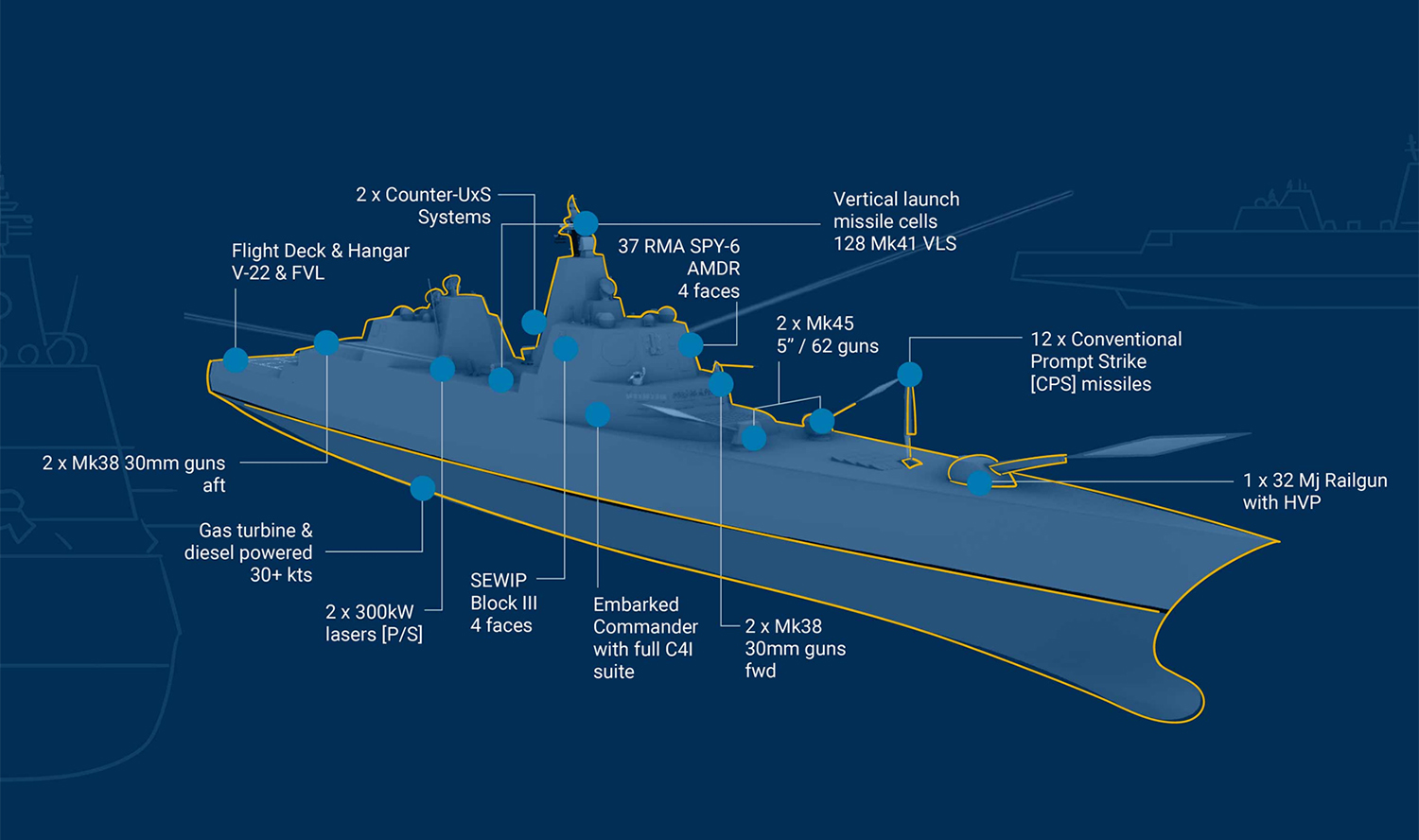
Costs and delivery timetables aside, the Trump class battleship would be “the largest surface combatant in the world and larger than any surface combatant built for the Navy since World War II,” CBO stated. Measuring 840’-880’x105’-115’ with a draft between 24’ and 30’, the Trump class battleship would be more than three and a half times the size of the Navy’s Arleigh Burke class destroyers and more than twice the size of the Navy’s Zumwalt class destroyers. The ship’s main battery would likely include antiship, antiair, and land-attack missiles; nuclear cruise missiles; launchers for hypersonic conventional prompt strike missiles; and large lasers, a rail gun, and “a variety of defensive systems,” according to the CBO report.
The CBO report stated that the Navy will likely shelve its DDG(X) destroyer class in favor of the Trump class, while continuing to build its DDG-51 ships.
CBO stated that its cost estimates are in 2026 dollars and carry the assumption that construction of the first Trump class ship would begin in 2028. A delay would likely move the cost estimate higher. By contrast, a lighter-displacement design would likely lower the delivery cost for the battleships. Similarly, a more open design that would minimize labor hours would also reduce construction costs, according to the CBO.
“Newer shipbuilding technologies and techniques could also make the battleship easier to build than previous classes of large surface combatants,” the CBO report stated. “Over the past several years, the federal government has provided substantial funding to support the shipbuilding industrial base. The 2025 reconciliation act (Public Law 119-21) alone appropriated over $5 billion for that purpose, on top of more than $10 billion appropriated since 2018. If advances in automation, modular construction, artificial intelligence, or other technology reduced the cost of ship construction, the BBGN could be easier and cheaper to build by weight than comparable ships built in the past.”
More broadly, the Navy’s 2027 shipbuilding plan would add additional strain on shipbuilders, with annual funding needed to deliver on the large surface combatant program growing from $6.9 billion per year in the 2025 plan to $15.2 billion per year in the 2027 plan. Expenditures for small surface combatants stayed about the same, dropping from $4.4 billion per year in the 2025 plan to $4 billion per year.
A shift in the Navy’s frigate program from the current FFG-62 guided missile frigates to the FF(X) general purpose frigate program would reduce “the amount of frigate tonnage shipbuilders would need to produce by about 40% in 2035 and by 45%, or 227,000 tons, over the next 30 years,” the CBO stated.
“The Navy has said that it will keep the initial design of the FF(X) relatively simple and add capabilities in future variants, though the 2027 shipbuilding plan does not describe those improvements or say when they might occur,” the CBO report stated.
Increasing the number of shipyards executing the Navy’s shipbuilding plan would allow the Navy to ramp up construction, CBO said, but it would also carry risks, since lead vessels often cost more and take longer to build.
