



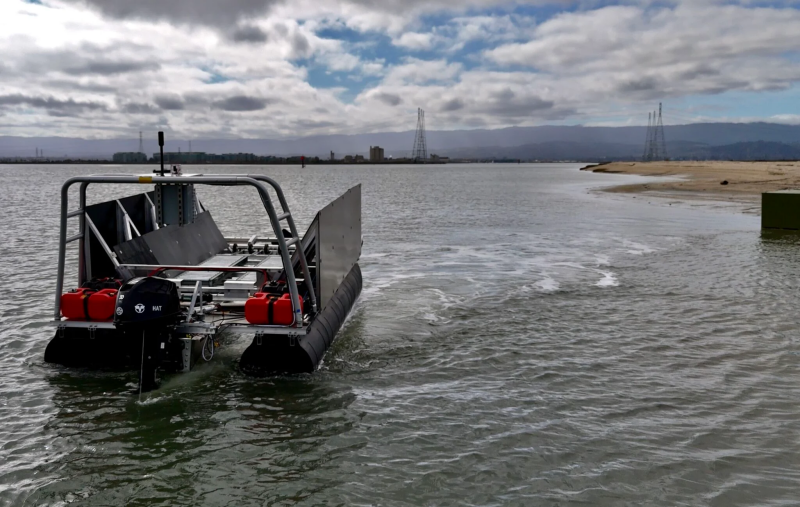
Bulwark Dynamics, San Francisco, said it has completed the maiden unmanned resupply demonstration of its Caravel autonomous landing vessel, a 15' platform designed for littoral logistics missions and autonomous cargo delivery from ship to shore.
The company said the vessel moved from initial concept to open-water operations in 43 days.
Bulwark designed the platform to address what it describes as the most vulnerable phase of maritime resupply operations, the final movement of cargo from sea to shore, particularly in environments where port infrastructure or cargo handling equipment are not available.
According to the company, the vessel is intended for austere beach landings where no docks, cranes, or personnel are present to receive cargo. The company said the primary operational challenge is not autonomous navigation alone, but the ability to land on shore and offload payloads in difficult coastal conditions.
The Caravel functions as a small autonomous landing craft optimized for "last-mile maritime logistics." Bulwarks noted platforms in this category are gaining attention as military planners focus on dispersed operations, expeditionary logistics, and island sustainment, particularly in regions such as the Indo-Pacific where port access may be limited or denied.
Bulwark said the vessel was developed with feedback from operators in the Indo-Pacific, with design requirements focused on practical field operations rather than experimental testing.
The company opened a prototype production facility in Menlo Park, Calif., in January 2026 and said the Caravel platform was designed for scalable manufacturing as autonomous maritime logistics systems move toward operational deployment.
The announcement follows several recent milestones for the company. Bulwark said it completed a pre-seed funding round in September 2025 to support prototype development, and in December 2025 signed a memorandum of understanding with a Japanese shipbuilder to explore co-production of autonomous maritime systems.
While much recent attention in autonomous maritime technology has focused on uncrewed surface vessels for surveillance or strike missions, logistics automation remains a major area of development, particularly for operations in contested littoral environments where traditional resupply methods may be at higher risk.
