



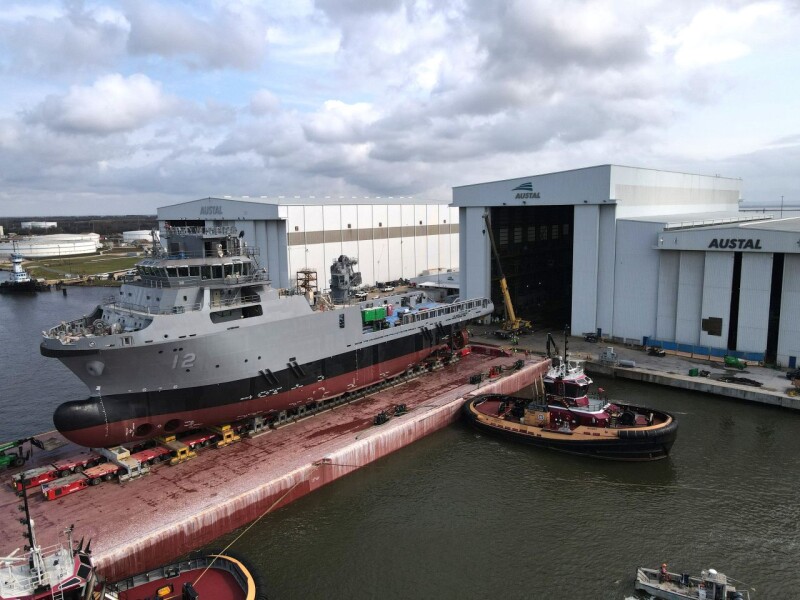
Shipbuilder Austal USA, Mobile, Ala., launched two Navy vessels within a three-day span, including the final Expeditionary Fast Transport and the second Towing, Salvage, and Rescue Ship.
The shipbuilder launched the future USNS Solomon Atkinson (T-ATS 12) on Feb. 23 and the future USNS Lansing (EPF 16) on Feb. 25.
The 263'x59' Solomon Atkinson is one of three T-ATS vessels under construction at Austal USA. The steel monohull ship is named after a Native American who was a plankowner of the Navy SEAL teams and one of the service's most decorated Alaska Native sailors.
"It's always exciting to see these giants we build roll out of the assembly bay," said Gene Miller, Austal USA's interim president. "The completion of this milestone is the result of the hard work and dedication of our talented workforce and the strength of our maritime industrial partnerships key to success in this proven launch process. I am so proud of all they have accomplished."
T-ATS vessels provide oceangoing towing, salvage, and rescue capabilities to support fleet operations. The platform will combine the capabilities of the retiring Rescue and Salvage Ship (T-ARS 50) and Fleet Ocean Tug (T-ATF 166) classes.
T-ATS vessels feature 6,000 sq. ft. of deck space for embarked systems. The large, unobstructed deck allows for the embarkation of stand-alone and interchangeable systems. The platform is designed to support missions including towing, salvage, rescue, oil spill response, humanitarian assistance, and wide-area search and surveillance.
The ship was more than 75% complete at the time of launch. Solomon Atkinson will now prepare for engine light-off as the vessel readies for sea trials and delivery.
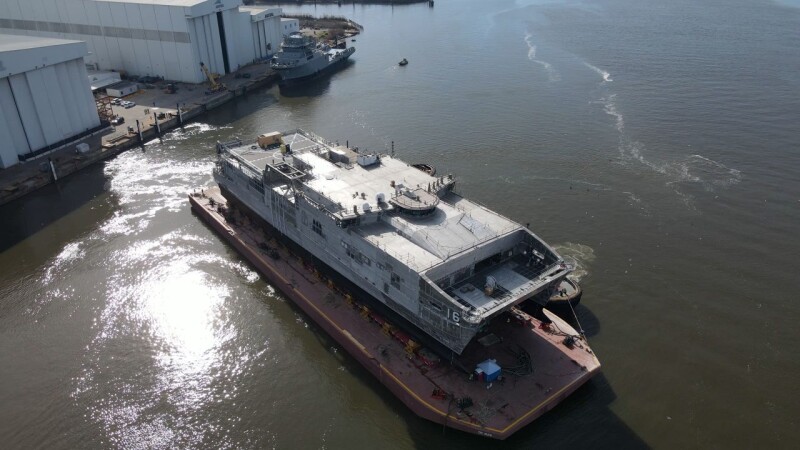
The 337'11"x93'6" Lansing is the Navy's 16th and final Expeditionary Fast Transport. The aluminum catamaran was christened in early January and is now docked pierside for final outfitting and system activation in preparation for sea trials later this year.
During the launch process, self-propelled modular transporters lifted the ship almost three feet and moved it approximately 400' onto a deck barge moored adjacent to the final assembly bay. The barge moved the ship downriver where it was placed in a floating drydock. The EPF was submerged in the drydock, enabling it to float for the first time, and was returned upriver to Austal USA's new construction facility.
"The successful launch of this final Expeditionary Fast Transport is a true reflection of the power of teamwork and our commitment to applying lessons learned to every aspect of our work," Miller said. "Our test and activation teams, crane and rigging crews, and safety personnel worked seamlessly alongside our Navy partners and trusted vendors like Berard Transportation, Alabama Shipyard, and E.N. Bisso & Son tug services. These strong partnerships enable us to continuously refine our processes, identify areas for improvement, and efficiently achieve critical shipbuilding milestones to further support and strengthen the maritime industrial base."
Lansing is the Navy's third EPF Flight II medical variant. This was the 26th ship launched at Austal USA using this process.
