



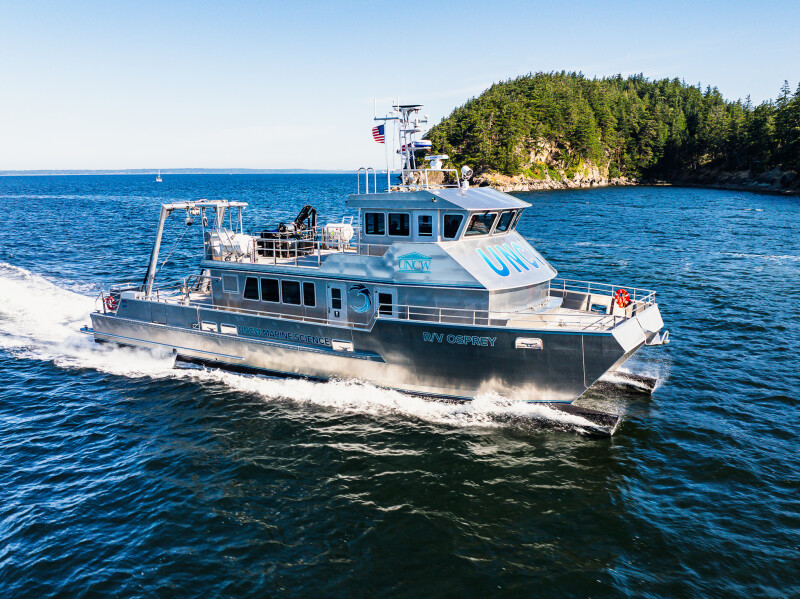
All American Marine, Bellingham, Wash., has delivered the aluminum research vessel Osprey to the University of North Carolina Wilmington.
The 78’x27’ catamaran completed sea trials at the builder’s Bellingham facility before departing for UNCW’s home port in Wilmington, N.C. The vessel will support oceanographic research, biological studies, and marine science education along the Mid-Atlantic, East Coast, and offshore waters.
Designed by Teknicraft Design, Auckland, New Zealand, the vessel was built and inspected to Coast Guard Subchapter T standards. Its hydrofoil-assisted hull is designed to reduce drag and fuel consumption while improving passenger comfort, AAM said in a press release.
Twin Scania DI16-082M EPA Tier 3 engines, each rated at 800 hp at 2,100 rpm, provide a cruising speed of 22 knots. The vessel can also operate at a survey speed of 1.5 knots and carries 1,500 gals. of fuel.
The vessel’s scientific equipment includes a Kongsberg acoustic Doppler current profiler electronics suite and a fixed WASSP multibeam system. The equipment will support multibeam, side-scan sonar, magnetometer and sub-bottom profiler surveys, as well as marine mammal monitoring, trawling and water and sediment sampling.
Osprey includes wet and dry laboratories, accommodations for up to 10 personnel and day-trip capacity for 20 passengers. The vessel is also outfitted for dive operations and the deployment and recovery of buoys, autonomous underwater vehicles and other oceanographic equipment.
“This vessel provides students and faculty a unique platform for interdisciplinary research and reflects UNCW’s commitment as North Carolina’s coastal university,” said Ken Halanych, executive director of the Center for Marine Science. “With state-of-the-art instrumentation, dedicated labs, housing, and diving infrastructure, the vessel expands our capacity to further the Center’s mission of advancing marine science and coastal stewardship.”
“This new vessel will add a level of capabilities the university has never had before,” said Jay Styron, associate director of marine operations. “The additional stability and speed, along with features such as dedicated dry/wet labs and satellite communications, will allow researchers to conduct experiments in situ while collaborating with their onshore counterparts.”
UNCW expects the vessel to remain in service for 30 years. The university will use it for faculty and student research, educational programs and charter work for outside agencies.
"For UNCW students, access to the R/V Osprey means greater opportunities to participate directly in research and gain practical experience at sea," said UNCW Chancellor Aswani Volety. "These experiences are invaluable in preparing graduates for careers in science, environmental stewardship, and maritime industries."
