


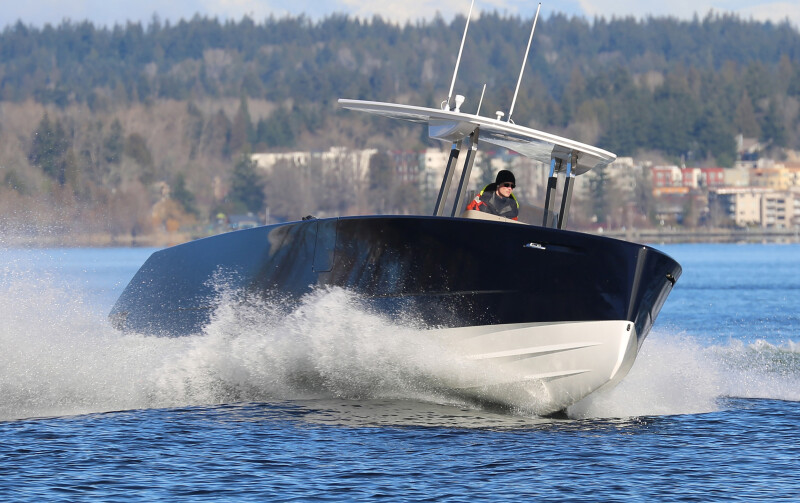
Ahead of the Pacific Marine Expo in Seattle, WorkBoat representatives visited Zin Boats to tour its facilities and get a closer look at its electric propulsion package. Founder and CEO Piotr Zin and Jonathan Kruse, vice president of business development, walked through the company’s direct-drive motors, power management software and cooling systems for vessels ranging from pilot boats and small ferries to yard tugs.
Zin Boats started in 2019 as a builder of recreational electric boats. It now designs and assembles propulsion systems in-house, designs vessels for select projects and contracts out hull fabrication. The company offers propulsion packages from 100 to 900 kW (134 to 1,207 hp), with dual-motor installations reaching about 1,200 kW (1,609 hp).
Zin Boats began developing its own propulsion system after an electric drive supplier declined to make changes Zin proposed, Kruse said. The drive was the closest fit for Zin’s early designs, but he still had to build a lightweight carbon-fiber hull to get the performance he wanted. That approach still guides the company when customers ask for something it can’t source.
“If you can’t do it, we’ll invent it,” Zin said.
Power management
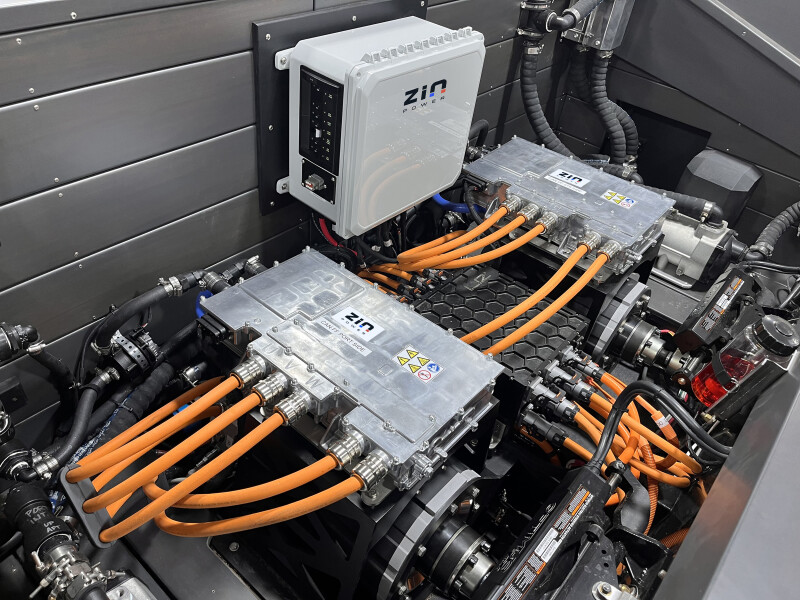
The first large system went into the Z11, Bill Gates’ tender that was designed to recharge using power from the hydrogen system aboard the yacht Breakthrough. Zin described the job as “first of it’s kind and a true breakthrough for electric boating.” It gave the company room to develop components it couldn’t buy, including the sealed aluminum module Zin calls the “magic box.”
The 80-lb. module distributes power from the batteries and charger to the propulsion equipment. It also manages the cooling loop, 12-volt systems and high-voltage interlocks. Zin said the module is rated to operate at a depth of nearly 10' in salt water, with the connectors setting the depth limit.
The system uses an 800-volt architecture. At the same power, an 800-volt circuit carries half the current of a 400-volt circuit, allowing the company to use smaller conductors. Zin pointed to a 50-sq.-mm. cable used between a motor and its converter as an example.
“Ninety-nine percent of success in electric building is cooling,” Zin said. A 100-kW motor operating at 98.5% efficiency still gives off about 1.5 kW of heat. A closed glycol loop carries that heat to exchangers that reject it to raw water, keeping seawater out of the electrical components. Zin said the company sizes components above expected loads. A boat that needs 100 hp might get a 150-hp motor, and an application that calls for 600 amps might get a 900-amp inverter.
Direct drive
The gearless motors use housings of the same diameter cut to different lengths for different output ratings. They can turn at up to about 4,000 rpm, and the windings can be configured for torque or speed. For applications that need more power on a single shaft, the company can stack two motors on that shaft.
At the throttle, the operator requests a shaft speed. The motor controller adjusts torque to hold that speed as the load on the propeller changes. Zin gave the example of a ferry turning a large propeller at 200 to 300 rpm and requiring about 3,000 ft.-lbs. of torque. Battery sizing depends on how much power the motor draws under load and how long it draws that power. A steady 200-kW draw for an hour would use 200 kWh.
Zin said the company rates its motors for continuous output. In one example, a 150-kW (201-hp) motor could deliver 300 kW (402 hp) for about 15 minutes or 400 to 500 kW (536 to 671 hp) for about a minute with its normal output limit removed. The controller then reduces power to protect the windings.
“If you can’t do the same thing as diesel does, we fail,” Zin said.
Commercial projects
Zin Boats sources batteries from outside suppliers and works with nickel manganese cobalt (NMC) and lithium iron phosphate (LFP) chemistries. Zin said the company generally specifies LFP for Subchapter T and K vessels because of its lower risk of thermal runaway. He estimated about 3,600 cycles for NMC and roughly twice that for LFP before the packs drop to 90% of their original capacity.
Onboard chargers accept 110- or 220-volt shore power, including 30- and 50-amp service. A 480-volt, three-phase supply can support Combined Charging System DC fast charging at up to 250 kW. An interlock prevents propulsion from engaging while the boat is plugged in.
Zin estimated that a 250-hp industrial diesel running 2,011 hours a year could cost about $1.5 million more to operate over 10 years than an electric alternative, factoring in fuel, maintenance, parts and downtime. Battery sizing depends on the vessel’s duty cycle. For boats that spend much of the day at partial load, Zin starts by sizing the battery for one hour at full throttle.
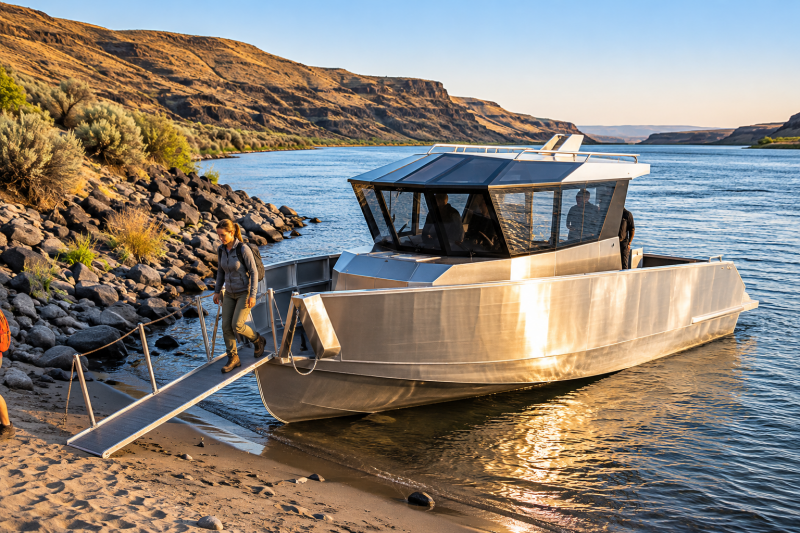
Zin identified Platypus Marine as the aluminum fabricator for a landing-bow vessel the company is working on for Washington State’s Confederated Tribes of the Colville Reservation. The vessel will transport elders, serve as a salmon tender and support aquaculture and diving operations. It will carry a 380-kWh battery pack and charge at up to 150 kW using hydroelectric power.
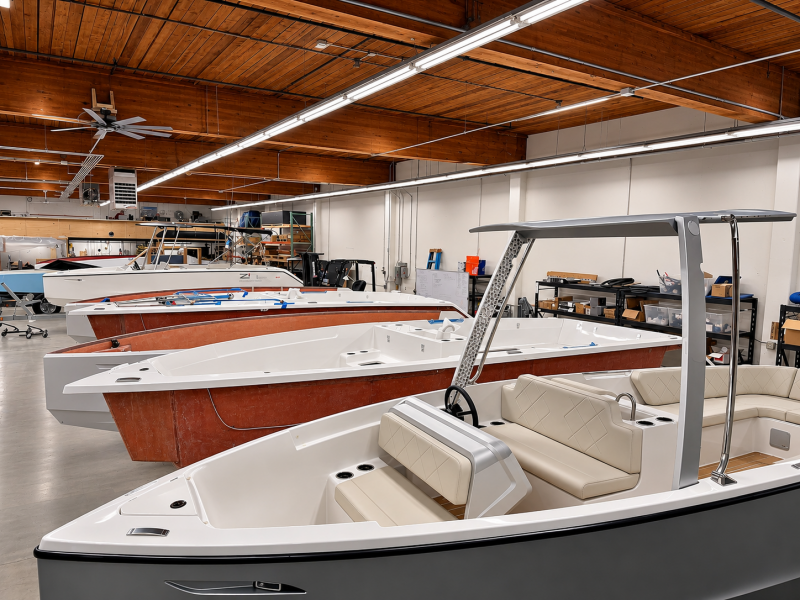
Zin Boats has added space for electrical assembly, research and development, and boat assembly. It is bringing high- and low-voltage wiring production in-house and raising capital to expand propulsion production.
