



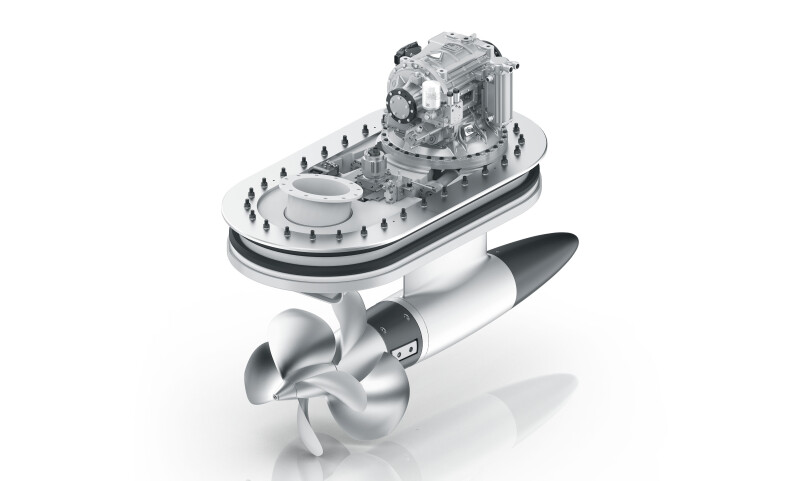
ZF Marine has introduced its latest pod propulsion system, the POD 4900, designed for commercial and recreational vessels up to 150'.
The POD 4900 is compatible with engines producing up to 2,000 hp at 2,450 RPM and supports a maximum input torque of 6,107 Nm. It is intended for vessels operating at typical speeds between 20 and 35 knots.
The POD 4900 can be configured in twin, triple, or quadruple layouts, depending on vessel requirements. It features a gear reduction ratio between 2.434 and 2.612, supporting larger counter-rotating propellers. According to ZF, this configuration can improve efficiency by up to 20% compared to traditional shaftline systems.
The system incorporates a +30°/-30° steering angle and integrates with ZF’s TotalCommand and joystick steering technologies. The hydrodynamic housing is made from corrosion-resistant nickel aluminum bronze and stainless steel. An elastic hull connection is included to reduce onboard noise and vibration.
ZF reports that the POD 4900 meets certification standards for up to 3,000 operational hours annually and is suitable for medium-duty commercial use, including wind farm support, crew transfer vessels, and ferries.
The system’s first deployment will be on a superyacht in collaboration with Italian shipbuilder Azimut and Rolls-Royce Power Systems. The yacht will use two units of the POD 4900, each delivering 1,920 hp. Rolls-Royce provided a fully integrated power pack for the installation.
“Azimut’s vessels have been a great showcase for our pod propulsion’s unique strengths,” said Federico Decio, ZF Marine's head of business unit marine and special driveline technology. “After our initial project back in 2022 with the POD 4600 in the Azimut Grande 26M, we are more than happy to continue this path of innovation with the new POD 4900.”
Denise Kurtulus, senior vice president global marine, Rolls-Royce Power Systems, said, “The ZF POD gives us the opportunity to make the best possible use of our high-performance, efficient mtu engine, significantly reducing fuel consumption and improving maneuverability.”
