


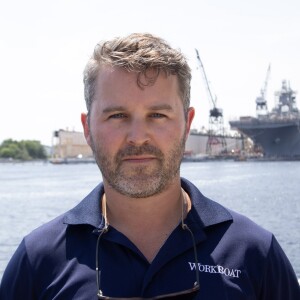
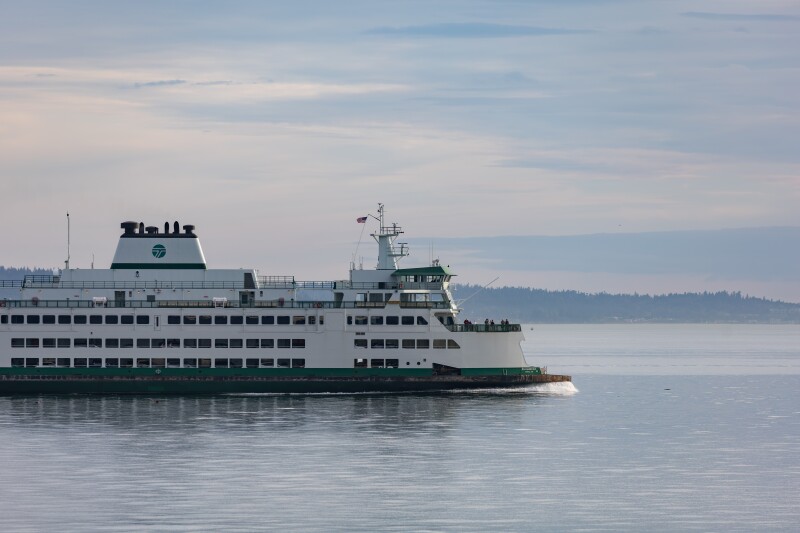
WorkBoat recently spoke with Steve Nevey, executive director of Washington State Ferries, to discuss the operational realities of running the nation’s largest ferry system amid an aging fleet, workforce shortages, and a complex transition toward hybrid-electric propulsion. Alongside those challenges, Nevey reflects on the progress made rebuilding crew pipelines, improving reliability, and staying closely connected to crews across the system as changes take hold.
What are the biggest vessel-related constraints you deal with right now?
We've got 21 vessels.
You know, the average age brings two constraints. There's this obsolescence of parts, you know, often the original parts manufacturer, in some cases, they don't exist.
In other cases, they've stopped making the parts that we have on our ships. When I worked in the cruise industry, we kind of factored in 10 years of system obsolescence... Once you had a system online for 10 years, you think about changing it because of obsolescence.
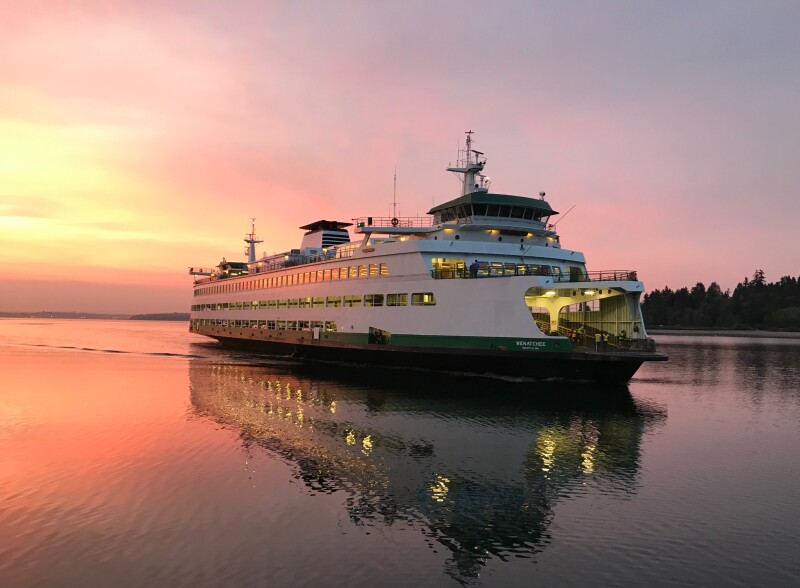
We've got, like I said, 67 year old boats operating out there and our Eagle Harbor maintenance staff having to machine parts themselves to keep them going. And then...with only 21 boats, expecting to have 18 in service and three in some kind of maintenance status, if we have one outage... one unplanned breakdown, these are really big, complex vessels... ocean going vessels. One unexpected breakdown, we don't have enough redundancy to plug and play another vessel in and kind of shuffle the deck in a way that makes sense.
It's all that the average age is getting up there and it's getting harder and harder to maintain those boats.
What drove the decision to go with diesel-electric hybrid vessels over fully electric in WSF's Ferry System Electrification Plan?
Washington State Ferries is the only viable means of getting to and from some of the islands that we serve. And we're part of those communities' emergency preparedness plan...to bring emergency resources to and from those islands if there's a natural disaster or any kind of situation.
So if the if the grid is compromised and we can't charge, we need a way to operate independent of the grid. So that's why we have to have two diesel engines and two battery power banks. And obviously, once we've got charging infrastructure at the terminals, which we'll talk about later, we will then be able to charge the two banks and run the boats 100% on those.
That's the plan. The end goal is to be able to just run on those two fully charged electric mode and then the two diesel engines will be back up in case of an emergency. We saw that as the current viable path to electrify while we're waiting for that charging infrastructure to be built out, the boats will be running in hybrid mode.
But the goal is to run them fully on those power banks. And our San Juan Island routes up in the north, those are the hardest ones to electrify because of the [long] distances between the islands. So we're focused on our south side routes, Mukilteo, the routes in and out of Seattle, Seattle-Bainbridge, Seattle-Bremerton.
We're focusing on our southern routes and central routes now, hoping that over the next few years that the technology will develop and there'll be viable solutions available in the next decade so that we can come up with a strategy to electrify our San Juan Island routes. But right now, we're kind of focused on the routes that we have, the operating profiles that are suitable for electric operations.
Given WSF’s Ferry System Electrification Plan, could you speak to the charging station implementation?
Each vessel will require 10 megawatts to charge. The terminals, they're all in different counties. They're all operated by different utility companies.
Some are in urban environments. Some run through people's backyards. So you have this range of parameters for each one.
The team is working really hard to manage each of those projects individually because each one is completely different depending on the county, the environment that the terminal is in. Some of our docks, you have to drive between people's houses to get down to the dock. One of our terminals is in downtown Seattle, so there's different challenges to each of those projects.
But we have a good team that's working really hard to make sure that it's done right. I think the biggest concern with that project alone is cost escalations.
The plan was written five-plus years ago, so the cost assumptions in that when the plan was written in today's environment, those costs are a lot more. There's a little bit of sticker shock when we're actually kind of like, "Now we really want to do this. What's the cost going to be versus what we estimated it would be when we wrote the plan?" We're working through that now to try and make sure that we are funded to do the projects.
Crew staffing levels seem to have improved in a big way. How? What were the key factors behind that turnaround?
I think there had been this crewing crisis that was in the making for years and it was kind of always on the horizon but it never quite arrived. There were conversations about what to do about it when the time comes and then the pandemic just accelerated it. There were people that were planning to retire in the next five years that were just like, "I don't want to be working out on these boats in these conditions so I'm going to take my retirement."
That really sped up that crisis. I come from the cruise industry and I had a job for a couple of years in the cruise industry when I oversaw personnel for cruise ships—deck personnel specifically. When I came in, everyone was focusing on getting new crew, entry-level crew.
I was looking at the numbers and I was like, "Every time we post the entry-level crew, we get hundreds of applications. Our problem isn't attracting entry-level crew. Our problem is that the entry-level crew that we have have got no path up into the qualified positions, the licensed positions."
We're not fully out of the water yet, but we've come a long way and we're having far fewer crew cancellations than we were even a year or two years ago. The challenge I have now is trying to convince the legislature and the governor's office to continue funding those programs and not let them expire.
I'm not saying there will be, but there could be this reflex to say, 'Well, now you've solved the problem, you don't need that money anymore'... These programs need to exist in perpetuity, otherwise in five years time, we'll be right back in that situation again.
What do you love most about what you do?
I've always wanted to lead a maritime organization. That's been my career goal.
One of the things I enjoy the most is that when I worked in the cruise industry, I loved being on the ships and working with the crews to figure out what needs to happen to make things work better.
But to get to a ship, I'd have to fly from Seattle to anywhere from Europe, Australia, Asia — days at a time. Here, I can just jump in my car, be on any boat with any crew, any terminal, within an hour or two. I get really energized being out there talking to crews about the challenges they're facing, and then coming back and trying to figure out how can I work with the governor's office and the legislature to overcome that challenge.
It's really rewarding to figure out how to get things done in this environment. I had no skill set dealing with governor's offices and legislatures. When I started here, I came from the private sector.
Learning how this world works and how to make things happen, and having the crews see that things can get better, we can get the resources we need. It's been really rewarding leading this agency and working with the people that work here.
If you could change one thing at the state or federal level, what would it be?
When I talk to ferry leaders around the world, it's clear to me that worldwide, the maritime industry, or if you just say the ferry industry, has decided that we're going to decarbonize. The discussions that they're all in are only about "How." The challenge that we face here is that in Washington state and the United States, decarbonization isn't a decided upon path forward yet.
It's still called into question, and we're still having debates on should we use Tier Four diesel engines and not decarbonize. It's challenging when you're out dealing with the rest of the world, and they've already made that decision to move on, and you're still having the fight of, "Are we going to decarbonize or are we going to carry on down the path of building diesel boats?" Those things aren't fully decided yet, and every legislative session we're still called to answer questions about the path forward. I think it would be nice to just be the same as those European ferry operators that I talked to, where they're confident that, "We've made this decision, we're decarbonizing, this is our strategy, this is the best path forward." Whereas we're still debating that.
It creates also a morale issue internally with staff who are working on these programs and they're constantly being called into question. I think one of the things that attracted me to come and work for Washington State Ferries was the electrification strategy. I thought it would be an awesome thing to be a part of, honestly.
I was genuinely excited about that. I wish the people in Washington State that are calling into question this strategy could experience what I experienced when I talked to other people around the world that see us as leaders in this space. I feel like we should be proud of it, right? Not constantly questioned.
