



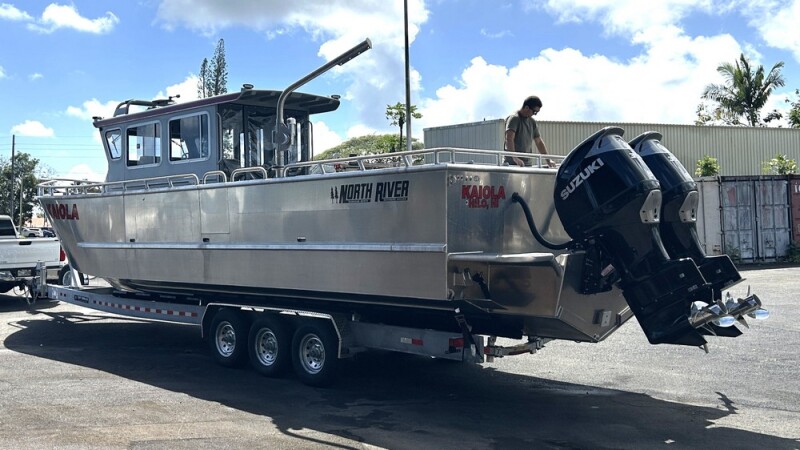
The University of Hawaiʻi at Hilo has taken delivery of a new 38' aluminum research vessel that will serve as a floating laboratory for the school’s marine science program.
The vessel Kaiola recently arrived on Hawaiʻi Island from Oregon and is undergoing final outfitting and inspections before entering service. Built by North River Boats, Roseburg, Ore., the vessel is based on the builder’s Sounder-class aluminum workboat design, a platform commonly used for coastal research and environmental monitoring.
According to the University of Hawaiʻi at Hilo, the new vessel will support a range of offshore and nearshore research activities including coral reef monitoring, water-quality surveys, coastal mapping, and oceanographic sampling. The boat will also be used as a teaching platform, allowing students to participate directly in fieldwork and marine operations.
John Burns, associate professor and chair of the marine science department at UH Hilo said in a statement the university selected the platform for its shallow draft, maneuverability, and stable working deck, which will support diving operations and the deployment of scientific instruments in exposed coastal waters around Hawaiʻi Island.
The welded marine-grade aluminum hull was another key factor in the vessel’s selection. Kaiola’s propulsion package includes twin Suzuki 350-hp outboard motors with a 200 gals. fuel capacity. Aluminum construction offers durability and corrosion resistance in saltwater environments while keeping overall weight lower than comparable fiberglass vessels.
According to Burns, those characteristics are important for a vessel expected to operate year-round in dynamic coastal conditions and remote locations.
The vessel features a large open aft deck designed for scientific operations. UH Hilo said the deck layout includes mounting points for deploying equipment such as water and sediment samplers, underwater cameras, acoustic mapping systems, oceanographic buoys, and water-quality sensors.
Interior cabin space provides room for navigation systems, computing equipment, and real-time data processing used during field missions, according to UH Hilo.
UH Hilo noted the deck arrangement also supports dive operations and student training, with boarding access, washdown systems, and equipment storage integrated into the design.
University officials said the vessel will significantly expand UH Hilo’s ability to conduct field-based research and instruction.
The vessel will support coursework and funded research projects around Hawaiʻi Island and neighboring islands, providing students with practical experience in coastal research and marine field operations.
WorkBoat reached out to North River Boats for further specs on the vessel.
