



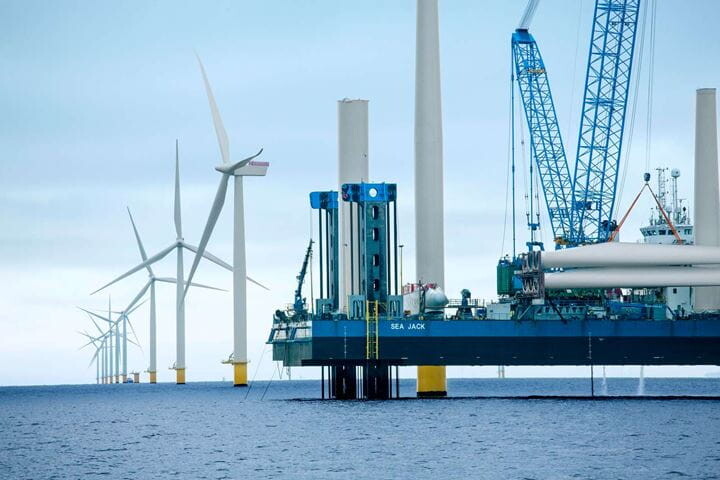
Looking ahead to potential offshore wind energy development along the East Coast,
VIMS is asking seafood processors, dealers, wholesalers, distributors and other first-sale seafood businesses from Massachusetts to Virginia are to participate in the “Seafood First Sale Value Added Survey.”
The project is funded by a grant from the Science Center for Marine Fisheries (SCEMFIS), a member of the National Science Foundation’s Industry/University Cooperative Research Centers program. The science center brings together marine scientists and members of the commercial fishing and wind energy industries to collaborate on fisheries research.
The survey is designed to “address the existing information gaps in how offshore wind development may affect shoreside businesses and local fishing economies,” according to a statement from the center.
Despite the offshore wind industry’s economic turmoil – and determined political and policy opposition from the Trump administration – plans for turbine arrays off southern New England and the Mid-Atlantic have survived. Revolution Wind developer Eversource Energy said it incurred a $164 million after-tax charge from construction cost increases as it battled the Trump administration’s stop-work orders on the project.
Notably Dominion Energy recently said its 2.6-gigawatt Coastal Virginia Offshore Wind project is 81% built out, and completion is expected by the end of 2027.
Previous surveys have focused on how offshore wind development can affect commercial fishing vessels. But there is less information collected about the impacts on processors, dealers, wholesalers and other businesses dependent on the catches.
“Strong industry participation is essential for the success of the survey, which will be used to provide baseline data for economic impact assessments, and inform offshore wind policy decisions and potential compensation programs,” researchers say.
“Compensation programs cannot fairly account for shoreside losses unless decision makers understand how seafood moves from the vessel through the other businesses that support the commercial fishing economy,” said Peter Hughes, director of sustainability for Atlantic Capes Fisheries, Cape May, N.J., and one of the fishing industry stakeholder representatives advising the multistate Fisheries Compensation Program.
“This survey gives those businesses an opportunity to document their economic contribution and explain what reductions in regional landings could mean for their operations, employees and communities,” said Hughes.
The VIMS research team plans to use the survey results to develop a customized economic model assessing how different levels of commercial fishing impacts could affect businesses at the individual, sectoral, and regional levels. The work will help coastal communities plan for and mitigate the effects of competing ocean uses.
“The businesses operating on shore are an indispensable part of the commercial fishing industry, and it is important to be able to quantify their potential losses,” said Jeff Kaelin, director of sustainability and government relations for Lund’s Fisheries in Cape May and another stakeholder representative to the Fisheries Compensation Program. “Seafood businesses should take the time to participate so future compensation policies are based on credible information from the people who buy, handle, process and distribute the catch.”
The 25-question online survey takes about 15 to 20 minutes to complete. Its questions ask about business operations, cost structures, what seafood species are purchased, the products produced, purchasing and distribution channels, and businesses’ ability to adapt to reductions in regional commercial landings.
Responses are voluntary, and participants are not required to provide identifying information. “Survey records will be maintained securely, and any email addresses submitted for the optional gift-card drawing will be separated from survey responses after the survey closes,” researchers say. Participants may enter a drawing for one of five $100 gift cards.
Seafood businesses may complete the survey here.
Businesses receiving an email or postcard invitation are especially encouraged to respond. Questions about the survey may be directed to Dr. Andrew M. Scheld of the Virginia Institute of Marine Science by email at [email protected] or by telephone at (804)684-7160.
