



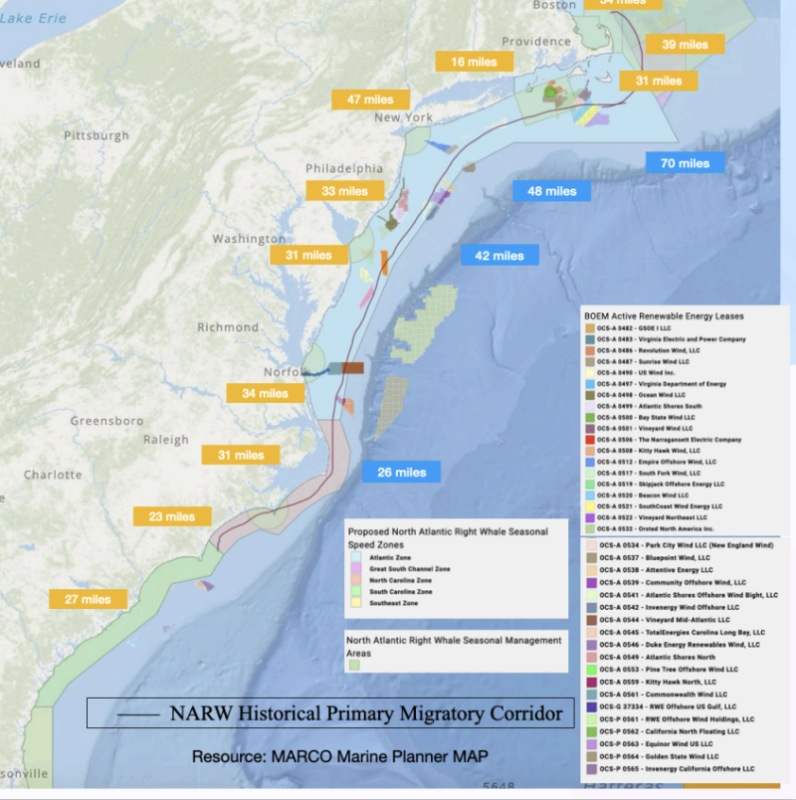
The National Oceanic and Atmospheric Administration turned down a petition to designate ocean waters along the U.S. East Coast as a “primary historic migration corridor of the critically endangered North Atlantic right whale.”
The petition filed in late March 2025 by Save Long Beach Island, a New Jersey community group, sought to have the waters from Maine to Georgia recognized as “critical habitat” under the federal Endangered Species Act, and exclude offshore wind energy projects.
NOAA rejected the petition July 2, with a lengthy explanation “that the petition does not present substantial scientific information indicating a revision to North Atlantic right whale critical habitat may be warranted.”
Despite “multiple follow-up letters, NOAA has not acted on the request, despite the mandated 90-day deadline for doing so,” the group said in announcing its lawsuit May 4.
“The deadline for response from the Agency has long since passed so we must go to court,” said the group’s lawyer Thomas Stavola, Jr. “This lawsuit compels NOAA to fulfill its legal duty to consider Save Long Beach Island's critical habitat petition.”
Save Long Beach Island, with support from homeowners, businesses and commercial fishermen on the barrier island, successfully fought the proposed Atlantic Shores offshore wind turbine project until it was cancelled amid the industry’s turmoil and opposition from the Trump administration.
The activists continue to campaign against any potential future revival of offshore wind projects, and their proposed “historic migration corridor” off the East Coast could restrict those years into the future.
That designation would “create a vital ‘missing link’ between critical habitats that NOAA designated in 1994, and later expanded, to protect the right whale’s feeding grounds off the coast of Maine (and New England) and its calving and nursery grounds off the coast of Georgia and South Carolina,” the group contends. “No habitat protections currently exist between these areas in the far north and south, putting the whale’s survival at great risk.”
“Only about 380 North Atlantic right whales are believed to remain, which means every preventable impact matters,” Denise Boccia, a Save LBI board member and the primary architect of the petition, said May 4. “Protecting their connected and continuous primary migration corridor as critical habitat is the most direct, science-based tool we have to keep this species from sliding into extinction.”
“A critical habitat designation would deter wind projects in the Atlantic Shores South and North lease areas that were unwisely positioned in the whale’s primary migration corridor…. noise from operating wind turbines extends for miles above levels that disturb the whale’s behavior,” the group contends.
“Consequently, those projects could adversely and appreciably affect the miles-wide migration corridor itself and not only seriously impair, but potentially block, the whale’s essential annual migration,” said Save LBI’s president Bob Stern.
In its July 21 notice filed in the Federal Register, the agency declined to take action.
“NOAA Fisheries reviewed the petition, references provided by the petition, and information readily available in our files, and found that the petition does not present substantial scientific information indicating a revision to North Atlantic right whale critical habitat may be warranted. Therefore, a negative 90-day finding was made.”
