



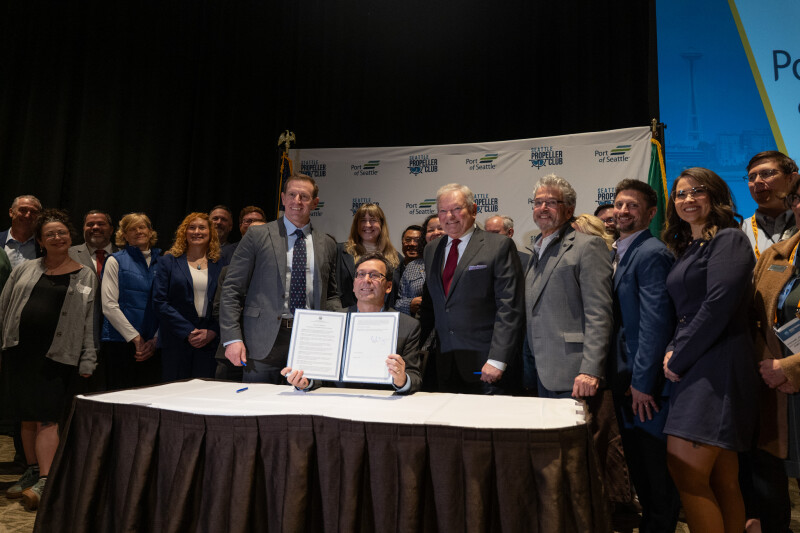
Washington Gov. Bob Ferguson on Friday signed an executive order directing the state to develop a maritime sector strategy meant to strengthen the industry, expand economic opportunity, and position Washington as a leader in maritime manufacturing, innovation, and commerce.
The order directs the Department of Commerce to work with industry leaders, labor organizations, ports, tribes, educational institutions, and other stakeholders. The strategy must be developed and published by Sept. 30, 2027.
Ferguson signed the order at a maritime industry economic forecast breakfast during Pacific Marine Expo, hosted by the Seattle Propeller Club.
"Bringing everyone to the table and coordinating a cohesive strategy is a simple but powerful step to reaching that goal," Ferguson said in a statement.
A maritime strategy was among the first recommendations from Ferguson's Economic Development Council, which he formed in June. The council includes small businesses, labor, Tribes, educators, and large employers in tech and aerospace. Two of its 26 members are port executives: Port of Seattle Executive Director Stephen Metruck and Port of Vancouver USA CEO Julianna Marler.
The order calls for the strategy to identify opportunities and recommend actions to strengthen Washington's competitiveness, attract investment, and leverage federal funding. It also targets expanded shipbuilding, vessel repair, and manufacturing, and calls for modernizing aging maritime infrastructure, preserving industrial land, improving freight connectivity, and strengthening the resilience of ports, shipyards, and working waterfronts.
Other goals include accelerating decarbonization of vessels, terminals, and fuels, expanding workforce development, supporting innovation and emerging technologies, and growing commercial fishing, seafood processing, and aquaculture. The strategy will also look for ways to streamline permitting and regulatory processes while maintaining environmental and worker protections, and to leverage international partnerships, particularly with Pacific Rim and Nordic nations.
Washington's maritime industry supports more than 174,000 jobs, generates $14.4 billion in worker income and contributes nearly $46 billion in annual business revenue, according to the Port of Seattle. The port says nearly a quarter of the nation's shipyards are in Washington, and 15 facilities can build commercial vessels up to 200' long in steel, aluminum, or composites. It cited barriers to growth including limited industrial land, aging infrastructure, workforce shortages, financing constraints, long permitting timelines, and an uncertain pipeline of work.
Ferguson focused on permitting in his remarks and compared outdated requirements to "barnacles on a ship" and urged industry to flag unreasonable rules to his office. His administration says an executive order he signed on his first day directed agencies to speed up permits and licenses. According to the governor's office, the Department of Licensing cut processing time across its 340 licenses and permits from 46 days to 25 and has no backlogs. The Department of Labor and Industries cut processing of new contractor registrations by 75%, from 12 weeks to three, and the Department of Financial Institutions cut franchise application processing from 17 days to eight.
Ferguson signed a separate regulatory reform order earlier this month directing agencies to review rules and statutes for unnecessary requirements. It also imposes a six-month pause on new agency rulemaking, with some exceptions.
Public ports helped drive the maritime effort. Eric ffitch, executive director of the Washington Public Ports Association, said Metruck proposed a statewide maritime plan at the council's first meeting. He said a landscape analysis by the association's Maritime Industrial Base Coalition found shipbuilding capacity that is "underutilized," constrained by an inconsistent demand signal from government buyers, high costs and scarce industrial land. The analysis also identified port-owned parcels suited to maritime manufacturing, and companies have shown interest, ffitch said. He said a fifth public shipyard "seems attainable."
ffitch said Ferguson also launched Washington's pursuit of a federal "maritime prosperity zone" designation with a June letter to the Defense Industrial Base Institute.
"This statewide strategy will ensure that Washington state builds on our maritime heritage," said Ryan Calkins, president of the Port of Seattle Commission.
Ferguson has also recently signed memorandums of understanding with Finland and Denmark, both with provisions on maritime industry cooperation.
Washington is not the only state moving on a maritime plan. Michigan Gov. Gretchen Whitmer introduced a 10-year maritime strategy in January, and Maryland Gov. Wes Moore signed an Oct. 22 executive order creating a Maryland Maritime Task Force to drive maritime growth, ease regulatory barriers and pursue a maritime prosperity zone designation. Maryland's action plan is due April 1, 2027.
