



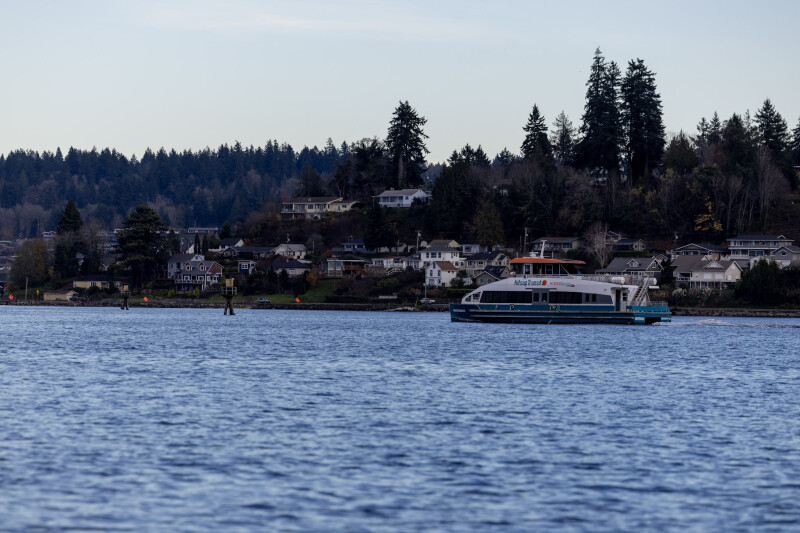
The Washington House of Representatives has passed legislation that would allow local governments, ports, tribes, and private operators to run passenger ferry service across Puget Sound.
House Bill 1923, known as the Mosquito Fleet Act, passed by a vote of 84 to 11 on Feb. 16. The bill now heads to the state Senate for consideration.
Under current Washington state law, most local governments, ports, tribes, and private operators are prohibited from running foot ferry service, with limited exceptions including Kitsap Transit's fast ferry operation.
"It's time to allow passenger ferries to connect communities once again," said Rep. Greg Nance, D-Kitsap, who sponsored the legislation. "They're the fastest and most cost-effective way to get boats on the water and restore reliable ferry service — while creating good-paying jobs right here in Washington."
Washington State Ferries has faced years of service disruptions, with delayed and canceled sailings due to aging vessels and maintenance challenges. New hybrid-electric ferries are not expected to arrive until 2030 at the earliest.
The legislation would authorize ports, counties, cities, and tribes to operate SOLAS-certified passenger vessels.
"Kitsap Transit Fast Ferries have made all the difference for folks on the peninsula," Nance said. "Passenger ferries are a proven tool that should be available to communities across Puget Sound."
Potential routes under the legislation could include San Juan Islands to Sidney, B.C., restoring an international connection paused since 2020; San Juan inter-island service to Bellingham; Port of Everett to South Whidbey; Olympia to Sea-Tac via Des Moines; a Vashon-Seattle-Des Moines circle route; and Westport to Ocean Shores.
"This is about empowering local solutions to a statewide challenge," Nance said. "The current exceptions in law prove this model works. Now it's time to scale it up."
Nance said the legislation would support Washington shipyards and marine manufacturers, create jobs in vessel construction and maintenance, strengthen supply chains for hybrid-electric and next-generation propulsion systems, and expand apprenticeship and workforce training opportunities in the maritime trades.
"This is about more than transportation," Nance said. "It's about economic development, green innovation, and making sure Washington workers are building Washington's future."
