


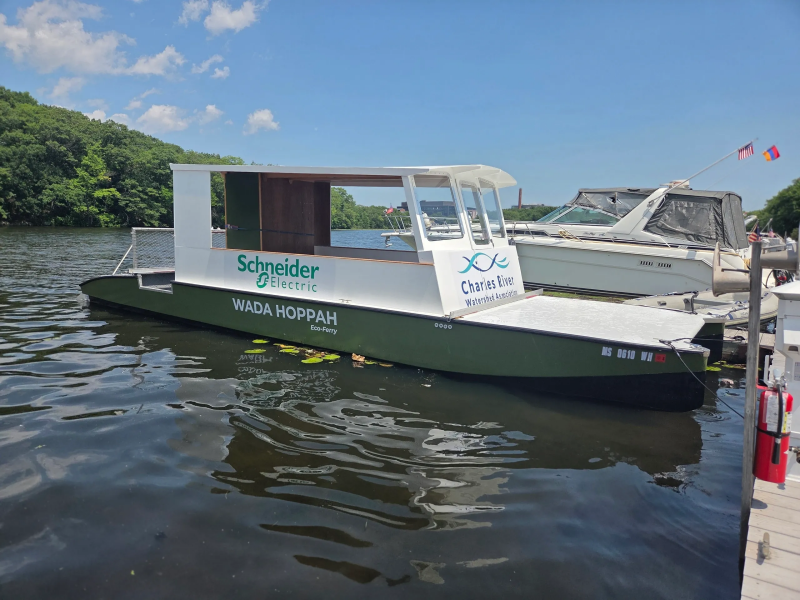
Boston-based Wada Hoppah has placed a 36' battery-electric passenger vessel into service on the Charles River, establishing a new transportation option between Boston and Cambridge, Mass.
The vessel was built at the company’s shop in Concord, Mass., which has produced racing shells for approximately 40 years. Wada Hoppah founder Drew Rollert said the design combines features of a racing shell and catamaran to minimize draft while carrying the weight of its battery system.
“The upper part of the Charles, which is where all the people are, happens to be really shallow,” Rollert said. “In order for us to pick up at the dock in the square, there’s one portion we have to get past that’s 17 inches deep.”
The 36'×9'6" vessel has capacity for up to 15 passengers. Its long, narrow hulls reduce resistance, while a pair of skegs extending aft help dampen its wake. The design is intended for shallow rivers and protected coastal routes where wake, emissions and spill risks can limit conventional ferry operations.
Rollert said the skegs are based partly on those used by coaching boats that follow rowing crews on the Charles. Wada Hoppah enlarged the concept for the passenger vessel, using the stern arrangement to reduce its wake in an area heavily used by rowers, sailors and other recreational boaters.
Rather than using a small number of large marine batteries, Wada Hoppah equipped the prototype with multiple smaller LiTime 5-kWh batteries connected through two banks. The modular arrangement allows the company to adjust capacity as it evaluates the effect of additional battery weight on the vessel’s draft.
Rollert said every two batteries increase the draft by approximately half an inch. Wada Hoppah plans to expand the installed capacity from about 40 kWh to as much as 85 kWh, provided the vessel can continue navigating the shallowest portion of the proposed route.
The smaller modules are also intended to simplify maintenance. Rollert said an individual battery can be removed and replaced in approximately eight to 10 minutes without hauling the vessel or using a crane.
“We went with a lot of smaller, 5-kilowatt batteries just to make that process a little easier as we test,” he said.
The ferry uses commonly available 50-amp shore power, allowing it to charge at marinas without dedicated high-capacity infrastructure. Rollert said the company is also discussing a DC fast charger with agencies overseeing the river, although demand charges can make fast charging costly for small commercial operators.
Alternatives could include shoreside battery storage charged during off-peak hours or portable battery systems that can be moved aboard at the dock. Rollert said those approaches could eventually extend operating hours without requiring the ferry to draw directly from the electrical grid during peak periods.
Wada Hoppah is working to expand access to 10 public and privately controlled docks along the Charles. Some were developed primarily for recreational use and would require improvements or new operating agreements to support expanded passenger service.
“We’re the builder-slash-operator,” Rollert said. “But on top of it, because none of this exists on the Charles, we’re the ecosystem developer. We’re helping the state build the ecosystem for an internal ferry network.”
While the electric vessel introduces a modern form of transportation to the Charles, passenger ferries regularly operated on the river during the early 20th century. Rollert said historical photographs collected by Wada Hoppah show several vessels moving passengers along the river before automobiles became the region’s dominant mode of transportation.
According to Rollert, as many as five ferries once operated daily along portions of the Charles. Some also carried cargo, but service declined as road transportation expanded and low bridge clearances restricted navigation farther upriver.
“They were very successful until cars came out,” he said.
Rollert pointed in particular to the low railroad bridge near Boston University, which has approximately 11'6" of vertical clearance. The bridge created an obstacle for the smokestacks carried by ferries of that period, further limiting commercial navigation on the river.
Wada Hoppah’s low-profile electric vessel was designed to operate within those constraints while reconnecting waterfront neighborhoods through the existing dock network. Rollert sees the service as both a revival of an earlier transportation model and a demonstration of how electric propulsion can work on environmentally sensitive urban waterways.
The company envisions the Charles River vessel as the first in a production series for cities seeking short, zero-emission ferry routes. Rollert said routes of approximately five miles represent a practical near-term application for battery-electric ferries, although range and service frequency depend on battery capacity, passenger load and available water depth.
Wada Hoppah is also developing a larger 55'×10' version with capacity for approximately 50 to 55 passengers. That vessel is also planned for the Charles River.
“The goal is really just to showcase that we could go from end to end on the Charles, from where it’s really deep to where it’s really shallow, pick up at both ends and take people back and forth all day long,” Rollert said. “We want to show you it’s possible.”
