



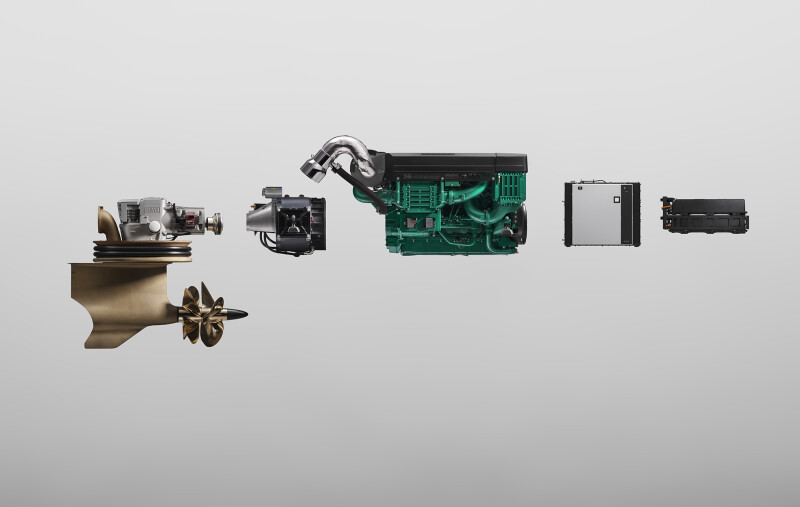
Volvo Penta has debuted a hybrid-electric version of its IPS propulsion system geared for professional vessel operators.
The new IPS Hybrid is designed for passenger ferries, coast guard vessels, offshore crew transfer vessels, short sea and river transport, and workboats. It is designed for twin, triple, and quadruple installation configurations, making it scalable across vessel types with demanding and variable duty cycles, according to the manufacturer.
Built on Volvo Penta's D13 platform, the IPS Hybrid is available in configurations ranging from the D13-IPS900H to the D13-IPS1350H, covering diesel propulsion outputs from 515 kW to 735 kW, Felix Engström, Volvo Penta's product manager for electromobility, told WorkBoat. Each configuration integrates a 160-kW liquid-cooled electric machine based on synchronous reluctance-assisted permanent magnet technology. Energy storage uses LFP battery chemistry in two capacities — 147 kWh and 221 kWh — optimized for the high charge/discharge demands of marine duty cycles.
The system supports shore charging via a CCS2 interface at up to 43 kW AC or approximately 215 kW DC, and onboard generator charging at up to 200 kW while underway or 250 kW in stationary mode. A power distribution unit integrating DC grid, charging, and auxiliary systems is included as a core component, alongside DNV-related approvals for key elements.
Volvo Penta, which positions itself as a single-supplier of "helm-to-propeller" propulsion packages, said that the IPS Hybrid consolidates propulsion, electric motors, batteries, energy management, and controls into one integrated system.
"The key differentiator is the helm-to-propeller integration, where propulsion, batteries, and energy management are designed to work together as one system," Engström said. "This creates a single point of responsibility, simplifying installation, service, and long-term operational capabilities."
"Marine commercial operators need solutions they can rely on every day, in every condition," Hanna Ljungqvist, president of Volvo Penta's marine business, said in a statement. "Our IPS Hybrid has been developed to meet those expectations by bringing together the maneuverability and efficiency of our IPS platform with integrated hybrid-electric capability in a complete package designed to support uptime, simplify operations, and deliver long-term value."
The IPS Hybrid is built on Volvo Penta's Electronic Vessel Control (EVC) platform, which merges propulsion and energy management into a single operator interface. The system offers real-time visibility into energy use, battery status, charging, and power flow, alongside existing Volvo Penta features including joystick driving, assisted docking, and a new 24" type-approved display.
The platform offers four selectable operating modes — Pure Electric, Hybrid Electric, Hybrid Fuel, and Cross-over — allowing crews to match power output to vessel activity, from low-speed harbor maneuvering to higher-load transit operations. The electric motor can also function as a generator, both during propulsion and at anchor, supporting onboard power needs and charging flexibility.
Volvo Penta said the system draws on more than 20 years of IPS development heritage and a fleet of over 45,000 operational driveline units. The company emphasized uptime and simplified maintenance as core selling points.
While the upfront investment is higher than a conventional IPS installation, Engström said the integrated approach is designed to deliver measurable long-term value.
"The business case is strongest in operations with variable load profiles, where hybridization enables more efficient energy use and improved operational flexibility," Engström said, adding that the system is designed to deliver value through reduced fuel consumption, optimized engine loading, and lower noise and vibration levels.
The solution is compatible with HVO100 renewable diesel, which Volvo Penta says can reduce lifecycle CO2 emissions by up to 90% compared to conventional diesel, and it meets IMO Tier III and EPA Tier 3 emissions standards.
Pilot collaborations are underway with selected partners, though Volvo Penta has not yet publicly named early customers or released performance data. "We will share reference projects and delivery timelines as these programs are formally announced," Engström said.
Orders opened this month, with first deliveries scheduled for the fourth quarter.
Engström said market interest is strong globally but uneven in its maturity. "Europe is currently leading adoption, driven by regulatory frameworks and sustainability targets, while interest in North America is increasing, particularly in segments focused on operational efficiency and future compliance readiness," he said.
"Commercial operators are balancing increasing demands around efficiency, emissions, performance, and availability," Ljungqvist said. "With the IPS Hybrid, we’re bringing these priorities together in one integrated solution designed not just to support lower emissions, but to help protect uptime, simplify service, and deliver confident control where it matters most."
