



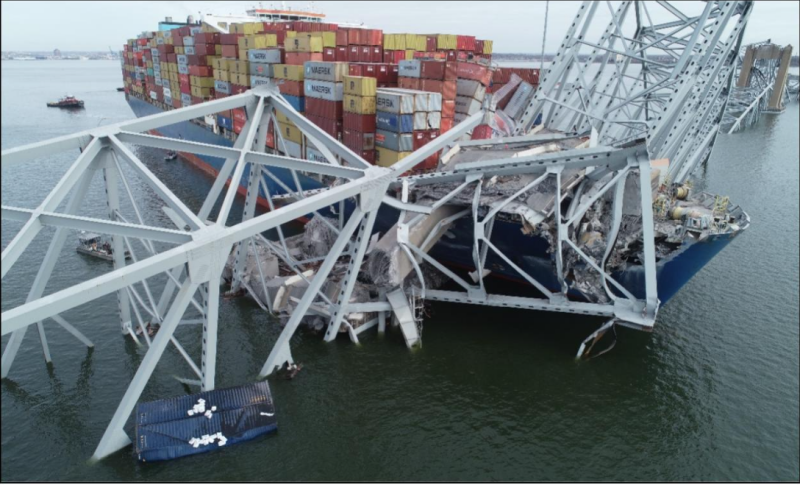
A prominent U.S. marine engineers’ union says the March 26, 2024 Baltimore ship allision and bridge collapse in Baltimore was “a cascading failure rooted in cost-cutting, poor maintenance, and disregard for U.S. maritime safety standards” – beyond the wiring faults identified by accident investigators.
A single electrical wire improperly seated in a circuit breaker block was identified as the ultimate root cause of electrical failures that led to the 984' containership Dali striking the Francis Scott Key Bridge, collapsing the 1,200' span over the Patapsco River, killing six highway workers and leaving $5 billion in damage.
But it’s a mistake to accept at face value news headlines about the National Transportation Safety Board’s final report Nov. 18, and the “loose wire” summary, contends Adam Vokac, president of the Marine Engineers’ Beneficial Association.
A deeper reading of NTSB findings “reveal that the crash would not have happened if the ship had flown an American flag (requiring it to adhere to American maritime laws) or hired American mariners,” Vokac wrote in a recent editorial.
“Press coverage implies a loose wire caused the ship’s collision with the bridge, but that oversimplifies the situation. A loose wire may occur, just as a flat tire might occur. But a properly-maintained car will manage a flat tire just fine, whereas the driver who does not maintain their car and allows multiple defects to develop is going to have a much different outcome, Vokac wrote. “Similarly, if the Dali had operated under American maritime standards, it could have weathered a loose wire without incident.”
Citing the NTSB report and U.S. Department of Justice court claims against Dali operators and owners Synergy Maritime and Grace Marine Private Limited, Vokac wrote that “foolhardy engineering policies by the Dali's Singaporean owners and operators, aimed at cutting costs…recklessly compromised operational safety. These failures ignored U.S. laws and sound maritime practices universally followed by American vessel operators and mariners. “
“This conclusion isn't born from misguided patriotism, but from the flag-of-convenience system under which much of global shipping operates,” Vokac wrote. “It is that system that has led to over $5 billion in bridge damage, six deaths, and years of traffic delays for Baltimore residents.”
Reviewing the NTSB’s chronology of the accident, Vokac noted the Dali “experienced two electrical blackouts while docked in Baltimore. Despite these unmistakable warnings, neither the NTSB nor the DOJ found evidence that the owner or operator performed diagnostics or repairs to prevent further blackouts.”
Before departing the port, “a third blackout occurred, leading to a complete loss of propulsion, steering, and lighting. After power was restored briefly, a fourth blackout struck, leaving the Dali adrift,” Vokac wrote.
“Vessel blackouts are rare and serious. In my experience, a well-maintained vessel may have one unplanned blackout every three to five years. American operators and mariners would never sail a vessel that had experienced a blackout until the root cause had been identified and fixed.,” he wrote. “Likewise, American mariners are legally required to notify the Coast Guard of a blackout, as well as all diagnostic and corrective action taken, before being permitted to leave the dock.”
The editorial goes on to list other failures, including disabled fuel service pumps and backup power systems.
“It is my opinion that unscrupulous operators prefer plausible deniability, discouraging safety reports and punishing whistleblowers. American mariners, by contrast, enjoy legal protections that allow them to report safety issues without fear of retaliation,” Vokac wrote.
“Lastly, a perverse incentive in U.S. law may have influenced the Dali’s decision to launch into Baltimore harbor under unsafe conditions. A maritime statute from 1851 limits a vessel owner's liability for damages to the value of the vessel and its cargo, motivating owners to take undue risks. The Dali’s owners almost certainly were aware of this stop-loss when they took the risks they did.”
“American vessels and mariners may have higher costs, but they are infinitely preferable to outsourcing our maritime economy and safety to the lowest bidder, then standing by helplessly as our reckless foreign counterparts bring it all crashing down around us."
