



It’s later this century, and two warring nations’ navies approach one another across a battlefield known as the Pacific Ocean. Out front, on both sides, are fleets of 60' to 180' uncrewed surface vessels (USV). Each of the state-of-the-art USVs carries swarms of flying drones and autonomous underwater vehicles (AUV) that will be launched when the fighting begins.
The nearest human is many miles away.
By nightfall, all boats have stopped. Two weeks later, the fleets remain in the same positions. Military brass strategize. Politicians negotiate.
Meanwhile, a 1,000' containership is hundreds of miles across the Atlantic Ocean heading to multiple ports in Europe, carrying goods for hundreds of merchants. The nearest human in control of the ship is in Boston.
Are these scenarios, or something like them, a possibility?
“It’s not a question of if, but when,” Rylan Hamilton, co-founder and CEO, Blue Water Autonomy, said during the conference session, “Uncrewed Surface Vessels for U.S. Defense: Charting the Navy-After- Next” at the International WorkBoat Show earlier this month in New Orleans.
Demand for autonomous surface vessels is rising as military and maritime operators seek persistent surveillance, logistics support, and force-multiplying capabilities without risking crews or incurring the full cost of manned ships.
“The real future here is commercial maritime interests,” Doug Lambert, co-founder & COO of Austin, Texas-based Saronic Technologies, said as part of the same conference panel.
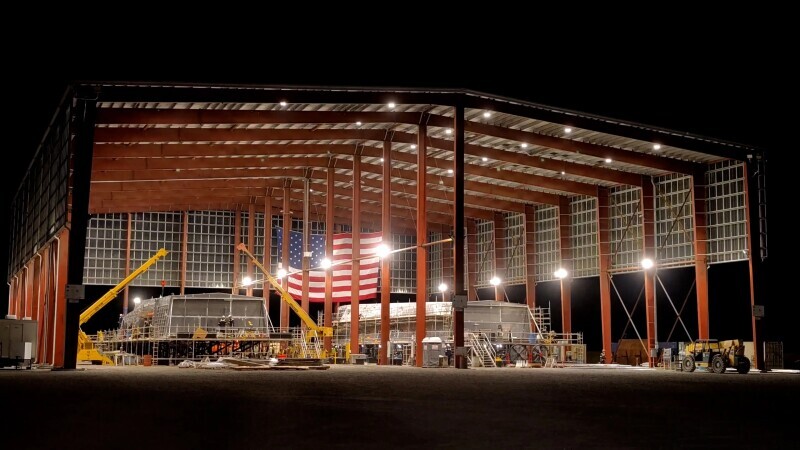
But for now, the military is where it’s at for USVs, and Saronic is reaping the benefits. In December, the company completed the hull flip of its first 150' Marauder USV at its shipyard in Franklin, La.
Saronic operates as a software-driven maritime technology company, combining autonomy development with in-house ship production. According to the company, this integrated approach enables faster iteration of vessel designs compared with traditional shipbuilding models.
The Marauder is Saronic's first vessel of its size designed from the keel up to be fully autonomous. It offers a payload capacity of 40 metric tons and can travel up to 3,500 nautical miles or loiter for over 30 days. According to the company, the platform is engineered for a wide range of mission types and aims to deliver advanced capability at a lower cost compared with traditional manned ships.
The vessel moved from initial design to full structural completion in six months. Following the hull flip, the completed aluminum vessel is expected to enter waterborne testing in the coming months as it advances to the next phase of development.
A second Marauder vessel is already in production, with Saronic reporting a 25% gain in production efficiency based on lessons learned from the first.
A third Marauder vessel, planned to begin construction in January 2026, is expected to incorporate an evolved 180' design intended to increase operational reach, payload capacity, and mission flexibility.
Also, this month, the U.S. Navy awarded Saronic a $392 million production contract for its Corsair autonomous maritime vessels, with nearly $200 million obligated at the time of the award. The announcement was made by Secretary of the Navy John Phelan, who said the deal reflects a new benchmark for rapid defense procurement.
According to Phelan, the Navy moved from prototype development to production in less than 12 months, a timeline far shorter than typical shipbuilding and acquisition programs.
“The Navy isn’t admiring problems from the sidelines, we’re moving at war-footing speed,” Phelan said in a social media post. “With Saronic, we went from prototype to production in under a year. That’s rapid innovation, real competition, and combat power in sailors’ and marines’ hands, not on PowerPoints.”
The contract focuses on Saronic’s Corsair platform, a 24' modular autonomous surface vessel capable of carrying roughly 1,000 lbs. over 1,000 nautical miles and achieving speeds greater than 35 knots. Saronic describes Corsair as suitable for bluewater missions ranging from maritime domain awareness to kinetic and non-kinetic strike roles.
In September, Blue Water Autonomy, Boston, which designs and builds unmanned ships for the U.S. Navy, announced it had entered into a production agreement with Conrad Shipyard, Morgan City, La. The partnership marks a major step forward in Blue Water's plan to deploy autonomous surface vessels at fleet scale.
“Our vessel is 180 feet,” Hamilton said. “The Navy wants vessels they can put in the water now.”
Under the agreement, Conrad will assemble Blue Water's first class of autonomous ships. The shipyard plans to use its multiple facilities, its automated panel line, and advanced welding techniques, allowing for parallel builds and scalable throughput.
The partnership also reflects Blue Water's broader strategy to activate underutilized U.S. shipyard capacity, particularly small and mid-tier yards that can adapt quickly to new platforms.
Blue Water said it’s focused on working with U.S. shipyards that are fully operational today, shipyards like Conrad, that are proven in both commercial and military shipbuilding and can deliver with speed, scale, and precision. Unlike manned warships, which often require years-long timelines and specialized build environments, Blue Water's platform is intended to be produced, updated, and maintained with speed and flexibility in mind. “I think we’re filling a gap,” said Hamilton. “We’re not trying to replace the destroyer but complement it.”
No animosity was visible as the competitors sat together on the stage. “Competition is good,” said Lambert. “It’s going to drop the price.”
“I think it’s a culture change,” said Ben Komar, the American Bureau of Shipping’s director of global government services and the third member of the panel.
