


Articulated tug-barges (ATBs) have long been a fixture in U.S. coastal petroleum trades, but a new generation of projects is showing how adaptable the platform can be as energy markets evolve.
Unlike self-propelled ships, ATBs operate under a regulatory and construction framework that certifies the tug and barge separately, providing added flexibility in construction strategy as well as operation, said Keegan Plaskon, director of business development North America at the American Bureau of Shipping (ABS).
That flexibility extends to the shipyard base. “Shipyards that specialize in either tug or barge fabrication can offer a competitive advantage to owners/operators looking to optimize project outcomes from a risk and economic standpoint,” Plaskon said. “While the future energy landscape continues to mature and volumes of associated cargos eventually scale, ATBs will continue to play a strong role in the near term for domestic U.S. maritime trade.”
In recent years, that role has increasingly shifted beyond conventional refined-product and crude movements. Two clear examples are LNG bunkering and the developing market for transporting captured carbon dioxide by sea. Operators are turning to ATBs as a practical bridge between emerging cargo demand and established U.S. shipyard and regulatory frameworks.
Plaskon said the ATB configuration also comes with design tradeoffs as alternative fuels enter the picture. “ATB platforms in the U.S. have unique design advantages that complement the regulatory framework for the markets they serve,” he said. “The adoption of alternative marine fuels is largely influenced by emissions reduction incentives and economic drivers.”
He noted that not every fuel pathway fits easily on a tug. “Availability of cost-competitive fuels like green methanol and drop-in replacements such as synthetic or biofuels are viable and maturing options for current and near-term ATB propulsion tug designs,” Plaskon said. “However, the limitation of physical space on board the tug constrains the integration of sufficiently large LNG/ammonia/hydrogen fuel tanks.”
Using cargo as fuel is technically possible, he added, but would require operational changes. “The utilization of cargo as fuel would necessitate a more symbiotic relationship between the ATB tug and the barge to enable internal bunkering between assets, which is less commonplace today,” Plaskon said. “As the adoption of low-carbon fuels expands across the maritime industry, it is anticipated that ATBs transporting such cargos would also leverage that energy source as a cost-effective and convenient fuel source.”
SEASIDE LNG
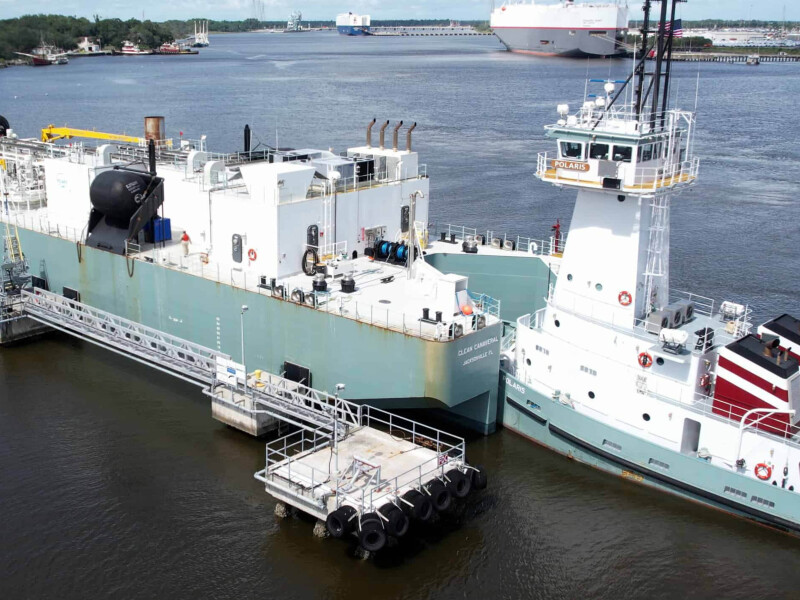
Jacksonville, Fla.-based Seaside LNG is using ATBs in support of its LNG bunkering operations along the U.S. East Coast. From the outset, the company saw the tug-and-barge configuration as a better operational and financial fit than a self-propelled LNG bunker vessel.
“[ATB are] the most cost-effective way to move smaller LNG cargoes,” said Jason Owens, Seaside’s chief operating officer, who compared the manning requirements of ATBs and tankers. “The big driver in this is when you get to a self-propelled vessel, it has a higher crew requirement versus the ATBs, so it drives up the operating costs.”
In addition, the decoupled nature of an ATB provides a key reliability advantage. “If your tug has a mechanical issue, or it needs some major maintenance, you can swap it out and keep the barge working,” he said. “That’s really huge for uptime, versus a self-propelled vessel, where the whole asset may be down.”
That flexibility is especially important in a niche market with a limited number of dedicated LNG bunker barges. “We’ve got three LNG barges right now… It’s not like there’s a fleet of 50, and you can easily substitute different vessels in for other ones,” he said. “Reliability and repeatability is something that’s really important to us.”
Seaside’s newest ATB barges, Clean Canaveral and Clean Everglades, each carry about 5,500 cubic meters of LNG. The company also operates Clean Jacksonville, an earlier unit paired with a conventional tug.
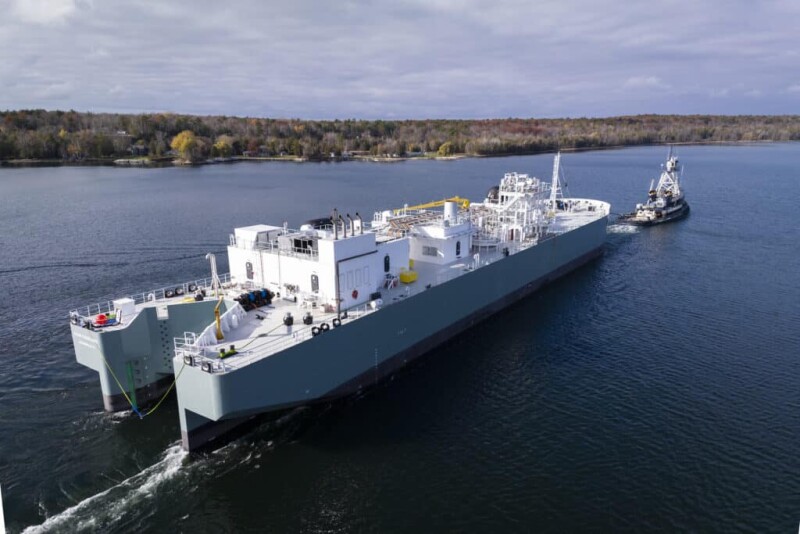
“Our 5,500s were specifically built because they fit very well with our LNG production… With our ATBs that we have, we size them to where we can roughly carry a week of LNG production,” Owens said. “So that really helps us out to where we can fill the barge up and then make several deliveries before we have to come back and refuel it.”
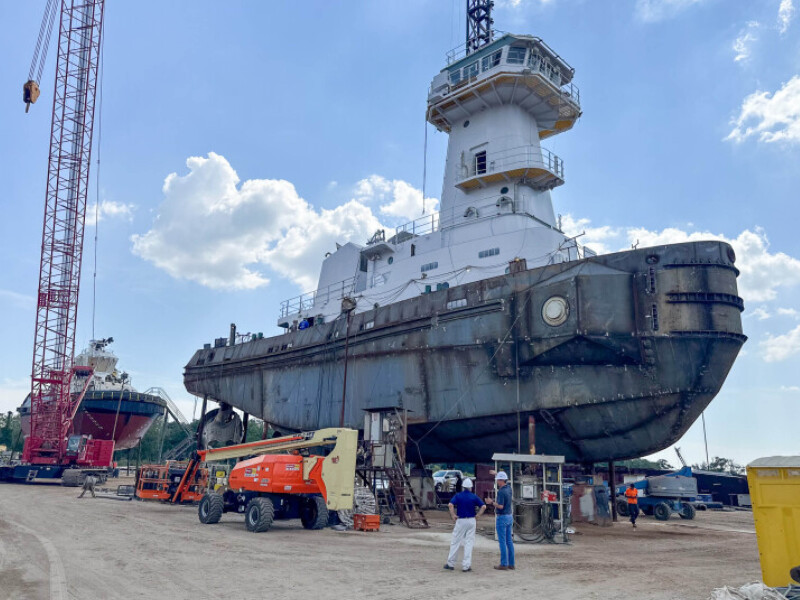
The ATB concept depends heavily on tug performance, particularly during close-quarters bunkering operations alongside large oceangoing ships. Seaside’s newest tugs, Polaris and Tortuga, were built by Master Boat Builders, Coden, Ala.
Delivered in March 2024, the 109' Tortuga operates from Jacksonville alongside her sister vessel. In 2024, McAllister Towing and Transportation Co. was contracted to manage, man, and operate the unit.
Tortuga is powered by two Caterpillar 3512E EPA Tier 4 diesel engines, each producing 2,000 hp. The engines drive Berg MTA 523 Z-drive thrusters. The tug is fitted with a Beacon Finland JAK-400PHL-L articulated coupler system with Hydrolock.
“These tugs are equipped with Z-drives, so that gives us that maneuverability that we’re looking for,” Owens said. “It’s especially important to us when we’re working alongside our customers, and we’re doing transfers, extended transfers, and depending on the variable weather conditions, it really gives us that stability that we need.”
He noted that propulsion and the ATB connection system work together. “If you couple that with the JAK coupling system, they kind of go together, and that allows us to really be able to control these ATBs safely.”
Seaside’s core service area currently runs along the Southeast and Florida coasts, also operating in the Gulf of Mexico, and is looking farther north. “In the future, we’re looking to expand that further up the coast towards the New England area also, and then expand on the Gulf Coast,” Owens said.
Since acquiring its first LNG barge in 2021, experience has led to improvements in barge design. On Clean Everglades, Seaside added an elevated loading platform.
“One of the modifications that we made with the Clean Everglades is that we added… an elevated loading platform,” Owens said. “What that allows us to do is actually load LNG from a typical LNG export facility.”
That expands supply options. “Instead of having truck-to-ship or kind of a bespoke land-based small-scale facility, we can pull up to and berth a large-scale facility and actually load LNG from there,” he said. “In our future ATBs, we’re looking to definitely incorporate that design feature.”
“We’re one of the only ones that have an integrated platform to where we have our own supply, and we’ve got our Jones Act barges,” Owens said, noting that the company operates three of the five Jones Act-compliant LNG bunker barges in the U.S. market.
LIQUEFIED CO2
A similar ATB approach is now being applied to carbon transport. Aptamus Carbon Solutions, Tampa, Fla., recently received approval in principle from ABS for a preliminary design of an LCO2 barge intended for ATB service in the U.S.
“We sized it based on what we think the optimal cargo quantity of liquefied CO2 will be per voyage based on vessel transit length, round trip time, and target annual throughput,” said Kent Merrill, Aptamus’ vice president of marine projects.
“Our planned initial phase has two ATBs carrying CO2 that is captured from power plants and/or industrial facilities in the Tampa region to one or more ports in Texas and Louisiana where the CO2 will be permanently sequestered or used for enhanced oil recovery,” Merrill said. “We are developing a loading terminal in the Port of Tampa Bay and a discharge terminal at LBC Tank Terminals near Baton Rouge, La.”
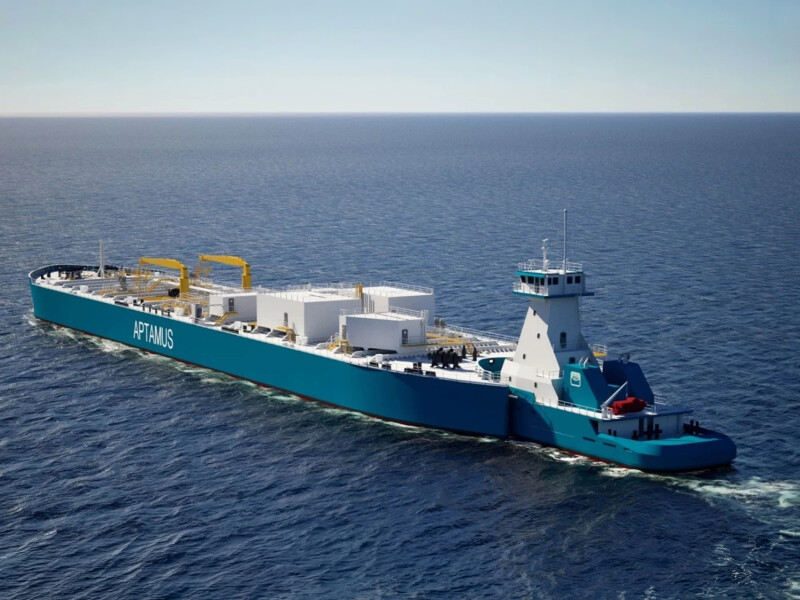
He added that discharge terminals could be built in other Gulf ports like Lake Charles, La., and the Texas ports of Port Arthur/Beaumont, Houston, or Corpus Christi, where CO2 pipelines and storage infrastructure exist.
Marine transport, he said, will be necessary alongside pipelines. “There is a general consensus that it will be impossible to satisfy the forecast demand with pipelines alone, and marine transportation of CO2 will be a critical piece of the nation’s decarbonization strategy,” Merrill said.
ABS’s Plaskon said ATBs are well-positioned for emerging liquid cargoes tied to the energy transition. He noted, however, that ATB construction is currently subdued compared with past cycles. “Overall, ATB newbuilding in the U.S. is in a relatively low point of the market cycle,” Plaskon said. “LNG bunkering units have been leading new construction programs while conventional petroleum ATBs have not been as actively contracted as they were in the 2010’s.”
Still, as Merrill said, ATB design evolution continues. “We think modern ATBs, regardless of what they carry, will need to have more attention paid to hydrodynamics and resistance reduction with tools like [computational fluid dynamics] analysis and model testing,” he said. “Innovative thought needs to occur with the design of the notch area where there is a gap between the barge and the tug and vortices in the water flow can increase drag and result in poor flow into the tug’s propellers, reducing their efficiency.”
Merrill also said that modern tugs should be designed for future fuels, such as green methanol, and that technologies like air lubrication and rotor sails should be explored to determine whether they could be effective on unmanned barges.
Taken together, the Seaside LNG and Aptamus Carbon Solutions projects point to a broader shift in how operators are thinking about the ATB platform. Once defined largely by petroleum service, ATBs are now being adapted for cargoes tied directly to decarbonization and the evolving energy mix.
