



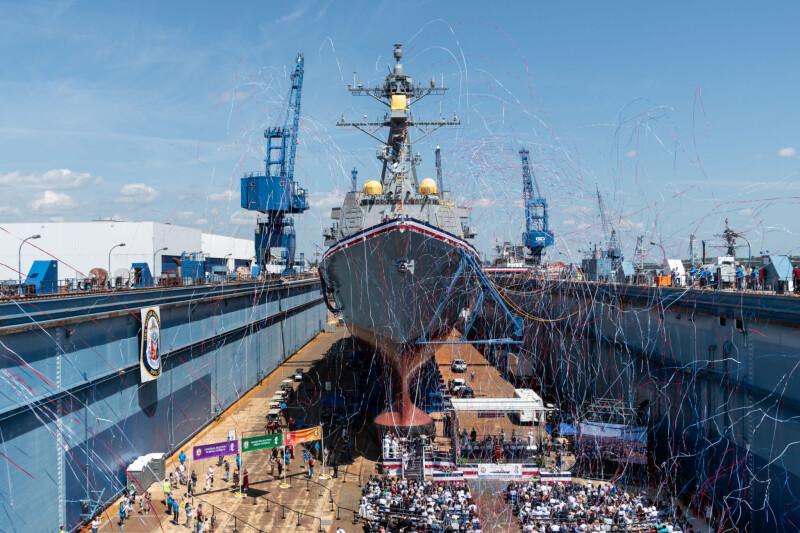
President Donald Trump has issued a memo calling on the Pentagon to source vessels for up to three Navy ship classes from foreign shipyards and to launch or acquire a new Navy shipyard to help shoulder the service’s long-term shipbuilding needs.
Titled “Rebuilding the United States Navy and America’s Shipbuilding Industrial Base,” the memo, which the White House released August 13, is addressed to Secretary of War Pete Hegseth; Russell Vought, the director of the Office of Management and Budget (OMB); and Secretary of State Marco Rubio in his capacity as assistant to the president for national security affairs (APNSA).
In the memo, the president acknowledged a series of “shipbuilding setbacks” for the Navy “stemming from overly complex designs and iterative design change procedures, which have resulted in cost growth, delays, and cancellations.” Trump also called out a “lack of capacity and competition among shipbuilders,” which has translated into widespread backlogs.
“An atrophied shipbuilding industrial base, coupled with diminished adjacent supplier bases, has expanded delays and increased costs,” Trump stated in the memo. “The Department of War shall restore both capacity and competition to the maritime industrial base as it expands our naval force structure.”
To accomplish that, Trump has directed Hegseth, Vought, and Rubio to use the U.S. government’s partnership with Finland in the construction of medium icebreakers for the Coast Guard as a model for foreign-sourced ships to meet the Navy’s immediate shipbuilding needs. As a prerequisite, foreign shipbuilders also would have to agree to build new or acquire existing U.S. shipyards, hire and train American citizens for those shipyards, license shipbuilding techniques and technologies used at parent shipyards to the U.S. shipyards, and utilize a U.S. supply chain for construction and maintenance work at those shipyards.
The memo identifies “surface combatants with sufficient inherent capabilities to perform anti-submarine warfare, surface warfare, and convoy escort duties” as vessel types subject to the new “international procurement model.” Consolidated cargo replenishment at sea (CONSOL) tankers and certain roll-on/roll-off vessels would also be fair game for the “Finland Model” for ship acquisitions.
The memo also specifically forbids iterative design changes for foreign-sourced ships.
“No changes from parent designs shall be made without the approval of the secretary of War, in consultation with the secretary of the Navy, the director of OMB, and the APNSA,” the memo stated.
The memo also calls for the addition of a fifth public Navy shipyard in order to boost “nuclear-powered submarine and aircraft carrier readiness” and the establishment of a component repair center for the Navy’s submarine fleet. Such a center would be required to maintain at least one “ship set” of spare components for the Navy’s Los Angeles, Virginia, Seawolf, Ohio, and Columbia classes of submarines.
Trump also directed Hegseth to develop a plan for “implementing personnel, organizational, and structural reforms” at the Naval Sea Systems Command (NAVSEA).
“The objective of these reforms should be to: introduce results based accountability for NAVSEA leadership, determined by speed of delivery of vessels and systems; reduce bureaucracy and red tape; eliminate competing priorities among different NAVSEA components, which often result in delayed, cost-prohibitive, or overly complex vessels and systems; and prevent NAVSEA from imposing redesigns or iterative design changes upon original mature parent designs,” the memo stated.
Lastly, the memo directs the Navy to pivot away from the use of electromagnetic aircraft launch systems and weapons elevators aboard its forthcoming Ford class aircraft carriers in favor of steam and hydraulic systems, respectively.
The memorandum is the latest move by the Trump administration aimed at growing the Navy’s fleet, speeding up vessel acquisition, and reforming the Navy’s overall acquisition strategy. Last October, Trump announced plans to accelerate Arctic Security Cutter construction through foreign shipyards, then in February, the White House released the administration’s Maritime Action Plan.
Foreign-direct investment in defense-focused shipyards in the United States has been growing for years. Responding to the president’s memorandum, Matthew Paxton, president of the Shipbuilders Council of America (SCA), said foreign-owned U.S. shipyards are a lot different than foreign-built ships.
“While foreign investment into the U.S.-based shipyards and facilities is lauded to read the administration’s goals of revitalizing the shipyard industrial base, directing the Department of War to build overseas only undercuts the federal Maritime Action Plan and generational investment into commercial and government shipbuilding,” Paxton said. “Every hull built abroad is demand, jobs, and industrial capability diverted from American shipyards this administration pledged to rebuild.”
Paxton went on to urge the Pentagon to reverse course.
“[We] remain committed to working with the Department of Ward, MARAD, and Congress to keep federal shipbuilding dollars strengthening — not bypassing — the domestic maritime industrial base,” he said.
Trump called for a phased implementation of his memo, with 60-, 90-, and 120-day deadlines.
