


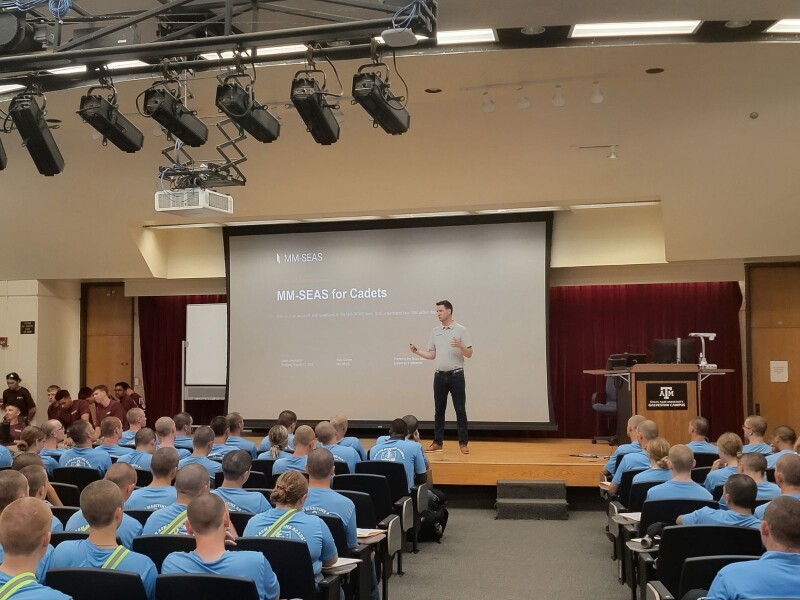
More than 200 incoming cadets established accounts with MM-SEAS, Washington, D.C., during orientation week as the academy prepares for the Coast Guard’s rollout of a new credentialing system.
The Texas A&M Maritime Academy enrolled 220 cadets in the mariner licensing platform Aug. 13 at its Galveston, Texas, campus. The credentialing company also conducted training sessions for academy staff and faculty.
The implementation comes ahead of the Coast Guard’s scheduled Sept. 14 launch of Navita, a new system for processing merchant mariner credentials. Maritime academies, training providers and vessel operators will have to adapt their credentialing processes to the new Coast Guard platform.
Texas A&M will use MM-SEAS to track sea service, prepare credential applications, calculate fees and issue digital course certificates. The company’s licensing consultants will also review applications before submitting them to the Coast Guard.
“We had been looking for a centralized place to maintain everything rather than using five different Excel spreadsheets,” Sarah Larsen, director of Coast Guard License Programs at Texas A&M Maritime Academy told WorkBoat. “I started using MM-SEAS for my own credentials and saw how easy it was to track my certificates, training and sea service.”
Larsen said the platform will give cadets greater visibility into the credentialing process.
“It gives our students hands-on knowledge of the application process and the transparency to see these things for themselves rather than relying on academy staff,” she said.
Academy staff have traditionally assembled and filed cadet applications with the National Maritime Center through an expedited processing program. Credentialing work continues throughout a cadet’s enrollment and includes tracking sea service, maintaining medical certificates, issuing course certificates and managing credentials.
Under the new process, sea service will be recorded as cadets earn it rather than reconstructed after a sea term. Course certificates will also be issued digitally, with identifiers tied to the course and individual mariner that allow the Coast Guard to validate them at their source.
“We started with our freshman class this fall,” Larsen said. “During orientation week, we added 220 new cadets, and we were already able to see their TWIC expirations and passports.”
MM-SEAS will check applications for missing information and the company’s Coast Guard licensing specialists will then review and submit the applications.
“We’re still here to help, and we still want to answer their questions,” Larsen said. “We’ve just added an additional group of experts to help answer them. It’s really another set of eyes to make sure everything is correct.”
The platform will also digitize Certificates of Discharge, which ships’ crews currently prepare manually. Once created and signed in MM-SEAS, each certificate will be added to the cadet’s record and show how the documented service counts toward graduation and license-testing requirements.
The academy plans to use the process aboard its training vessels for cadets and crewmembers.
License Option cadets have nine months from enrollment to demonstrate that they meet Coast Guard medical and physical requirements. Credentials are checked again before Summer Sea Term, along with sea bags and medical screenings.
Current credentials are particularly important for cadets assigned to commercial vessels. Those billets become available according to vessel operating schedules rather than the academic calendar, meaning cadets must have their documents ready when an opening occurs.
The system will continue supporting cadets after graduation, MM-SEAS said. Advancing from third mate to second mate or from third assistant engineer to second assistant engineer requires documented sea service but no additional examination. Tracking sea days as they accrue allows graduates to apply as soon as they become eligible.
MM-SEAS said its platform supports more than 30,000 mariners and is used by three of the five largest maritime training providers in the U.S. Several Coast Guard-approved schools issue course certificates through the system, but Texas A&M is the first state maritime academy to adopt it. The privately held company operates independently of Coast Guard systems.
“Navita is an important step forward, and the Coast Guard deserves credit for taking it on,” said Nate Gilman, president of MM-SEAS. “Modernizing the systems mariners depend on makes life better for everyone in this industry, and we are glad to help academies like Texas A&M get ready for it.”
On Aug. 21, Marad took delivery of the 524' Lone Star State, the fourth of five National Security Multi-Mission Vessels being built by Hanwha Philly Shipyard. The ship was christened July 17 in Philadelphia and is expected to arrive at the academy within the next few weeks.
The Lone Star State will be the academy’s first purpose-built training ship in more than two decades. It can train as many as 600 cadets annually and accommodate up to 1,000 people during disaster-response deployments.
“We have dreamed of this day for 21 years,” Rear Adm. Michael Fossum, the academy’s superintendent, said at the christening. “If you build these ships, we will crew them.”
Texas A&M’s Class of 2030 is scheduled to begin its first Summer Sea Term in 2027.
