



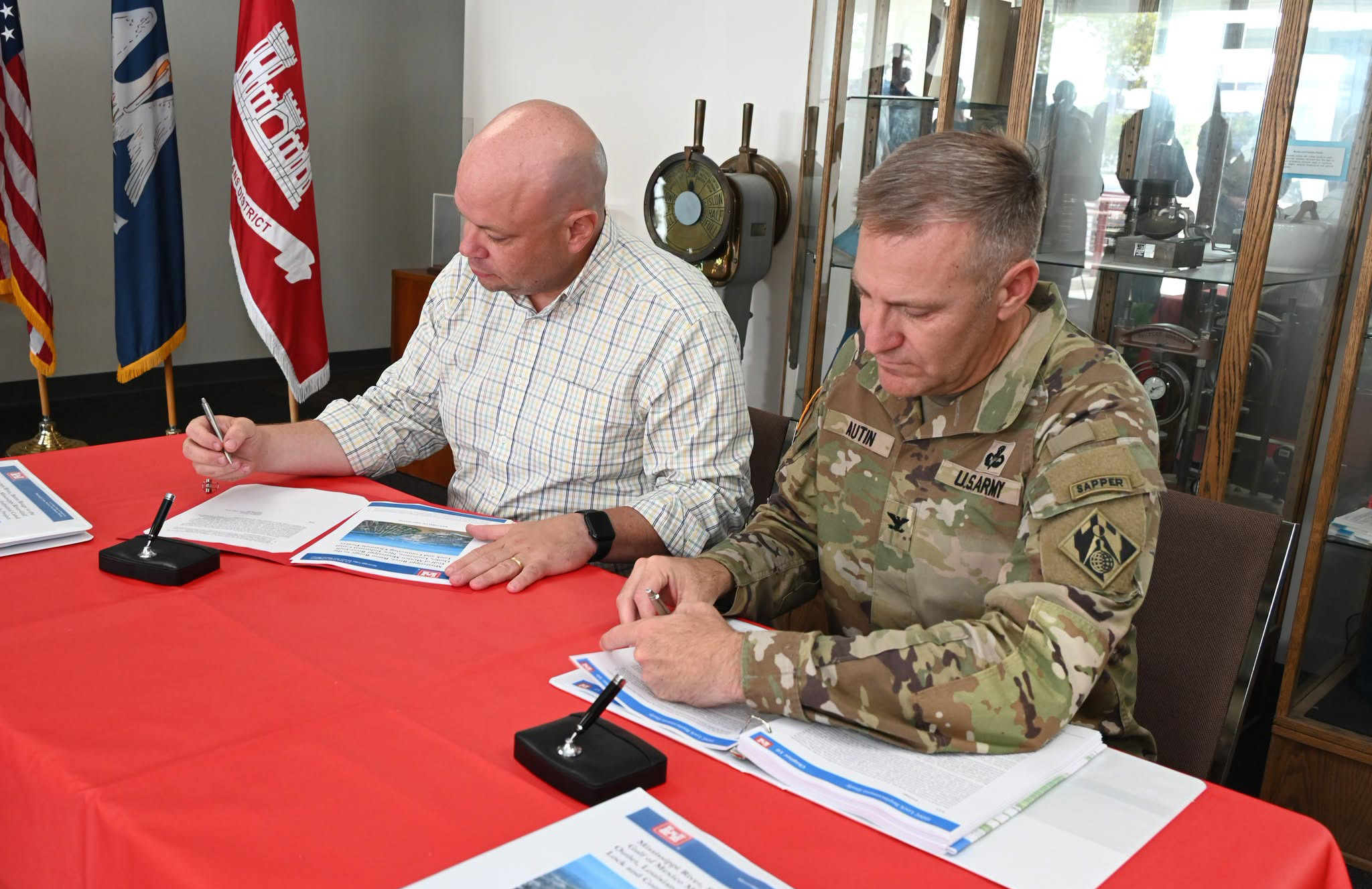
Assistant Secretary of the Army for Civil Works Adam Telle, sitting alongside Col. Scotty Autin, commander of the Corps of Engineers’ New Orleans District, signed the record of decision (ROD) Aug. 27 for the replacement of the Inner Harbor Navigation Canal Lock in New Orleans. With Telle’s endorsement, the 103-year-old structure, the only point of access on the east side of the Mississippi River for the Gulf Intracoastal Waterway (GIWW), moved one step closer to being replaced with a modern, shallow-draft lock measuring 900’x110’x22’.
“The Inner Harbor Navigation Canal Lock is a vital artery for regional and national commerce, and we have a responsibility to move projects like this from review to reality,” Telle said. “By completing this environmental review efficiently and rigorously, we are clearing the path to deliver a modern, resilient lock system that relieves costly navigation bottlenecks, strengthens supply chain reliability, and supports American commerce.”
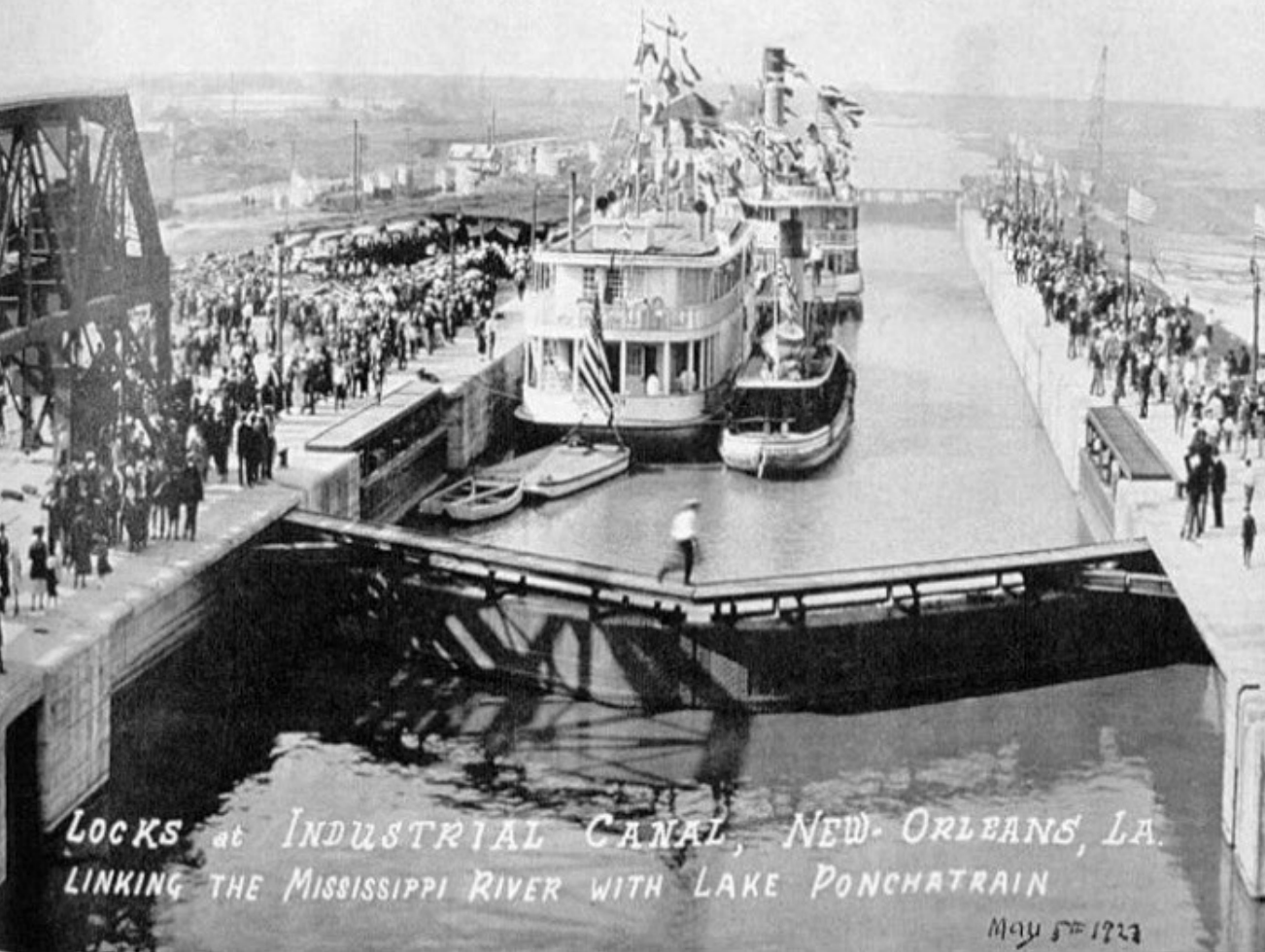
The existing lock, which measures 640’x75’x31.5’, opened in May of 1923. Today, the typical jumbo tank barge transiting the lock measures 250’ to 300’ long and 50’ to 54’ wide, meaning a standard six-pack takes three “trips” or more to get through the lock. According to the New Orleans District, the locking process alone can take up to 16 hours, not counting time spent in the queue. That adds time and expense to both the tow and local traffic due to repeated openings for drawbridges on either side of the lock.
The New Orleans District, which has studied the replacement for decades, ultimately settled on the recommended plan of a new 900’x110’ lock chamber about 2,400 feet north of the existing lock in order to pass a standard six-pack tow in a single lockage.
Paul Dittman, president of the Gulf Intracoastal Canal Association, the trade group representing GIWW stakeholders, said the proposed replacement will be a huge improvement over the existing structure.
“A modern, larger structure will greatly increase efficiency by virtually eliminating the need for larger tows to trip through the lock, minimizing the number of transits and decreasing lock queues and the amount of time vessels are on turn waiting to pass through the structure,” Dittman said. “The IHNC Lock is also a single point of failure providing the only viable access to the east canal portion of the GIWW east of New Orleans. A modern lock, built to 21st century engineering and design standards, will significantly enhance the resiliency of the nation’s inland maritime transportation system.”
While the New Orleans District will proceed with further engineering and design work for the lock replacement, Congress will have to authorize the project and appropriate the funds needed for it to move to construction. And there’s sure to be some sticker shock.
According to the New Orleans District, the “project first” cost for the lock replacement is about $5.2 billion. Based on the district’s forecast for future barge traffic and cargo values, the project would have a benefit-cost ratio (BCR) of 1.01, barely above the 1.0 threshold for a project to be economically feasible.
In the final report on the project, the New Orleans District noted that close to $757 million of the project cost would be classified as flood risk management, due to the need to extend the Mississippi River & Tributaries levee and floodwall system into the canal. The project also carries a high-cost contingency, which drove up its price tag. The district further noted the limitations of its calculation of benefits.
“The official BCR is primarily based on transportation efficiency,” the report stated. “It does not fully monetize the significant benefits of ensuring system reliability and avoiding the catastrophic economic consequences of an extended, unplanned failure of the 100-year-old lock. The value of preventing cascading rerouting and mode-shift impacts is a critical, though not fully calculated, national benefit.”
Elsewhere in the study, the district noted that rerouting barge traffic to bypass the IHNC Lock requires going up the Mississippi to the Ohio River, then taking the Tennessee River to the Tennessee-Tombigbee Waterway down to Mobile, Ala. That route alone takes an additional 17 days, plus fuel and personnel costs.
“In summary, a comprehensive assessment reveals that the project’s full value is substantially greater than the official 1.01 BCR indicates,” the report stated. “Tolerating a single-point failure at the junction of two of the nation’s busiest waterways constitutes an unacceptable risk.”
The project, though, will likely cost more than $5.2 billion. Spreading the cost across a 14-year construction window, forecast to begin in 2033 and conclude in 2047, could raise the price tag to an estimated $7.563 billion.
Estimated costs include the lock construction, replacement of the St. Claude Avenue drawbridge, and community mitigation measures.
This is the second time the IHNC Lock Replacement project has reached the record of decision step in the process. After a 1997 environmental impact statement (EIS), litigation and a federal court ruling in 2006 in the wake of Hurricane Katrina pushed the Corps to develop a suplemental EIS. The Corps published that report in 2009, with a record of decision shortly thereafter. A new round of litigation followed.
A reevaluation of the project got underway in 2015, and a draft report was published in 2017. At that time, the New Orleans District "pivoted the project scope from a deep-draft design to the recommended modern shallow-draft configuration," said Matt Roe, public affairs specialist with the New Orleans District.
"After a brief pause in 2019 to secure additional funding, efforts resumed in 2021," Roe said. "This work culminated in the 2026 Final Integrated Report and ROD, which built directly upon the 2017 framework while delivering a more robust, re-developed community impact mitigation plan and a transportation mitigation program."
