



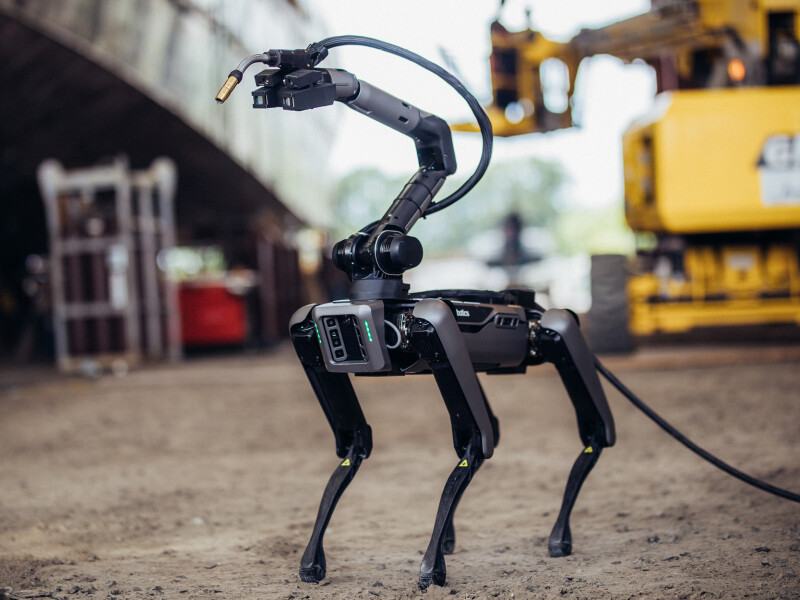
It walks. It welds. And it might be exactly what short-staffed, scaling shipbuilders have been waiting for.
Rove, a four-legged robot from Path Robotics, Columbus, Ohio, can walk on a ship hull or heavy equipment frame and execute welds autonomously without a fixed cell or human setup.
Quadruped robots — four-legged machines such as the Spot (named for its dog-like aspect) from Boston Dynamics Inc., Waltham, Mass., modeled loosely on animal locomotion — have gained traction in industrial inspection and monitoring in recent years. Applying that mobility to precision welding, however, has not taken off.
That is where Path and its Obsidian artificial intelligence (AI) model come into play, mounted on the Spot quadruped to bring mobile, automated welding technology to the shipyard.
“The Rove platform combines Path’s physical AI model for manufacturing with Spot’s world-class mobility and autonomy,” Marc Theermann, chief strategy officer at Boston Dynamics, wrote on social media. “The result is the intelligence to autonomously weld, the adaptability to handle any environment, and the mobility to bring the worker to the workpiece.”
Once limited to repeatable tasks such as those common in automotive manufacturing, robotic welding has become more widely used in shipbuilding — especially in Asia’s shipbuilding powerhouse nations: South Korea, China, and Japan — thanks to advances in computer modeling and AI.
These technologies allow robots to interpret complex, nonstandardized joint geometries and irregular hull structures in real time, enabling them to adapt their welding paths to the kind of one-off, large-scale variation that shipbuilding requires — something the fixed, repetitive motions of traditional automotive welding robots could never handle.
SKILLS SHORTAGE
Many U.S. shipbuilders, who have long struggled to recruit and retain skilled workers, are also beginning to see the technology as attractive.
U.S. shipyards will need 200,000 to 250,000 additional maritime workers over the next decade in critical occupations such as welding, soldering, and front-line management, according to the Department of Labor. That gap is expected to widen as the country pursues ambitious plans to revitalize its maritime sector and demand for ships grows.
The workforce woes are not limited to shipbuilding. The American Welding Society projects a nationwide shortfall of 330,000 welders by 2028, as an aging workforce retires and industries compete for skilled talent.
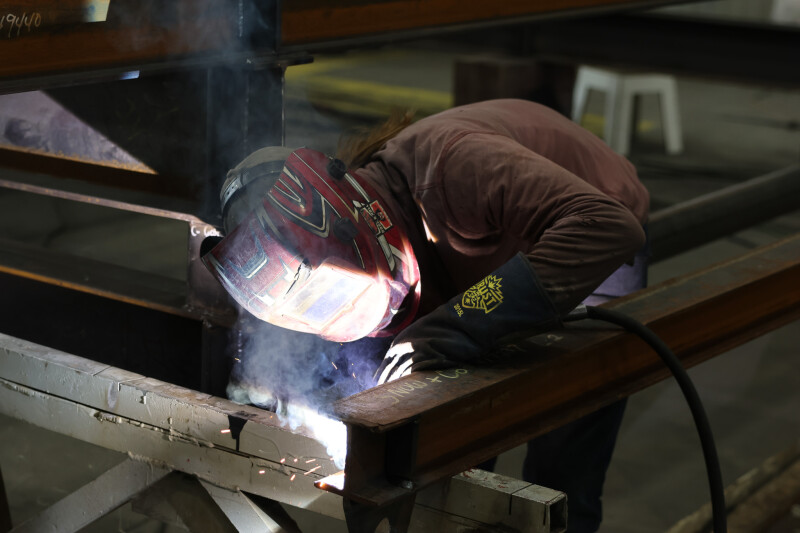
Rove is not meant to replace human workers or even help shipyards cut costs. Its purpose is to allow shipbuilders to keep pace with demand, said Andy Lonsberry, CEO and cofounder of Path Robotics.
“It’s not really about ROI but unlocking capacity at a time when hiring welders is impossible,” Lonsberry said. “This delivers capacity, at a similar price point to hiring humans, so you can finally get the capacity you need.”
Asked about the types of welds Rove can perform, Lonsberry said, “We’re designing it to handle the common welds in shipbuilding. We have more to learn here.”
The solution can handle surface irregularities, vibration, and environmental conditions common in shipyards. “This is exactly what Rove is designed for. It adapts in real time to the conditions in front of it to deliver quality welds,” Lonsberry said.
“While slower than our traditional cells, Rove is designed for flexibility over speed,” Lonsberry continued. “[Weld speed] very much depends on the application.”
Rove is intended to be a set-and-forget option working alongside human shipbuilders.
“Battery life will not be a limitation. The dog is wired to an autonomous mobile robot that carries the ancillary equipment,” such as welding power supply, computer, etc., “that will also be able to power Rove,” Lonsberry said. “Once working, Rove works fully autonomously.”
EARLY ADOPTERS
Path unveiled Rove in April alongside an early adopter program for manufacturers that will help it to fine-tune the robot’s capabilities.
Saronic Technologies, Austin, Texas, a builder of autonomous vessels, has signed on as one of the first participants, integrating Rove into operations at its Franklin, La., shipyard. The company, which holds a $392 million production contract to supply the Navy with its 24' Corsair uncrewed surface vessels, has ambitious plans to scale, announcing plans in July to develop a $3 billion greenfield shipyard in Brownsville, Texas. Robotics will be integral.
Path declined to share Rove pricing but said it aims to deliver the first 50 units to early adopters in 2027.
“We’re talking with many shipyards about integrating Rove,” Lonsberry said.
Path also offers its physical AI solutions for nonquadruped welding systems and announced it tallied an order from LAD Services, Morgan City, La., in December 2025.
“The welding craft is aging, quality is under pressure, and skilled welders are getting harder and harder to find,” Joseph Crappell, general manager at LAD Services, said. “We reached a point where we simply could not make everything we needed to make with people alone.”
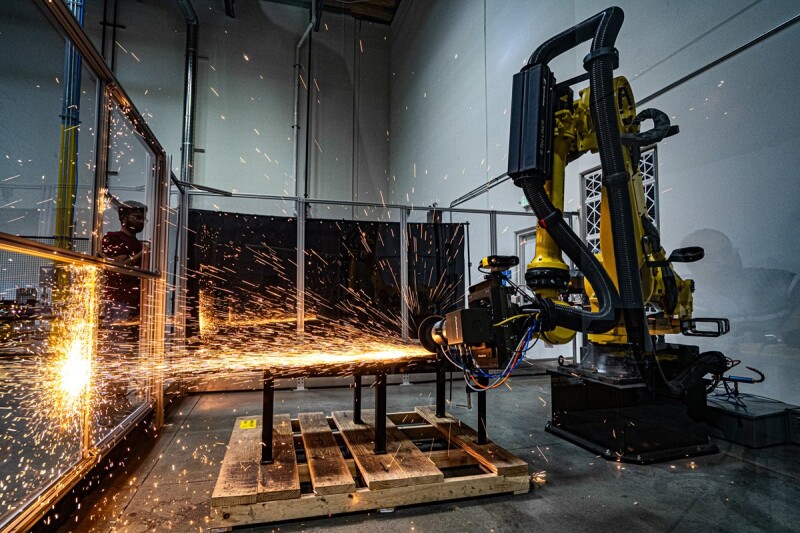
In February, Path signed a memorandum of understanding with the nation’s largest military shipbuilder, HII, Newport News, Va., to explore the integration of physical AI for welding. In April, the partners announced the High-Yield Production Robotics (HYPR) program alongside GrayMatter Robotics, Carson, Calif.
For HII, which has already observed the benefits of automated welding through the incorporation of robotic systems from Finland-based Pemamek into production at its Ingalls Shipbuilding yard in Pascagoula, Miss., the move is intended to augment the welding workforce, automate structural production, and accelerate throughput, the company said.
“This HYPR initiative will allow us to apply next-generation robotics to complex, variable shipbuilding tasks that have been difficult to fully automate,” Eric Chewning, executive VP of maritime systems and corporate strategy at HII, said in a statement.
“Teaming physical AI technologies together,” Chewning said, will “create fewer labor hours per hull, more predictable schedules, and a production model that can scale to meet the Navy’s generational demand signal.”
HII’s shipbuilding throughput was up 14% in 2025, and the company aims for an additional 15% increase in 2026, Chewning said.
BOTS ON THE BAYOU
South Korea-based HD Hyundai Robotics, a longstanding player in industrial robotics, is also making inroads in the U.S. shipbuilding industry, striking a deal in June to supply portable cobot arc-welding systems to four Chouest Group, Cut Off, La., shipyards, including three in the U.S. and one in Brazil.
The ArcLift GO cobot welding solution is built on the expertise HD Hyundai Robotics has accumulated over decades in shipbuilding and robotics. HD Hyundai Heavy Industries, the world’s largest shipbuilder and a sister company under South Korean parent HD Hyundai, has widely adopted robotic and cobot welding across its shipyards that collectively produce up to 100 ships per year.
The portable system is designed as a plug-and-play package, paired with operating software intended to let workers with little robotics background run multiple units at once and adapt them to different hull geometries and working conditions, said Jason Jin, senior sales manager at HD Hyundai Robotics USA Inc., Duluth, Ga.
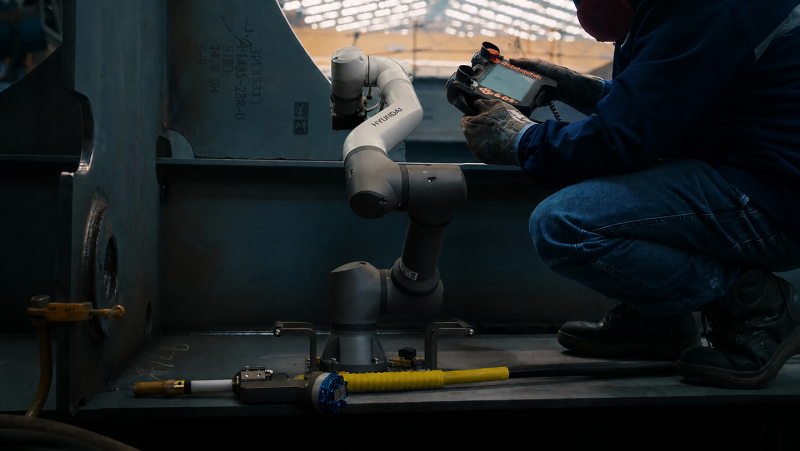
“Training an operator to use this system is greatly reduced. We can train an operator in a couple of days and only need base level information to program,” Jin said. “The time savings from the parametric programming give companies the flexibility to use robots in high mix, low volume applications.”
The Chouest order marked HD Hyundai Robotics’ first robotic welding contract with a U.S. shipyard and a foothold the company hopes to build on as it looks to expand further into the American commercial and military shipbuilding markets, Jin said.
“We’re really excited to be in the era of all those changes and modernization of U.S. shipyards,” he said, referencing signals from government, military, and commercial stakeholders to support industry modernization.
American shipbuilders have little choice but to embrace automation, Jin added. “The U.S. has to do it because you cannot run away from it,” he said. “It’s getting more and more difficult to find experienced welding people. And by using robotics, you also get quality because the welds are all consistent.”
HD Hyundai Robotics expects to make a broader push to reshape shipyard technology. In 2025, it unveiled plans to develop a humanoid robot for shipbuilding through a partnership with AI-based humanoid robot specialist Persona AI Inc., Houston, and robot engineering firm Vazil Co., Busan, South Korea.
