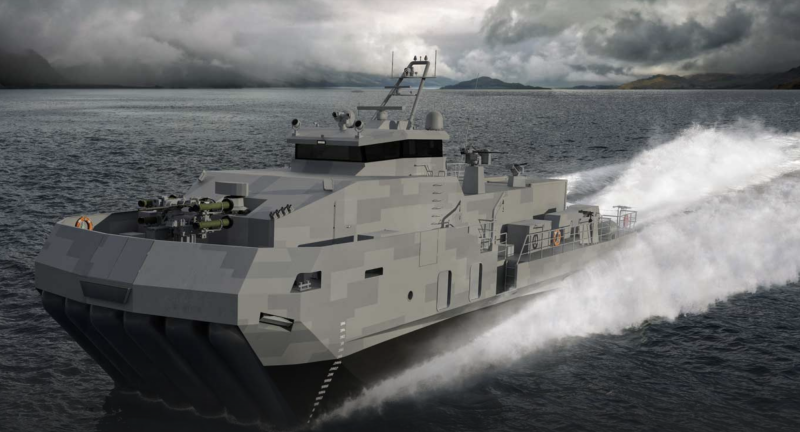
The Aircat Bengal surface effect ship can operate as a fully or semi-autonomous vessel, able to carry a 40-ton payload at top speeds over 50 knots. Eureka Naval Craft image.
Eureka Naval Craft, Houston, said Aug. 20 it plans to increase production of its Aircat Bengal MC warship design in Asia, after signing an memorandum of understanding with Singapore shipbuilder Strategic Marine (S) Pte Ltd.
Eureka CEO Bo Jardine said the partnership is aimed at bringing a highly advanced Modular Attack Surface Craft (MASC) to the U.S. Navy and allied navies quickly at a time of increased threat. The company says its catamaran vessel design can be adapted for the commercial offshore industry as a workboat.
Eureka Naval Craft, Houston, said Aug. 20 it plans to increase production of its Aircat Bengal MC warship design in Asia, after signing an memorandum of understanding with Singapore shipbuilder Strategic Marine (S) Pte Ltd.
Eureka CEO Bo Jardine said the partnership is aimed at bringing a highly advanced Modular Attack Surface Craft (MASC) to the U.S. Navy and allied navies quickly at a time of increased threat. The company says its catamaran vessel design can be adapted for the commercial offshore industry as a workboat.
“By joining forces with Strategic Marine, we are combining American innovation with Singaporean shipbuilding excellence to meet the needs of navies worldwide,” said Jardine. “The Aircat Bengal MC’s modular payload system, large aft deck range, and speed ensure it is at the forefront of maritime technology, ready to adapt to the ever-evolving threats and mission requirements. Our collaboration demonstrates the value of U.S.-Singapore cooperation in driving innovation, strengthening supply chains, and supporting regional security. We are proud to contribute to the U.S. DoD and U.S. Navy’s vision for a more innovative, autonomous, and collaborative maritime force."
“Our Singapore shipyard is equipped with the latest technology and staffed by a highly experienced team, enabling us to deliver complex vessels quickly and at scale,” said Chan Eng Yew, CEO of Strategic Marine. “This partnership not only benefits our companies, but also contributes to the broader economic and security interests of both Singapore and the United States, while supporting allied and partner country collaboration in the Indo-Pacific."
“The reality is the naval market in this weight class needs disrupting,” said Jardine. “Too many vessels today are outdated, sluggish, and expensive. The Aircat Bengal MC provides an alternative to naval corvettes and frigates, thanks to its optimized design and use of modular construction techniques…the vessel is so versatile it can be used as a troop transport vessel, landing support craft, electronic warfare platform, drone mothership and for mine laying and counter-mine warfare.”
Jardine said Eureka is in talks with U.S. shipyards and Navy to build Aircat vessels in the United States.
The shipbuilding MOU will also have an Australia-U.S. dimension via Eureka’s partnership with Australian defense company Greenroom Robotics. Jardine said the Aircat Bengal has an advanced autonomous navigation systems, deploying the Greenroom Advanced Maritime Autonomy (GAMA) Software system. Greenroom has spent years developing the system, notably on a 57-meterdecommissioned Armidale-class patrol boat, Sentinel, known as the Patrol Boat Autonomy Trial (PBAT).
Jardine said the MOU will further see the Aircat Bengal vessels adapted for the commercial offshore oil and gas sector, taking advantage of the vessel’s ability to move items offshore and provide a fast, safe alternative for personnel transfer as key advantages.