



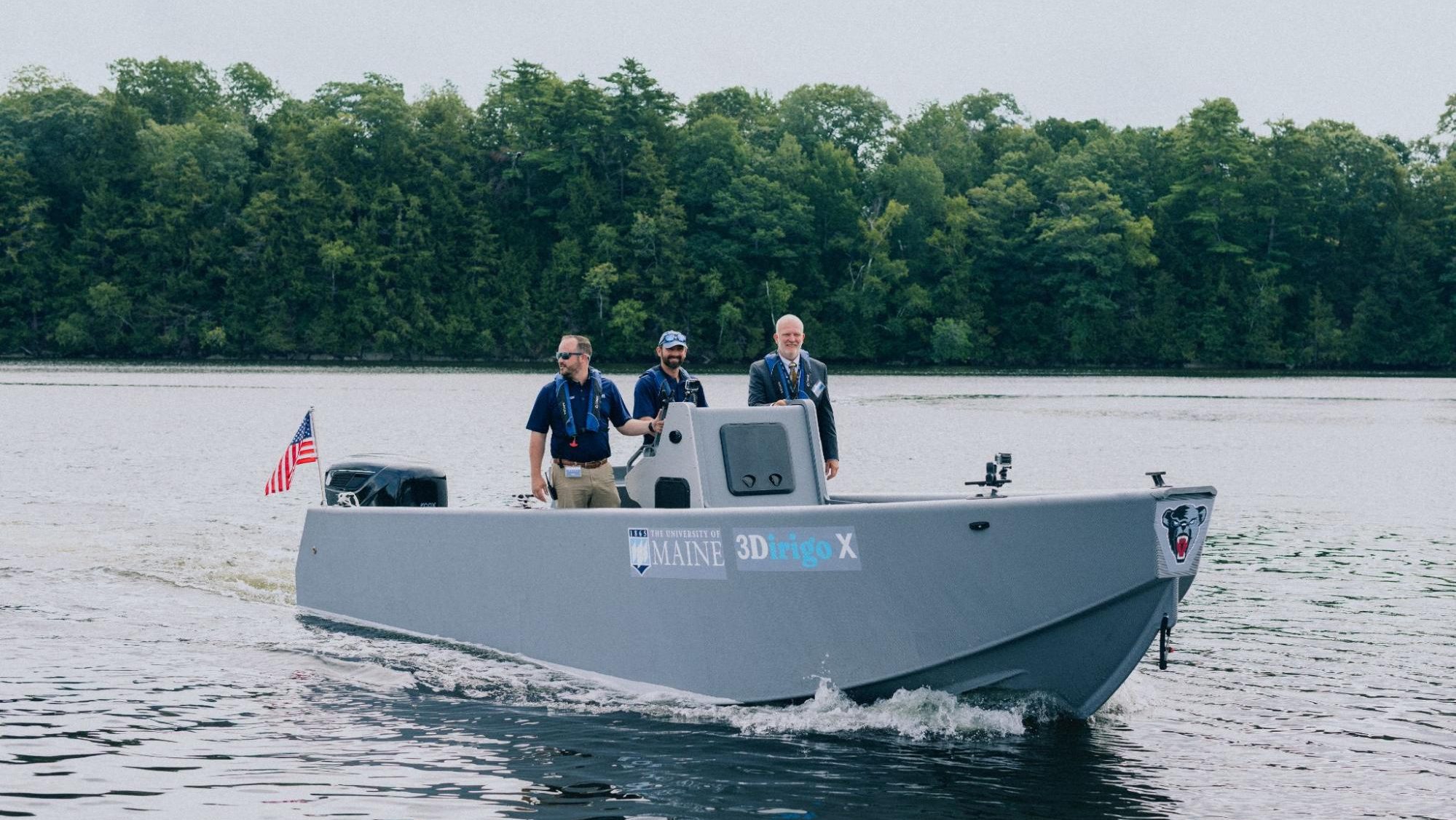
Researchers at the University of Maine launched a 30’ boat produced by 3D-printing that they say can handle offshore wind and sea conditions approaching 40 knots.
The 3Dirigo X may show how manufacturers can “build vessels faster, cut the need for expensive molds and adapt designs more quickly for commercial and defense use,” according to the builders at UMaine’s Advanced Structures and Composites Center.
The Aug. 28 launch “marked a major step in moving large-scale 3D printing from a technological demonstration toward a practical manufacturing tool,” they said.
The launch at Hampden was hosted by UMaine administrators including chancellor Dannel Malloy, president Joan Ferrini-Mundy and Habib Dagher, executive director of the Advanced Structures and Composites Center. Guests included Sen. Susan Collins, R-Maine and Keith DeVries, Manufacturing Technology director at the Office of the Secretary of Defense.
3Dirigo X builds on UMaine’s original 3Dirigo, unveiled in 2019. That vessel demonstrated that a boat of its size could be produced using large-scale 3D printing and earned three Guinness World Records.
The new vessel goes further, with engineering designed for higher speeds and the forces of offshore operation.
“What’s different today, again, is the fact that we can model and design vessels,” Dagher said. “We have developed technologies to design vessels that can withstand the kinds of extreme environments in the open ocean. Today is a big milestone for our research and development projects. There is more work to do to continue to optimize the manufacturing process and the material properties.”
UMaine researchers also have made the manufacturing process much faster. The printing rate has increased from about 20 pounds per hour when the research began to about 500 pounds per hour today, while improvements in composite materials, digital design, sensors and process controls have helped shorten production timelines. Because designs can be changed digitally, the same equipment can produce different hulls and components without requiring a new mold for each one.
UMaine is also preparing to open its Factory of the Future within the new 55,000-square-foot GEM facility, which will further expand the university’s large-scale additive and convergent manufacturing capabilities.
“The Factory of the Future will allow us to significantly expand our capabilities and reach a deposition rate of 1,000 pounds an hour,” said Dagher, acknowledging the federal backing that helped move the project forward.
“We’re grateful for Senator Collins’ support in helping make this facility possible,” he said.
Collins said the launch shows the potential of that research for U.S. manufacturing and national defense.
“This really is a great day for the University of Maine, for American manufacturing and for our national security,” she said. “Three Dirigo X represents Maine ingenuity at its best — practical, innovative, forward thinking, hard working and focused on solving problems of national importance.”
The technology could have applications beyond commercial boatbuilding, including unmanned vessels, patrol craft, logistics vessels, sensor platforms, replacement components and other specialized systems. Digital designs also can be modified for different missions or operating environments without first building new molds and tooling.

3Dirigo X was developed through the federally funded Accelerated Rapid Prototyping initiative, which has brought UMaine together with national defense research organizations, national laboratories and industry partners to advance large-scale manufacturing technology.
DeVries said digital manufacturing allows engineers to learn from each build and improve future designs.
“Digital manufacturing allows us to build the digital twin,” DeVries said. “It enhances our design cycle. It enhances our test modeling and iteration so that the next copy is that much stronger than what we had today.”
He emphasized that the launch is another stage of development rather than the end of the research.
“This is not a finish line,” DeVries said. “This boat just started a new journey, being run through its paces to evaluate its suitability in the waters of the Atlantic, its ability to stand up over time, over stress. Those things need to be evaluated. We need to understand what this means and feed that back into our models.”
Moving from a successful prototype to widespread use will require the technology to be repeatable, inspectable and affordable. The goal is not to replace traditional shipyards or skilled workers, but to provide another tool that could reduce reliance on specialized molds, speed design changes and expand production capacity.
The project also gives UMaine students hands-on experience with advanced manufacturing technologies, digital design, material science and AI while working alongside researchers.
The Advanced Structures and Composites Center has employed more than 3,000 student interns over the years, reinforcing the university’s learner-centered R1 mission by giving students hands-on research and workforce experience.
“Students are working alongside world-class researchers on technologies that have real-world implications, and they earn their degrees along the way,” Ferrini-Mundy said. “Experiences like this prepare the engineers, scientists, innovators and manufacturing leaders that Maine and the nation need.”
That combination of research, technology and workforce development also has implications for Maine’s economy, where manufacturers can face high costs, long lead times and demand for workers with advanced technical skills.
“The work that you are doing, those of you who are here today, really is quite remarkable,” Malloy said. “It reminds the people of Maine, the people of New England, the people of the nation, about how important our institution is, and how we can contribute to the safety of our forces, how we can make sure that Maine has the people who will drive the economy going forward.”
