



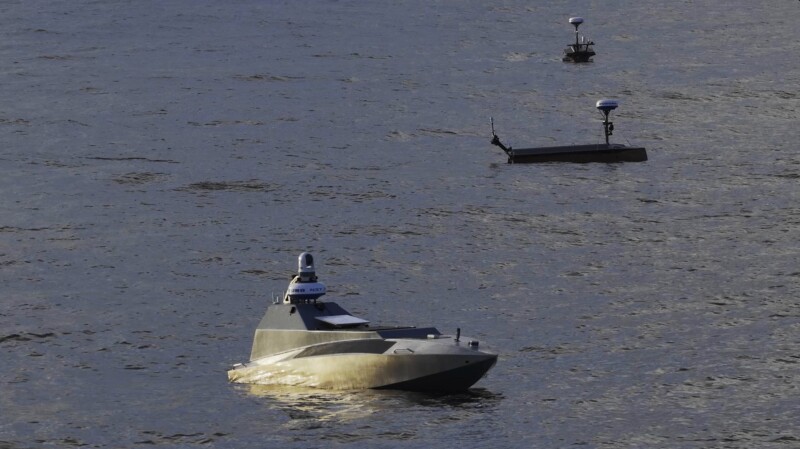
Seasats, San Diego, Calif., reported that its high-speed Quickfish unmanned surface vehicle (USV) completed an eight-day continuous sea trial, demonstrating extended endurance capabilities aimed at defense and security operations.
The company said the trial validates Quickfish’s ability to remain on station for prolonged periods. The interceptor-class vessel is designed to reach speeds exceeding 35 knots while maintaining endurance measured in weeks, enabling pre-positioning for missions including port security, border protection, and coastal defense.
Since its unveiling in October 2025, Quickfish has undergone a series of offshore tests and customer exercises focused on autonomy, safety systems, and operational reliability. According to Seasats, the platform incorporates a hybrid propulsion configuration, pairing low-speed electric propulsion for loitering with a high-speed jet drive for sprint capability.
The vessel also includes a payload bay designed to deploy unmanned aerial vehicles, expanding its operational flexibility beyond traditional surveillance or strike roles.
“The Quickfish was a natural extension of our proven Lightfish USV. It's built to provide the persistence that our customers require. Solving the persistence problem is a critical piece for moving these vehicles beyond one-way attack missions and into a wider range of maritime operations,” said Mike Flanigan, CEO and founder of Seasats.
Interest in USVs has accelerated in recent years, driven by evolving naval strategies and operational use cases. Conflicts in the Black Sea and Red Sea, along with procurement efforts in the Indo-Pacific, have highlighted both the effectiveness and limitations of small, unmanned platforms, particularly their restricted endurance.
Seasats said it has worked to address those constraints, citing prior long-range transoceanic USV operations and recent contract awards supporting U.S. military programs. The company received an $89 million SBIR Phase III award in 2025 tied to U.S. Marine Corps USV initiatives, followed by a $24 million APFIT contract in 2026.
“Reliable, scalable USVs are going to be key for U.S. and allied maritime defense. Quickfish will play a big part in that,” Flanigan said.
