



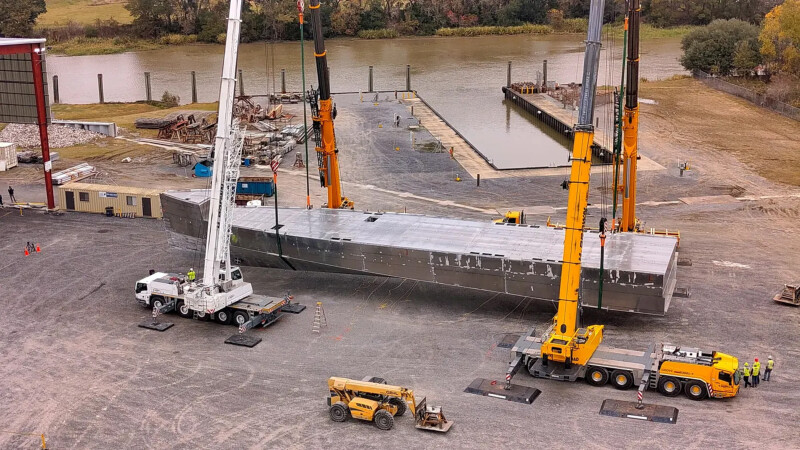
Saronic Technologies, Austin, Texas, this week completed the hull flip of its first Marauder uncrewed surface vessel at its shipyard in Franklin, La.
The hull flip is a milestone in the ship's construction, marking the transition from early structural build to a platform ready for outfitting and systems integration, the builder said.
The Marauder moved from initial design to full structural completion in six months. Following the hull flip, the completed aluminum vessel is expected to enter waterborne testing in the coming months as it advances to the next phase of development.
“This milestone reflects the extraordinary work of our team and the speed at which they are bringing an entirely new class of autonomous ships to life,” said Dino Mavrookas, co-founder and CEO of Saronic Technologies. “Designing, constructing, and launching a large autonomous vessel in this timeframe shows what we can achieve when the right processes and world-class talent align.”
Saronic, which acquired the Franklin shipyard from Gulf Craft in April, said the shipbuilding team there has completed more than 60 hull flips over the past 30 years. The company announced earlier this month that it will invest $300 million to expand capacity at the site.
Saronic operates as a software-driven maritime technology company, combining autonomy development with in-house ship production. According to the company, this integrated approach enables faster iteration of vessel designs compared with traditional shipbuilding models.
The Marauder is Saronic's first vessel of its size designed from the keel up to be fully autonomous, the company said. It offers a payload capacity of 40 metric tons and can travel up to 3,500 nautical miles or loiter for over 30 days. According to the company, the platform is engineered for a wide range of mission types and aims to deliver advanced capability at lower cost compared to traditional manned ships.
Demand for autonomous surface vessels is rising as military and maritime operators seek persistent surveillance, logistics support, and force-multiplying capabilities without risking crews or incurring the full cost of manned ships.
A second Marauder vessel is already in production, with Saronic reporting a 25% gain in production efficiency based on lessons learned from the first.
A third Marauder vessel, planned to begin construction in January 2026, is expected to incorporate an evolved 180' design intended to increase operational reach, payload capacity, and mission flexibility.
