



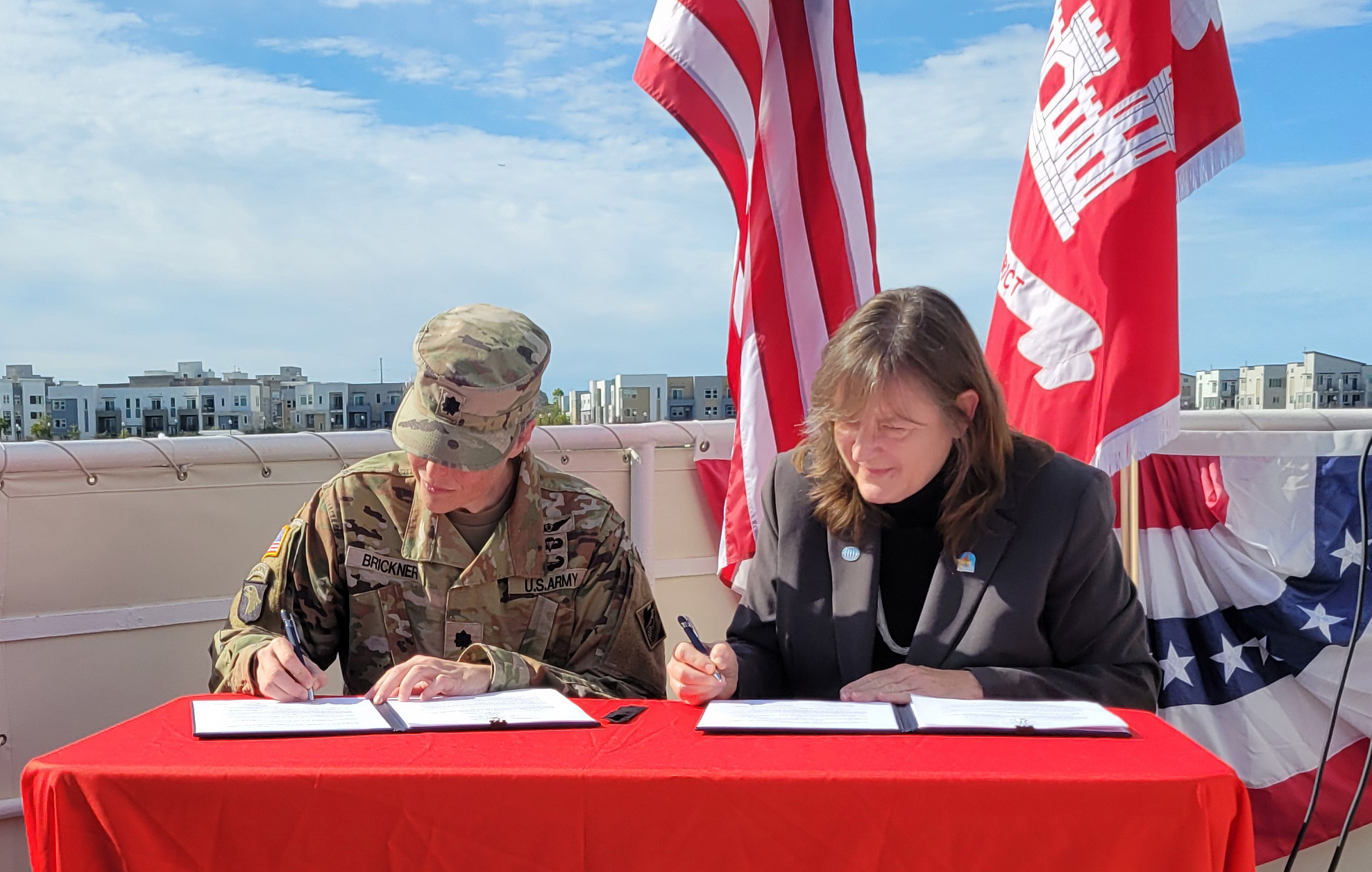
Officials from the Port of Oakland, Calif., and the U.S. Army Corps of Engineers' San Francisco District gathered recently aboard the USS Potomac to sign the design agreement for the Oakland Harbor Turning Basins Widening Project.
With the design agreement in place, the $642 million project to widen Oakland Harbor's inner and outer turning basins can now proceed. The study for the widening project began in 2020, and the Corps is targeting 2030 for completing the work.
"Investing in critical infrastructure today ensures Oakland remains a competitive port city for generations to come," said Kristi McKenney, executive director of the Port of Oakland. "Larger vessels and taller cranes are the lifeline to our regional economy, and we're grateful our partners at the Army Corps of Engineers share our vision for a more prosperous, efficient, and safer future."
The Corps deepened Oakland's harbor from 42 feet to 50 feet in 2009. As ships calling on the port have grown over the years, and as the port installed 440-foot-tall ship-to-shore cranes in July, Oakland Harbor's restrictive turning basins spurred interest in widening them. With the turning basins' current dimensions, many of the larger ships calling on Oakland terminals have as little as 150 feet of clearance when maneuvering in the turning basins.
“If we look back, it has really been an enormous lift by so many people moving us through the early stages of the planning process to a signed chief’s report in 2024 to today’s design agreement to the investment we will see for decades to come,” said Lt. Col. Virginia Brickner, commander of the San Francisco District. “We will ensure taxpayer dollars are spent delivering results rather than unnecessary process, something our assistant secretary of the Army for civil works, Mr. Adam Telle, has been championing through the Building Infrastructure, Not Paperwork initiative."
The San Francisco District is using a design-build strategy, as opposed to a design-bid-build strategy, in order to accelerate contracting timelines and get dredging contractors on site sooner.
The project design calls for widening the inner turning basin 334' to a total of 1,834' and the outer turning basin 315' to a total of 1,965'. According to the Corps, a portion of the dredged material from the project will be used beneficially for marsh creation in the area.
Maj. Gen. Jason Kelly, deputy commanding general for civil and emergency operations for the Corps of Engineers, said the project will pave the way for sustained success at the Port of Oakland. “Oakland Harbor is a critical node in our nation’s supply chain. Today, we take the next step in ensuring it remains a powerhouse of American commerce for decades to come."
