


The Pacific Northwest is home to a mix of large repair yards, boatbuilders, and new entrants seeing increased activity tied to Navy modernization work, Coast Guard fleet recapitalization, and new private investment. From a startup shipbuilder occupying a former World War II yard outside Portland, Ore., to established boatbuilders delivering specialized vessels for the Coast Guard, companies across the region report growing backlogs and expansion plans.
The activity across these shipyards points to a region positioning itself for a larger share of the nation’s shipbuilding and repair work. The Pacific Northwest’s existing industrial base, composed of drydocks, fabrication facilities, and a workforce with decades of experience in complex vessel construction and repair, is drawing renewed attention as the Navy and Coast Guard look to expand capacity outside the traditionally dominant Gulf Coast and East Coast yards.
That attention is showing up in concrete terms with new ownership and technology investment at Vigor Marine Group, a startup filling out a Kaiser-era yard at New Pacific Industrial, specialized newbuild contracts at Rozema Boat Works and North River Boats, and infrastructure work at Cape Disappointment tied directly to the vessels those yards are producing. Whether that momentum continues will depend in part on factors outside any single company’s control: federal budgets, contracting timelines and the pace of the broader shipbuilding buildout nationwide. For now, the companies interviewed for this story describe a region with more work in front of it than it has seen in years.
NEW ENTRANT, OLD FACILITY
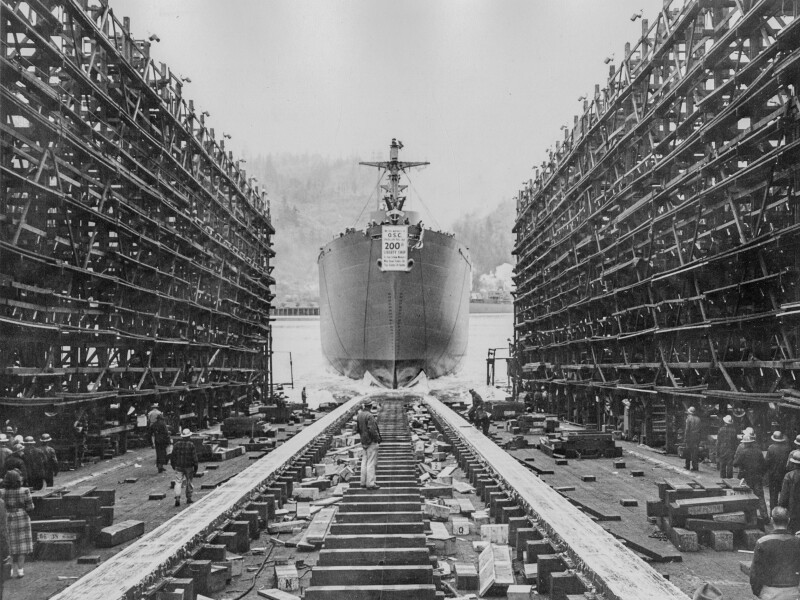
New Pacific Industrial, Portland, Ore., occupies a facility that was one of the Kaiser Co.’s three Portland-area shipyards during World War II, when the site produced escort carriers and Liberty ships. The company, founded by CEO Joe Corvelli, CCO Pete Roney, and COO Chris Palmer, is in its early stages but has already secured its first newbuild contract.
“We’re in what essentially is a 220-plus-acre shipyard that... was part of supporting the Pacific Fleet,” Corvelli said. “Escort carriers came out of these buildings that we’re in.”
Corvelli said the company will reuse existing industrial infrastructure rather than build new capacity from scratch.
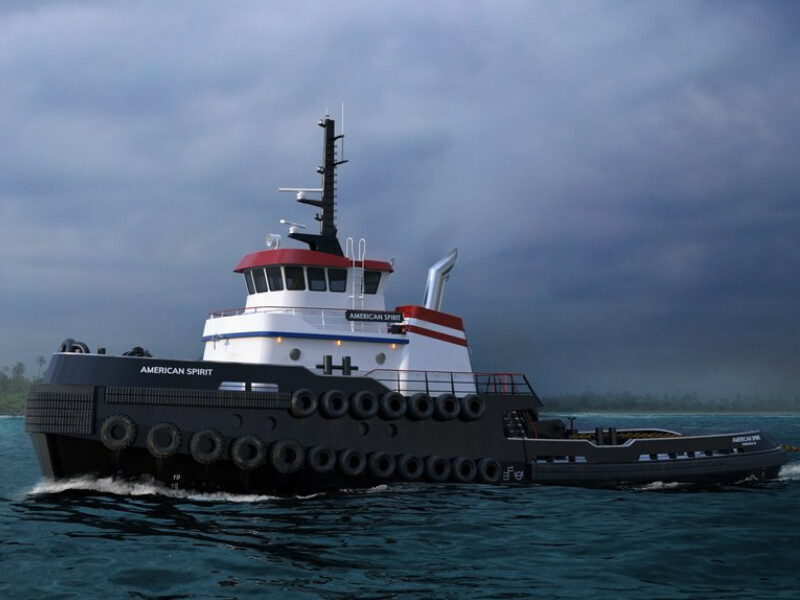
New Pacific’s first contract is for two 122' oceangoing tugs for American Marine Corp. Roney described the arrangement as a design-build partnership rather than a traditional fixed-spec bid process.
New Pacific currently has fewer than 20 employees and expects to reach more than 30 by the end of the year, with a goal of more than 100 once the facility reaches capacity.
Beyond the initial tug contract, Corvelli said the company is structuring its leadership and engineering teams around capabilities beyond standard commercial construction, with an eye toward supporting the defense industrial base. “We’re building the project, the project management, the engineering management, the technical leadership team to have capabilities greater than… standard commercial construction,” he said.
That effort includes direct outreach to the Navy. Corvelli said the company has made repeated trips to Washington, D.C., to make its capabilities known to Navy leadership as the service seeks new sources of production capacity. “We’ve been regularly in D.C. and telling the Navy, ‘Hey, we’re here. You’re asking for new capacity. We’re here and we’re ready to support,’” he said. He noted that building out the quality-management systems and operating track record needed to take on defense work will take time, but said the company isn’t waiting for contracts to come to it.
As New Pacific looks beyond the American Marine tug contract, Roney said the company is pursuing work on “long, large, complex, welded, and assembled structures,” a tagline description Palmer uses to capture opportunities beyond complete vessels.
Corvelli said New Pacific sees no upper limit on the complexity of work it could eventually pursue, including module construction for large Navy shipbuilding or submarine programs, though the near-term focus remains on the tugboat contract and building out the yard’s workforce and systems.
As for the opportunity, Corvelli recalled a comment from a Pacific Fleet admiral at a commissioning ceremony for the new Dry Dock 5 at Pearl Harbor, where Corvelli was working in a prior role. “He said, ‘This is the Pacific century,’ from a Navy perspective. Everything is about…where the capability is going to come from for the Pacific, and how the capability is going to be supported in the Pacific,” Corvelli said. “And so, you know, for us, boy, what opportunity.”
NATIONWIDE FOOTPRINT
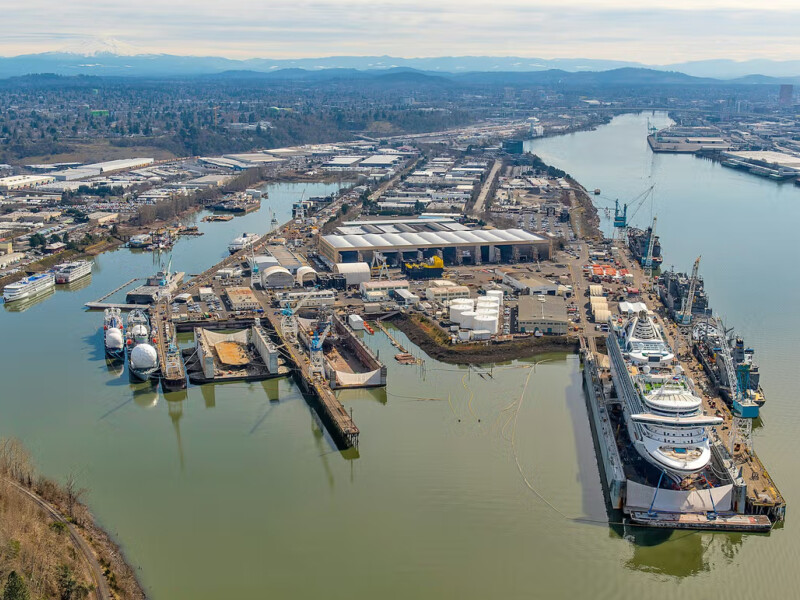
Vigor Marine Group operates four repair yards — Swan Island in Portland, Ore.; a Seattle facility; the former Continental Maritime San Diego shipyard; and the former MHI Norfolk shipyard in Norfolk, Va. — along with a fabrication facility in Vancouver, Wash., and two services companies, Accurate Marine and Vigor Services Seaward.
The Swan Island facility employs roughly 1,000 people. The Seattle yard, which is about half that size, carries a heavier share of Navy work, according to Benton Strong, Vigor’s public affairs director.
Current work includes modernization availabilities on the destroyers USS Kidd and USS Sampson and the littoral combat ships USS Gabrielle Giffords and USS Savannah, split between the Northwest yards. Vigor recently completed work on the Coast Guard icebreaker Healy in Portland, and the Polar Star was pierside in Seattle at the time WorkBoat went to print.
“The biggest kind of new and growing area is the modernization programs,” Strong said. “There is work to modernize these vessels because it’s faster and a bit cheaper to modernize an existing vessel if you’re trying to grow the fleet.”
Vigor’s Seattle yard also performs regular work for Washington State Ferries, including a hybrid-electric conversion completed last year. Strong said the company works with the ferry system to accommodate emergent repair needs alongside Navy and Military Sealift Command priorities.
“We have a long history with Washington State Ferries. We built half the fleet,” Strong said. “We are proud to be able to support WSF in scheduled availabilities and with emergent repair.”
In August, Paris-based private equity firm Antin Infrastructure Partners acquired Vigor from an affiliate of Lone Star Funds, Dallas. Financial terms were not disclosed.
Strong said the new owner recognizes the importance of continuing to invest in the technology and facilities required to operate a “world-class shipyard.”
The company is also finalizing a joint development agreement with Samsung Heavy Industries covering technology exchange, potential repair collaboration and a planned workforce training center likely to be sited in Seattle.
CEO Francesco Valente, who entered the role two years ago, said the company’s focus on maintenance and modernization sets it apart among major ship repair companies.
“Vigor Marine Group is the only one of the major ship repair companies with a main focus on maintenance and modernization,” Valente said. “Our commercial mindset means we can deliver for our customers by using the deep expertise we have gained to anticipate their needs and provide solutions before issues arise. This has enabled us to complete nearly every Navy availability on time over the last decade.”
Valente pointed to specific technology investments the company has made to support that work, including ultra-high-pressure paint removal, 3D scanning, and increasingly automated processing with a recent focus on how it generates, moves, and manages production data. “We have focused on how we generate, move, and manage data more efficiently to improve planning, manage change faster, and provide better information to our production workforce at the point of execution,” Valente said.
Valente also said that reforming the Navy’s contracting model through multiyear awards or bundling multiple vessels into single packages would support better planning and greater investment in facilities and workforce over time.
COAST GUARD BOATS
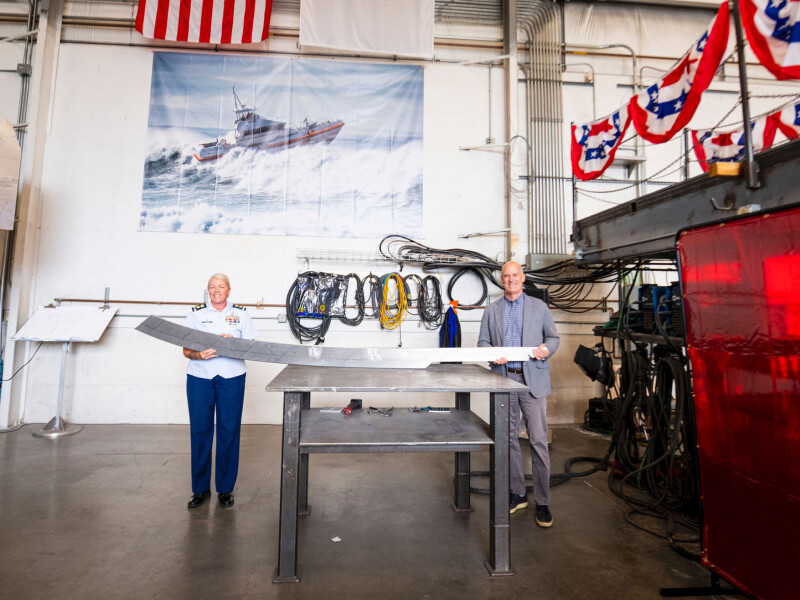
Rozema Boat Works, Mount Vernon, Wash., held a keel-laying ceremony in July for the first vessel in the Coast Guard’s Special Purpose Craft-Heavy Weather 2nd Generation (SPC-HWX II) program. The 64' boats are designed to replace the Coast Guard’s 52' heavy-weather boats, which served from the 1950s until their retirement in 2021.
The Coast Guard’s contract with Rozema is worth up to $70.9 million for as many as six vessels.
Designed by Camarc Design, Chichester, England, the SPC-HWX II features a self-righting hull rated for 35' seas, 25' surf, and winds up to 60 knots. Twin 1,200-hp diesel engines will give the boats a top speed of 20 knots and a towing capacity of up to 300 tons, with a 150-mile offshore range and accommodations for a relief crew supporting missions of up to 48 hours.
Delivery of the first vessel is scheduled for 2027. All six boats will be homeported in the Pacific Northwest.
North River Boats, Roseburg, Ore., was awarded a fixed-price, indefinite-delivery, indefinite-quantity contract in September 2025 for up to 66 Cutter Boat-Aids to Navigation-Small (CB-ATON-S) vessels. The contract, valued at approximately $11.8 million, was issued as a total small-business set-aside.
The 21' aluminum monohull boats, powered by twin four-stroke Honda 60-hp outboards, will deploy with the Coast Guard’s future Waterways Commerce Cutters (WCC) and support shore-based aids-to-navigation teams. The CB-ATON-S will serve as the standard cutter boat across all three WCC variants: river buoy tenders, inland construction tenders and inland buoy tenders. The cutters are replacing an aging fleet of inland tenders, some more than 70 years old, that maintain more than 28,000 aids to navigation across 12,000 miles of inland waterways.
Mike Blocher, North River’s director of sales, said the structure and pace of the 66-boat award fit the company’s approach to government work.
“We don’t generally go after large contracts. We’re not the company that looks for a 100-boat contract from the Navy,” he explained. “This contract is, one, a repeat contract for us, and two, it spans multiple years. So, it’s 66 boats, but it’s over five or six years. It’s roughly 10 boats a year after it gets rolling, so it’s not a big demand on our production schedule.”
“This is the only government-furnished equipment that the government is supplying to the shipbuilders for the WCCs,” Blocher said. “The cutter program is being watched pretty closely, and we have to be on schedule for them to stay on schedule.”
Brent Hutchings, North River’s CEO, said nine Coast Guard representatives attended the prototype’s sea trial. North River has completed its first prototype and is preparing to build a second before full production begins. “Fortunately, we’re ahead of the cutter boat schedule, so we’re in good shape,” Hutchings said.
CAPE DISAPPOINTMENT
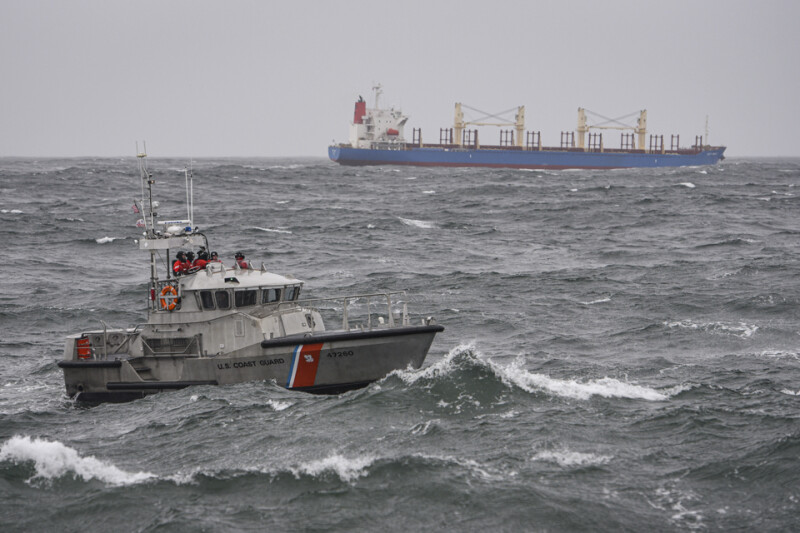
Coast Guard Station Cape Disappointment, Wash., and the National Motor Lifeboat School sit at the mouth of the Columbia River, a location U.S. Coast Guard Cmdr. Brett Ettinger described as critical to both the region’s commercial maritime economy and the Coast Guard’s broader mission set.
“The money being invested in our ashore and afloat infrastructure really supports our regional maritime economy and specifically that lower Columbia River maritime transportation system,” Ettinger said. “It also provides us that jump-off point, not just for search and rescue, which has and always will be a bread-and-butter mission of the Coast Guard, but for all of the multimissions, whether it’s marine resources or maintaining border integrity and having a good jump-off point for our coastal sovereignty.”
The station and school are the subject of a multitiered infrastructure project being developed with the Army Corps of Engineers. The project, still in the design phase, includes long-term dredging solutions, new pile dikes, redeveloped in-water moorings, rebuilt boathouses, and shoreline stabilization to address erosion that has at times blocked access to the station’s boathouse.
“It’s a multitiered project revitalizing both Station Cape Disappointment and the National Motor Lifeboat School,” Ettinger said. He said the redeveloped moorings need to accommodate the station’s fleet of 47' motor lifeboats as well as future SPC-HWX II vessels under construction at Rozema.
Ettinger said the location’s role is tied to commercial traffic on the Columbia River, noting foreign trade and goods that pass the bar top $31 billion annually. “Having Station Cape Disappointment and our cutters at West Tongue Point...provides that safety net for the bar pilots, for the tugs, for the commercial fishing vessels, for the deep-draft vessels coming in and out of that port.”
Ettinger also said the new SPC-HWX II boats address a capability gap in the current 47' motor lifeboat fleet, which is limited to towing vessels up to 150 gross tons within 50 miles of shore. “If you’ve got a foundering fishing vessel well beyond 50 miles or greater than one hundred and fifty gross tons, our motor lifeboats are pretty limited in their ability to tow or support those vessels,” he said. “So we’ve got greater range with these bigger boats, greater crew longevity... which is a capability that simply doesn’t exist right now in the Northwest.”
He said the CB-ATON-S boats being built by North River will support the Coast Guard’s aids-to-navigation tender fleet on the river. “Having the ability to get into shallow water from a supported cutter on a river is hugely helpful to our ATON fleets,” Ettinger said.
