



The Pacific Northwest is a key hub of the U.S. maritime industry, home to dozens of small and large shipyards that support a diverse range of commercial and government customers. These include the nation’s largest ferry system, a significant portion of the U.S. commercial fishing industry, and much of the Navy’s Pacific fleet. The region also boasts deep expertise in naval architecture and shipbuilding.
GROWTH CURVE
Among long-tenured players in the region is Gunderson Marine & Iron, Portland, Ore., which opened as a repair yard in 1919. The company operates a 58-acre industrial waterfront facility — the largest side-launch shipyard on the West Coast — equipped for constructing large river and oceangoing barges as well as other types of steel vessels.
For many years, the facility was a leading builder of railcars, but its focus shifted back primarily to the marine business in 2023, when its owner, The Greenbrier Companies Inc., Lake Oswego, Ore., sold the site to Oregon Green Manufacturing LLC, a joint venture between Oregon manufacturers and businessmen Terrence Aarnio and Lee Burch, setting the company on a new growth course. The next year, Burch acquired full ownership of the shipyard, and he now serves as its president.
“Within the first six months that we were here, we got about $200 million worth of contracts, and it hasn’t slowed down,” said Burch. “Right now, we have about $150 to $160 million of backlog.”
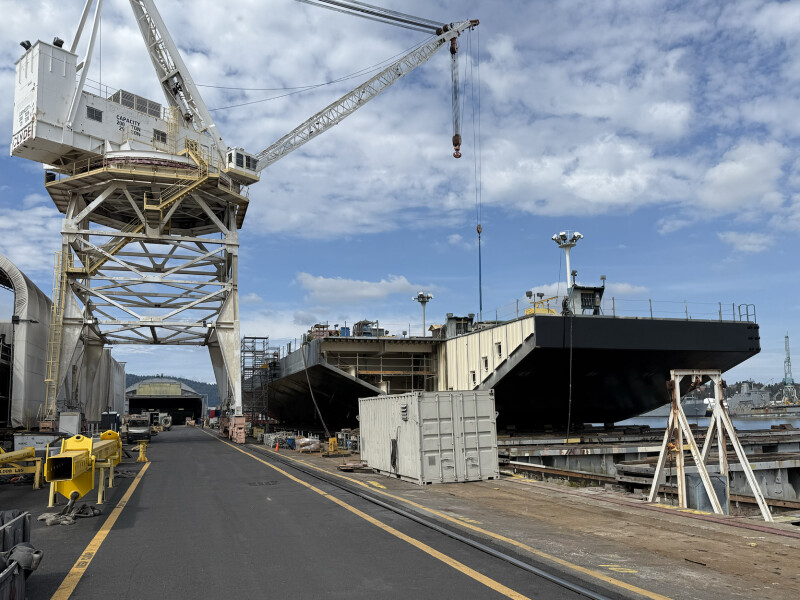
Under Burch’s leadership, Gunderson is investing in training, technology, and infrastructure to enhance its capabilities, with a new outfitting dock on track for completion next summer. “In order to keep the growth going and keep things moving, we’re investing a lot of money back into the facility,” he said.
“We have some welding automation currently that we’re trying to better utilize. We have a laser cutting machine that’s basically brand new — it’s top-notch technology… We always have our eyes open for the next opportunity. We’re looking at replacing some cranes in the next five years, too.”
The facility has produced nearly every type of steel structure imaginable, from bridges and buildings to World War II landing crafts, submarines, and even science stations, said Burch. “When rail came in and took over two-thirds of the facility, it got more specialized. Now we’re going back to that ability to build lots of different types of structures.”
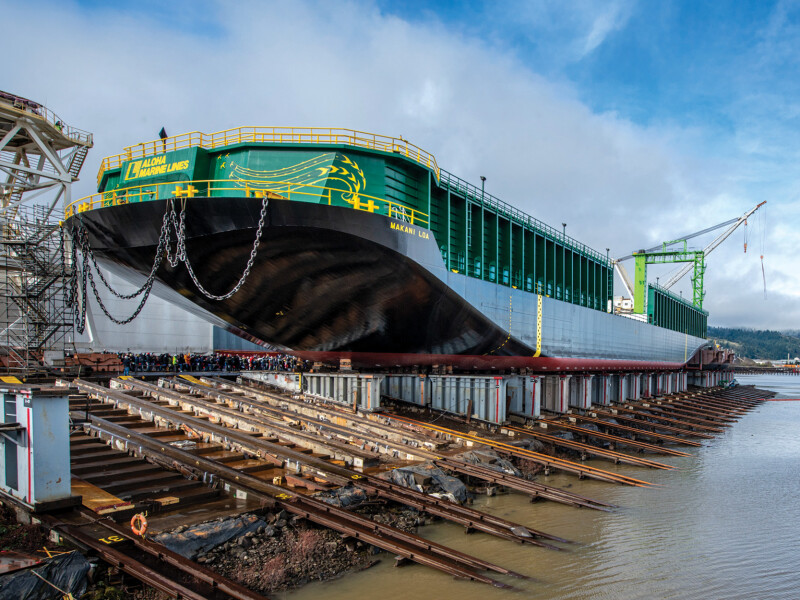
Notable marine builds in recent years include the Makani Loa, a 438'x105' deck barge for Lynden Aloha Marine Lines’ Seattle to Hawaii trade delivered in 2024, as well as the U.S. Navy Mobile Ship Target (MST) MST 2301, a target for missile testing and training, delivered this summer. It is currently constructing the NSF Discovery Pier, a specialized docking barge for the U.S. Army Corps of Engineers, destined for McMurdo Station in Antarctica.
“We’re finding ways to be competitive throughout the country, which opens up another level of diversity for us,” said Burch, noting that Gunderson has used its large panel line to maintain a stream of bridge construction work.
Gunderson has a full in-house team handling everything from engineering and design to production, covering all crafts, including steel processing, welding, painting, blasting, electrical work, pipefitting, and outfitting. “We’ve added a hundred people in the last two years, so we’re up to 375 or more,” said Burch.
The company’s workers can seamlessly transition between marine and bridge projects as the company adjusts its project portfolio based on market demand. “There were a lot of skeptics, people in the business, who said, ‘You can’t take rail people and have them be bridge builders. You can’t take barge builders and have them build a caisson. You don’t know what you’re doing,’” said Burch. “Our crews not only know what they’re doing, it’s amazing what they’re doing.”
A UNIQUE WAY TO BUILD
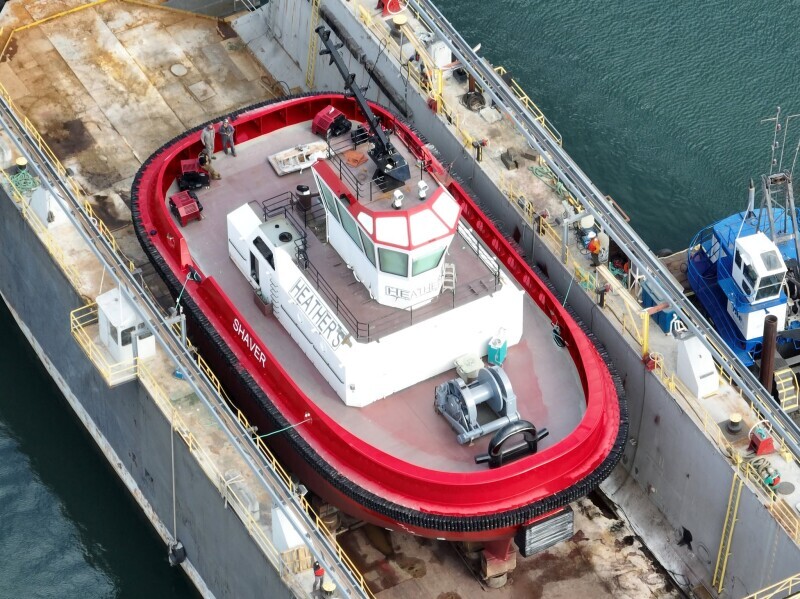
Diversification is a common theme among shipyards in the region. Nearby shipyard Diversified Marine Inc. (DMI), Portland, Ore., is a leading tug builder that has built vessels for many of the industry’s top operators over the past 40 years. Constricted to a footprint of less than an acre, the company has found new ways to succeed, building tugs on a floating drydock, for example.
DMI has recently partnered with Gunderson on tug projects, with Gunderson building the hulls and Diversified handling assembly and outfitting. “The model has been very successful for us,” said Frank Manning, DMI CEO. “It enables us to be more efficient and hopefully build more tugs.”
In July, DMI was acquired by private equity firm Bochi Investments LLC, Lake Oswego. The deal enabled founder Kurt Redd to exit the business, while Manning was promoted from president and COO to partner and CEO.
The move will enable DMI to explore new opportunities, said Manning. “We’re looking to expand both repair and newbuild activities, and then some vessel deconstruction as well,” he said. “We’re interested in taking on more backfilled projects internally with the capabilities and resources that Bochi brings to the table.”
DMI is currently building three tugs, including the Heather S, scheduled for delivery this year to Shaver Transportation Co., Portland, and two set for delivery in 2026 to Ursa Major Holdings LLC, Los Angeles.
NEWBUILDS IN THE MIX
JT Marine Inc., Vancouver, Wash., is looking to grow through diversification too. Known primarily for repairing tugs and barges, the family-owned company has also serviced fishing boats and Coast Guard cutters. Its marine division operates a fleet of tugs, barges, and floating cranes for local contractors.
“The current mix right now is pretty much 90/10 in terms of repair versus new construction and marine division income. We are shooting to get more into new construction. I’m hoping for a 50/50 split,” said Irene Toristoja, controller at JT Marine. “I think next year it will be 60/40.”
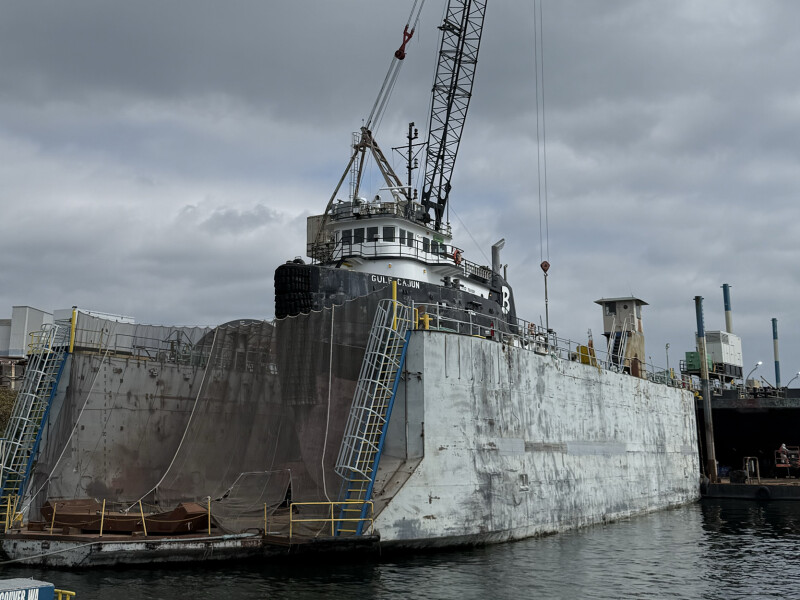
The company’s Vancouver facility houses three drydocks (600-ton, 1,200-ton, and 1,600-ton), with extensive waterfront access and covered fabrication and assembly areas. In 2021, JT Marine acquired the Foss shipyard in Rainier, Ore., giving it the capacity to take on additional work. According to Toristoja, the company is preparing for a range of newbuild projects that have not yet been announced. While tug construction is a goal, it’s not the top priority.
“The tug market is very competitive. Builders from the South can just close their eyes and build tugs at a cheaper rate than we can,” said Ariel Marquez, COO, JT Marine. “We’re trying to do a lot of one-offs, focusing on one-off research vessels, one-off complex fabrication. Facility-wise, we’re not set up for a multiple flow for a panel line to build over and over. We could get there if we get the right contract, but right now we’re better off and more competitive building one-offs.”
“You have to be flexible and be able to bend in the direction that the money is flowing,” said Toristoja, referencing the shift in how federal funding is being directed toward the maritime sector.
Today, many shipyards across the U.S. are pursuing new opportunities in government shipbuilding, such as constructing submarine and warship modules for assembly at larger yards, or producing large fleets of uncrewed surface vessels. JT Marine is also exploring these opportunities, Marquez said, but he noted that as more shipyards shift their focus to government contracts, new gaps are likely to emerge in traditional shipbuilding. “We have our eyes on those projects too,” he said.
‘COMMERCIAL DNA’
Vigor Marine Group, Portland, Ore., operates shipyards in Oregon, Washington, California, and Virginia and is positioning itself as a national leader in ship maintenance and modernization, particularly as the Navy looks to expand fleet readiness in the Pacific. Francesco Valente, a veteran shipyard executive who took over as CEO last year, said the company’s “commercial DNA” and deep technical expertise give it a unique advantage in meeting this critical demand.
“Vigor Marine Group is the only one of the major ship repair companies with a main focus on maintenance and modernization,” Valente noted. “Our commercial mindset means we can deliver for our customers by using the deep expertise we have gained to anticipate their needs and provide solutions before issues arise. This has enabled us to complete nearly every Navy availability on-time over the last decade.”
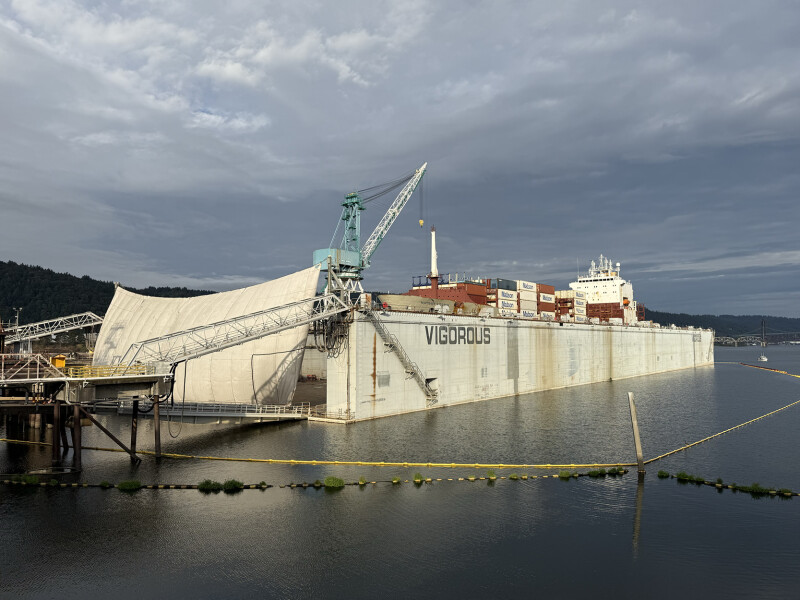
Valente emphasized that the fastest and most efficient way to meet fleet expansion goals is to maintain and modernize existing vessels, and he noted that Vigor is equipped to lead this work. “We differentiate ourselves by being solutions-focused and innovative, creating new and better ways to support our customers more efficiently and effectively,” said Valente. “A key part of that effort is working closely with our customers to plan work in ways that support our ability to perform well, and give them certainty on schedule and cost.”
Valente sees reforming the contracting model as key to long-term success. Multi-year awards or bundling multiple vessels into one package would improve planning and support greater investment in people and facilities, he said.
Looking ahead, innovation remains central to Vigor’s strategy. The company is investing in areas such as light automation, data management, and unmanned systems. “We are facing a unique opportunity to modernize the shipbuilding and repair industries,” Valente said. “Vigor Marine Group is ready to lead that effort.”
REGULATORY BURDENS
The region is not without its challenges. Stricter environmental regulations and the higher cost of doing business are among the major obstacles, several shipyard officials told WorkBoat.
“The main challenge that we see is the cost of everything in this region. And it’s not pointing the finger at any particular person or agency,” said Toristoja. “In the Gulf Coast, you don’t have the regulatory agency from an environmental standpoint that we do. The yards down there aren’t held to the same standards for permitting, waste handling, pollution and really stewardship of the waterways and the lands that they serve. Not to say that they don’t have responsibility, but it’s not as stringent as it is up here. And that definitely drives up pricing.”
Daniel Zech, business development manager at All American Marine (AAM), Bellingham, Wash., shared a similar view. “Shipyards on Puget Sound face strict stormwater and permitting requirements tied to federal and state environmental laws, which drive up compliance costs and add lead time to facility improvements,” he said.
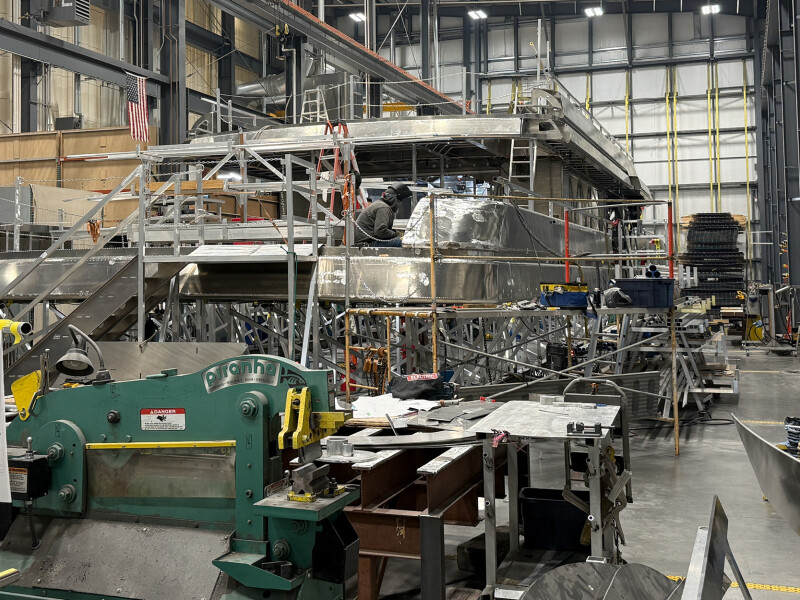
Asked about challenges of doing business in the region, Burch first praised the history and expertise of the industrial base. “No matter how much money you had, if you tried to rebuild this, you would really struggle,” he said. “The downside is the government regulation, the super high taxes, the lack of appreciation or consideration of businesses in general, and basically just kind of viewing businesses like ours as just cash machines to fund other government programs and not reinvest in the program here.”
Toristoja said that JT Marine has recently been more intentional about engaging with regulators and policymakers to help garner support for the region’s marine industrial base. “The marine community in the Pacific Northwest is extensive, but very small [compared with the Gulf]. And I think that we’re seeing a shift in that if we can come together, then as the harbor fills, we all float,” she said.
IT PAYS TO BE PROACTIVE
AAM, which holds contracts for passenger ferries, hybrid research vessels, tour boats, and patrol craft, takes a proactive approach to regulatory challenges as state and local mandates along the West Coast drive the shift to low- and zero-emission vessels.
“Downstream regulatory mandates, particularly from California’s Air Resources Board, require AAM to design vessels with Tier 4 engines, hybrid propulsion, or zero-emission platforms even before the market fully matures,” said Zech, who described the builder as a pioneer in alternative propulsion. “Because AAM has been an early mover on hybrid, battery-electric, and hydrogen propulsion, it is positioned ahead of less adaptable yards as a proven and repeat builder of these vessels… AAM is pursuing projects where efficiency, innovation, and alternative propulsion are not optional but essential.”
AAM is nearing completion of a 108'x32'6" parallel hybrid USCG Subchapter K vessel for Harbor Breeze Cruises, Long Beach, Calif., a versatile monohull designed for dinner cruises and whale-watching tours that meets California emissions standards. The company is also building the first battery-electric ferries for San Francisco Bay Ferry’s REEF program. In addition, AAM is constructing patrol vessels for the Los Angeles Port Police and Orange County Sanitation District, as well as new research vessels for UNC Wilmington and the University of Texas, following the January 2025 launch of Cal Poly Humboldt’s 78'x27'6" North Wind.
WORKFORCE WOES
A challenge faced by nearly all shipyards across the U.S. — not just those in the Pacific Northwest — is a prolonged shortage of skilled workers. “One of the biggest challenges remains workforce availability: skilled welders, fabricators, and marine systems technicians are in high demand, yet supply has not kept pace with industry needs,” said Zech.
It’s been a similar story for JT Marine. “Workforce has been the number one challenge,” said Toristoja. “Pre-Covid, you could put an ad in Craigslist, and you’d have 35 applicants. Of the 35, 20 of them would be qualified.”
Nowadays, shipyards aren’t having such success finding and retaining the workers they need. “I do see that [the situation] is just a little bit better — not much, but it is not getting worse.”
To tackle the skilled labor shortage, shipyards are investing in workforce development efforts, but the issue is far from resolved. “AAM and other regional yards have leaned into apprenticeships, maritime programs at technical schools, and on-the-job training to help address this pipeline gap, but competition for talent remains fierce,” said Zech.
Last year, Gunderson launched a training center with paid programs in basic metal fitting, welding techniques, and industrial safety. Trainees earn $19.95 per hour while learning, and those who complete the program are evaluated for full-time, living-wage positions as welders and shipbuilders.
Manning also emphasized the importance of developing the next generation of shipyard workers, noting that DMI has been reducing the average age of its workforce. By partnering with local schools like Portland Community College to shape maritime training programs, DMI has hired many young graduates — a large portion of its workforce is now under 20-somethings — reflecting a strong focus on attracting and developing young talent.
