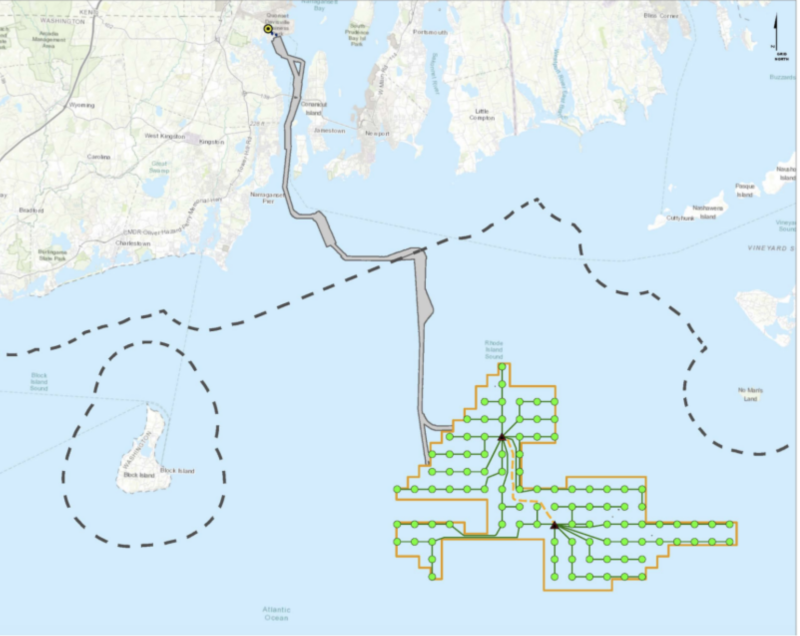

Boulder fields have strewn the sea floor off southern New England since the ice ages. Commercial fishermen have maneuvered around those obstacles for generations.
Now with offshore wind projects in the region, subsea cable installers have relocated some stones to make way – changing the bottom seascape and potentially creating new hazards for towed gear and access to traditional fishing grounds.
A new report from the Rhode Island Sea Grant Legal Program and the Marine Affairs Institute at Roger Williams University School of Law is titled Boulder Relocation for Offshore Energy Development in Rhode Island: Artificial Reefs and Cross-Industry Collaboration.
The report looks at how the planning and permitting process for cables and pipelines can be improved to reduce conflicts with commercial fishing, and taking into account the sea bottom habitats that support economically important species such as Jonah crabs, quahogs, scallops, clams, and lobsters.
The report also explores whether relocated boulders could be intentionally clustered to create artificial reefs, noting that “artificial reefs can provide alternative structures for fish to spawn and benthic species to live within.” It examines the federal and state permitting frameworks that would govern such proposals.
Beyond the legal framework, the report emphasizes that successful solutions depend on collaboration among all ocean users. According to the report, “Fishers and developers may derive mutual benefits from sharing data” to identify suitable locations for offshore energy infrastructure and relocated boulders while reducing environmental impacts and minimizing conflicts with commercial fishing operations.
Beyond Rhode Island waters, the report also highlights approaches in Massachusetts, Maine, Scotland, and Ireland where early consultation and cross-industry collaboration helped address similar challenges.
“Strategies to involve fishers early in the pre-construction period of a project could prove beneficial to all parties interested in and involved with the project,” the report concludes.
Kevin Sloan, a coastal policy analyst with the Rhode Island Coastal Resources Management Council, said engaging commercial fishermen throughout the review process helps strengthen project evaluations by incorporating the firsthand knowledge of those who know the seafloor best.
“The reality is that the fishermen know what’s happening,” Sloan said. “They know where things are and aren’t, so we try to engage the commercial fishermen as best we can.”