


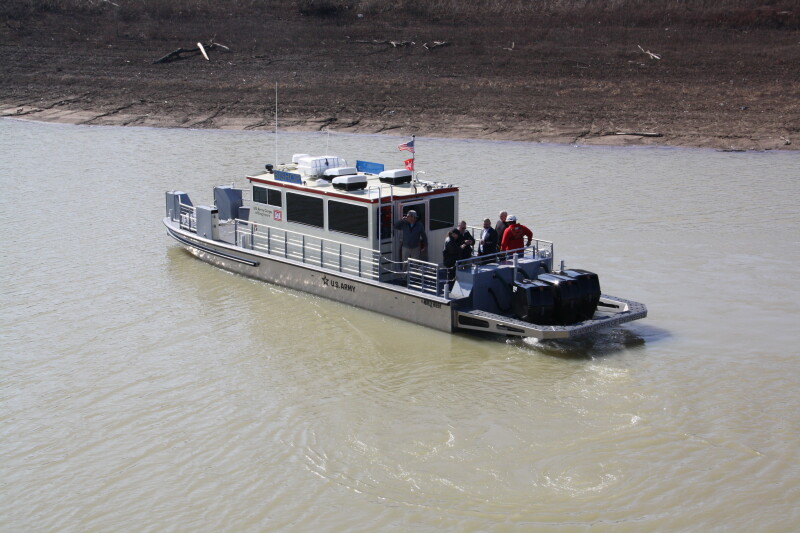
North River Boats, Roseburg, Ore., has delivered the 44'x14' aluminum crew transfer vessel Bishop to the U.S. Army Corps of Engineers Vicksburg District to support operations of the hopper dredge Jadwin on the Mississippi River.
Certified under U.S. Coast Guard Subchapter T, the vessel can carry 28 passengers plus two crew and will ferry personnel and supplies between shore and the dredge during operations. The new boat replaces previous crew-transfer arrangements that relied on contracted vessels with limited availability.
“Previous crew transfer arrangements relied on contracted vessels that offered limited availability and reduced operational flexibility,” said Paul Richards, plant section chief in the River Operations Division for the Vicksburg District. “Previous boats were generally contractually restricted to 12-hour service windows, while the dredge Jadwin operates continuously on a 24-hour schedule.”
That mismatch created logistical challenges for crew changes and supply transfers, particularly during peak dredging operations. According to Richards, the dedicated vessel ensures around-the-clock support aligned with the dredge’s operational tempo.
The passenger capacity was also selected to accommodate full crew rotations. “The 28-passenger plus two-crew certification was specifically designed to meet the maximum anticipated crew rotation requirements of the dredge Jadwin,” Richards said, allowing entire shift changes to be completed in a single trip.
Richards noted that Mississippi River conditions heavily influenced the design. The aluminum vessel features a shallow-draft hull capable of handling strong currents, floating debris, and fluctuating water levels. The configuration allows the boat to land along unimproved riverbanks and operate close to the dredge during personnel transfers.
Richards said the triple 300-hp OXE diesel outboard engine configuration was selected for redundancy and maneuverability during close-quarters operations alongside the dredge.
“Outboards allow for more straightforward maintenance and faster replacement in the event of mechanical failure,” he said. “The triple-engine setup provides propulsion redundancy and enhanced maneuverability, which is critical during personnel transfers and supply deliveries.”
The vessel also carries a 12.5-kW Phasor generator to power three roof-mounted air-conditioning units and onboard electronics, including a full Garmin navigation suite. With a fuel capacity of 400-gals., the boat has an estimated operational range of about 150 miles, depending on load, river conditions, and operating speed. “Refueling intervals will vary based on mission tempo and usage patterns; however, fuel planning will be integrated with dredging operations to ensure uninterrupted availability and operational readiness,” Richards said.
During active dredging, the vessel will support Jadwin’s 24-hour operational cycle. Typical duties include transporting crews during shift rotations, making grocery and supply runs, and supporting hydrographic survey work ahead of dredging operations. The boat will also remain available for standby or emergency-response roles when needed.
The new vessel is expected to significantly improve logistical efficiency for the dredge, whose crews live aboard for extended deployments.
“As a floating work community, the dredge Jadwin is equipped with its own galley, laundry, and living quarters,” Richards said. “Assigning operational control and maintenance responsibility to personnel associated directly with Jadwin reduces reliance on external contractors and improves responsiveness.”
Although the vessel was built specifically to support Jadwin, “outside of dredging season, the vessel could be deployed on a limited basis for support to other projects, contingent upon availability and mission priorities,” he said.
