



NOAA has published an application from The Metals Company, Vancouver, British Columbia, for deep seabed mineral exploration and commercial recovery in the Federal Register, opening a 60-day public comment period on the first consolidated application of its kind.
The application was submitted by the company’s U.S. subsidiary, The Metals Company USA LLC. NOAA determined April 28 that the application met the information requirements necessary to move forward under the Deep Seabed Hard Mineral Resources Act. The determination does not constitute approval but allows the agency to continue processing the application.
The consolidated application seeks both an exploration license and a commercial recovery permit for polymetallic nodules in the TMC USA-A area of the Clarion-Clipperton Zone in the Pacific Ocean. The area is located in international waters between Hawaii and Mexico.
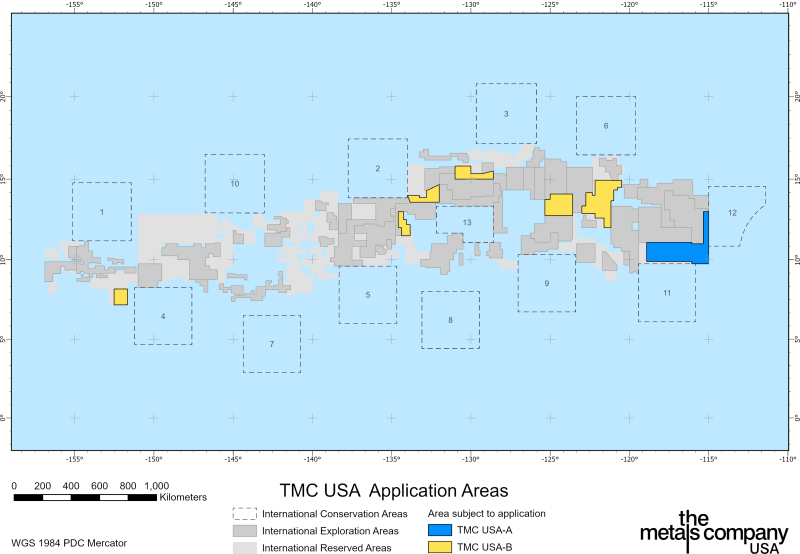
According to the company, the proposed exploration and recovery area covers approximately 25,100 square miles and contains an estimated 619 million metric tons of wet polymetallic nodules, with the potential for an additional 200 million metric tons. The nodules contain nickel, cobalt, copper and manganese.
TMC said its application draws on more than a decade of environmental baseline studies, scientific research and offshore engineering work.
The application was filed under NOAA’s newly established consolidated review process, which allows eligible applicants to seek an exploration license and commercial recovery permit simultaneously.
The public comment period will conclude Oct. 19. NOAA will also hold a virtual public hearing Oct. 13 from 3 p.m. to 5 p.m. Eastern time to receive oral comments.
Feedback from the public and other federal agencies will inform NOAA’s decision on whether to certify the application. Before issuing a certification, the agency must evaluate TMC USA’s financial responsibility and technological capabilities, along with the adequacy of its proposed exploration and commercial recovery plan.
If NOAA certifies the application, the agency would then prepare an environmental impact statement examining the potential effects of issuing the exploration license and commercial recovery permit. That process would include additional opportunities for public comment before NOAA makes a final decision.
TMC USA is separately seeking an exploration license for its USA-B area. NOAA certified that application May 26 and published a notice of intent Aug. 17 to prepare an environmental impact statement.
The approximately 47,100-square-mile USA-B area contains an estimated 1.02 billion metric tons of polymetallic nodules, according to the company.
The review follows an April 2025 executive order directing federal agencies to advance access to offshore mineral resources as part of U.S. economic and national security policy.
“NOAA is proud to set the global standard for science-based deep sea mining practices,” NOAA Administrator Neil Jacobs said. “Our review process is built to ensure responsibility within this emerging industry as we unlock access to these critical resources for the benefit of our nation.”
