



Governors Island is a 172-acre island in New York Harbor, located half a mile from Lower Manhattan. Once a military outpost, it has been transformed into a vibrant public space offering parks, historic buildings, art installations, and panoramic views of the city.
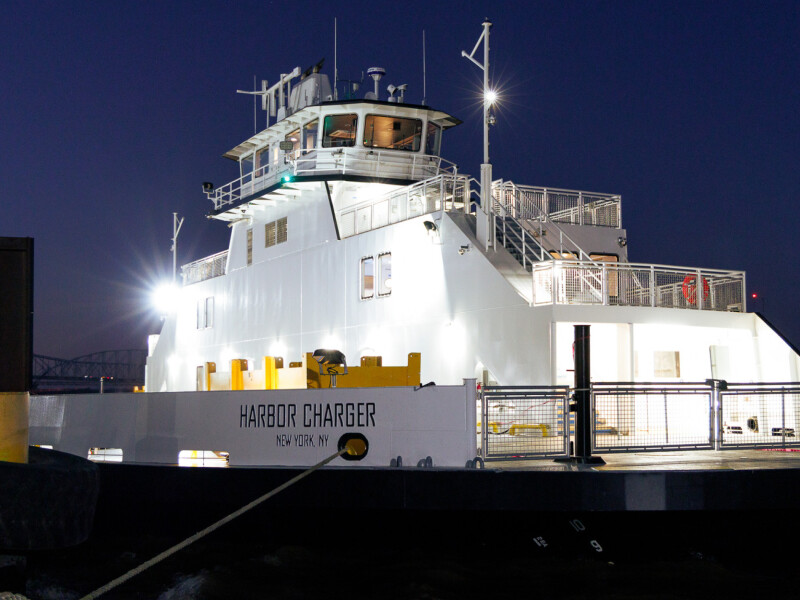
This summer, the trust that manages Governors Island took delivery of the Harbor Charger, New York’s first diesel-electric hybrid ferry. Built at Conrad Shipyard, Morgan City, La., and designed by Elliott Bay Design Group, Seattle, the $33 million double-ended car and passenger vessel measures 190'x62'2"x13'3" with an 8'6" draft.
Since opening to the public in 2005, Governors Island has become a hub for climate innovation, now serving as “a model for the research and demonstration of climate solutions for cities,” a Trust for Governors Island spokesperson told WorkBoat. The island hosts several climate-focused tenants and will soon be home to the New York Climate Exchange. “The addition of the Harbor Charger to our fleet helps us make significant progress toward the island’s sustainability while serving as a model for low to no-emissions maritime transportation,” the spokesperson said.
With capacity for 1,200 passengers and 30 vehicles, the Subchapter K-compliant Harbor Charger replaces the aging Lt. Samuel S. Coursen, a diesel-powered workhorse that’s been in service between Manhattan and Governors Island since 1956. The new ferry offers faster, cleaner, and more efficient service for the nearly one million passengers who visit Governors Island each year.
The Harbor Charger runs on Siemens Energy’s BlueDrive Eco diesel-electric propulsion system, supported by the company’s battery systems and digital control platform — the “brain” of the ferry, according to Julio Santiago, general manager for NY Waterway, Weehawken, N.J., which operates the trust’s ferry fleet.
The system allows the operator to both control and monitor the vessel’s power and propulsion. “Everything’s digital. You can see the condition of the batteries and the whole system in the office or from your phone,” said Santiago. “If I’m home and I get an alarm, I can call and say, ‘Hey, what’s going on?’”
Equipped with 870 kWh of Siemens Energy BVES-V3X batteries (split evenly between two battery rooms) and a pair of Cummins QSK 19 diesel generators that provide 656 kWm at 1,800 rpm, the vessel can toggle between three modes of operation: fully battery-powered, hybrid electric with diesel assist, and diesel backup. In hybrid mode alone, it’s expected to cut carbon emissions by nearly 600 tons annually.
The power setup also offers several operational advantages, according to Ed Schwarz, head of marine sales for the U.S. and Canada at Siemens Energy. The hybrid arrangement allows the generators to run at a constant, optimal load. “We can hold them there, take all the power, and then put it to the batteries or drop a generator if we have enough power. It gives us flexibility. What you want the propeller to do doesn’t necessarily have to link to exactly what the engine’s going to be asked to do,” he explained. “There will be maintenance benefits as well through less wear and tear on the generators.”
“We view this as a battery-first vessel, with the diesel plant serving as a secondary power supply,” said Anthony Pervolarakis, director of engineering and special projects at NY Waterway. “When shoreside rapid charging becomes available, the vessel will operate on all-electric, emissions-free power.”
Funded in part by a $7.5 million grant from the Federal Transit Administration, charging infrastructure is in the design phase. Once completed, emissions could be reduced by an additional 800 tons annually, according to the trust.
“The vessel was designed with redundant modular systems — or “building blocks,” as Siemens [Energy] refers to them — integrating two independent buses joined by the Intelligent Load Controller (ILC). Under normal conditions, the buses operate in parallel, and the ILC distributes power as needed to meet demand,” said Pervolarakis. “If a failure occurs in one of the building blocks, the buses separate, allowing the vessel to continue operating on the intact bus without service disruption. This modularity ensures continued operations while repairs are made.”
Enhanced maneuverability is made possible by two 360° Schottel SRP 210 LEC FP azimuthing thrusters, each driven by a 560-kW motor, allowing for smoother docking and navigation across the busy harbor. Harbor Charger cruises at 10-12 knots.
Onboard equipment includes a Furuno navigation suite, Ultra Fog water mist system, Hiller fire detection system, Li-ion Tamer and Consilium gas detection systems, BrightSign informational video alert, and IMS public address/general alarm and closed-circuit television camera systems.
“Redundant safety systems and automation technologies provided by Siemens enable our captains and crews to focus on vessel operations and passenger safety while maintaining full situational awareness of all systems from the wheelhouse operator’s station,” said Pervolarakis.
“Governors Island is accessible only by ferry, and it is vital that our nearly one million annual riders are able to enjoy a safe, comfortable, and efficient ride to the island,” the trust spokesperson said. “With amenities including air conditioning, accessible restrooms, indoor lounge areas, and space for service vehicles — all of which were designed with these goals in mind — the Harbor Charger has exceeded expectations during its first month in service.
“The feedback from our riders has been incredible, especially our everyday riders, who have noticed just how quiet our hybrid engine is compared to our older, diesel engine.”
