


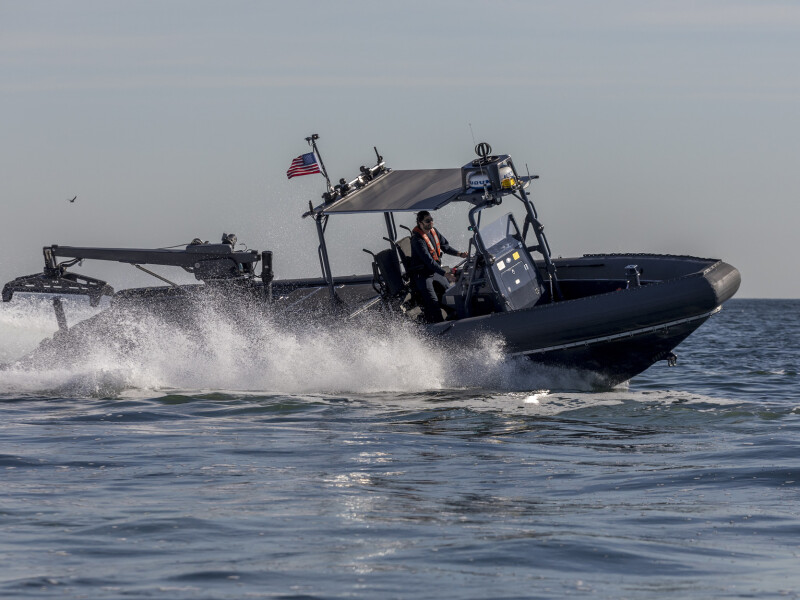
The U.S. Navy has long relied on rigid-hull inflatable boats as the jack-of-all-trades of its small boat fleet — moving personnel, conducting search and rescue, enforcing maritime security and putting special operations forces on target. This spring, it fundamentally changed how it buys them.
In May, Naval Sea Systems Command (Navsea) awarded a 10-year, indefinite-delivery/indefinite-quantity (IDIQ) multiple-award contract (MAC) to eight boatbuilders for the construction of composite RIBs in 7-, 9- and 11-meter (23', 29'6", 36') hull sizes. The base value is $325.9 million; if all options are exercised, the total ceiling reaches $650.1 million. Up to 474 boats could be procured under the agreement, which also covers the explosive ordnance disposal mobile expeditionary response craft (EOD MERC), used by Navy EOD units for locating and recovering submerged ordnance and conducting expeditionary salvage operations.
Key takeaway
The Navy’s new 10-year contract allows eight prequalified builders to compete for orders covering as many as 474 rigid-hull inflatable boats. The contract has a $325.9 million base value and a potential ceiling of $650.1 million.
The Navy said annual procurement quantities will continue to be driven by fleet requirements. “Each year, the Navy sets its procurement plan for boats which dictates the demand signal,” a Navy spokesperson told WorkBoat. “This signal is for both new growth and for replacements.”
The awardees are Asis Boats USA LLC (dba Ocean Craft Marine), Annapolis, Md.; Brig USA LLC (dba Fluid Marine Response), Franklinton, N.C.; Ghostworks Marine Inc., Holland, Mich.; Ribcraft USA LLC, Marblehead, Mass.; St. Johns Ship Building Inc., Palatka, Fla.; Structural Composites Inc., Melbourne, Fla.; United States Marine Inc. (USMI), Gulfport, Miss.; and The Whiskey Project Group USA LLC, Edenton, N.C. The contract drew 15 offers, and each awardee receives a $1,000 minimum guarantee.
The eight awardees
| Builder | Location | Position in the program |
|---|---|---|
| Ocean Craft Marine | Annapolis, Md. | International RIB builder expanding U.S. production. |
| Fluid Marine Response | Franklinton, N.C. | Prequalified contract holder. |
| Ghostworks Marine | Holland, Mich. | Autonomous-vessel and advanced integration experience. |
| RIBCRAFT USA | Marblehead, Mass. | Current Navy builder of 7- and 11-meter RIBs. |
| St. Johns Ship Building | Palatka, Fla. | Prequalified contract holder. |
| Structural Composites | Melbourne, Fla. | Composite technology and vessel-development specialist. |
| United States Marine Inc. | Gulfport, Miss. | Current Navy builder of 9-meter and special-warfare RIBs. |
| The Whiskey Project Group USA | Edenton, N.C. | Prequalified contract holder. |
By the numbers
The Navy said the MAC is part of a broader shift in how it plans to acquire small boats. “The U.S. Navy is shifting its procurements to two large-scale, MAC IDIQ contracts: the composite boats MAC (a small business set-aside) and the approximately $3.5 billion service craft and boats MAC,” the Navy said. “This new approach establishes a prequalified pool of contractors, allowing competition for individual delivery orders with greater speed and agility.”
The Navy said the strategy is intended to “dramatically reduce acquisition cycle times, increase competition at the order level, and significantly lower the government’s administrative burden.” Officials added that the structure also gives industry, particularly small businesses, “wider access to opportunities and a clearer signal of the Navy’s long-term requirements, fostering a more resilient and competitive maritime industrial base.”
CURRENT VENDORS
For roughly the past decade, Navsea awarded single-vendor IDIQ contracts for specific hull sizes — one builder locked in for five years with no pricing flexibility. It was predictable for the Navy, but it left builders exposed, and competitors shut out.
Matthew Velluto, chief operating officer of RIBCRAFT USA, has watched that model evolve across four separate Navy IDIQ contracts.
“The way the IDIQ contract worked was that the government would award a contract that had five ordering periods or option years with a defined purchase price for each option year that the builder would be locked into for the life of the contract. The builder would never ultimately know how many boats the government would [order],” Velluto said. “On one level, it was great for a builder because if the government had a need for a certain boat, you were going to be the one they’d buy it from.”
The Covid-19 pandemic exposed the downside. Supply chain disruptions and inflation drove material costs up, but builders locked into fixed-price contracts had no recourse. “Builders were seeing 40, 50 percent increases in costs, but the government was unable to make adjustments to the contract,” Velluto said. “So, it was a real double-edged sword.”
The Navy says that under the new approach, each delivery order will still be subject to competitive bidding, but only among eight pre-qualified contract holders who will vie for delivery orders.
According to the Navy, each delivery order will still require a formal request for proposal and award process, “but without the administrative pre-work as it has been standardized across the IDIQ.” Officials added, “Competition is not eliminated; instead, it is shifted to the delivery-order level, where it is faster, more agile, and encourages consistent performance from the industrial base.”
Barry Dreyfus, CEO of USMI, credited Navsea for “hard work and out-of-the-box thinking,” with respect to IDIQ contracts. “We believe the acquisition strategy of the overall [multiple award] contract will really streamline acquisition in the future and the ability for the government to act more quickly and get contracts to industry,” he said.
USMI’s president, Tim Hunt, compared prequalification to a hunting license. “You can go out and hunt,” he said. “Don’t mean you’re going to shoot anything.”
RIBCRAFT USA
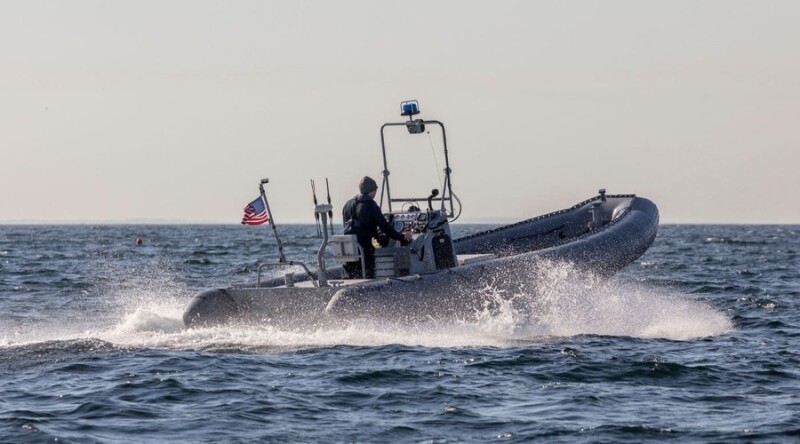
RIBCRAFT has supplied the Navy for more than two decades and is currently the sole active builder of the Navy’s 7- and 11-meter RIBs under existing contracts with ordering periods now closed, but deliveries still running. The company’s 11-meter expeditionary RIB, fitted with a stern davit for deploying unmanned underwater vehicles, supports counter-mine measures, a mission set growing in relevance given tensions in the Persian Gulf.
The Massachusetts boatbuilder is currently delivering multiple boats per month, though Velluto said he was unable to share exact figures due to the sensitive nature of the contract. On the MAC, his enthusiasm was unguarded. “We’re excited about it from a company standpoint. It’s a great opportunity. We’re honored to have gotten it. And that’s not just an official answer — we legitimately are.”
Taken together, Velluto’s and Dreyfus’ remarks suggest that the two boatbuilders with the most experience under the Navy’s prior single-vendor IDIQ contracts are, so far, the ones speaking most favorably about the shift to the new MAC structure.
USMI
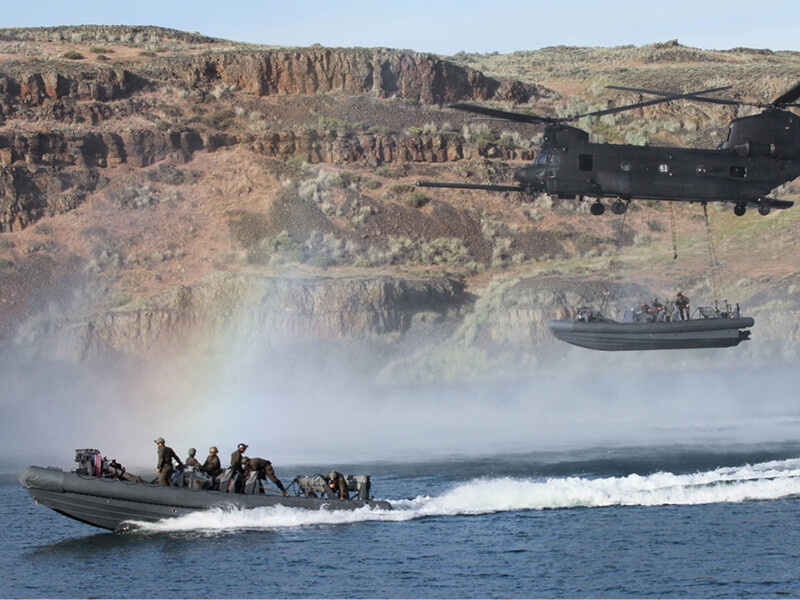
USMI brings one of the deepest Navy track records to the MAC pool, having been the sole builder of the Navy’s 9-meter EOD MERC since winning the original five-year IDIQ contract for that hull in 2016, with 83 boats delivered to date and a follow-on contract for 25 more underway.
The yard also holds a Navsea contract for the 11-meter Naval Special Warfare RIB in its airdrop variant, developed at the Navy’s request to let SEAL teams deploy the craft from an aircraft when carrier or shore-based launch isn’t possible. USMI funded and engineered the system with Navsea and has since delivered it to multiple foreign military sales customers.
For the MAC, Hunt said the company intends to respond to any delivery order for boats it currently builds, with decisions on other hull classes based on resources and existing commitments. “The name of the game is once you have a production line, sustain it as long as you can,” Hunt said.
Dreyfus spoke to the boatbuilder’s track record of carrying zero debt with no outside financial backers or venture capital. “Past performance is number one. When you get with somebody that proves they can do it, keep buying from them.”
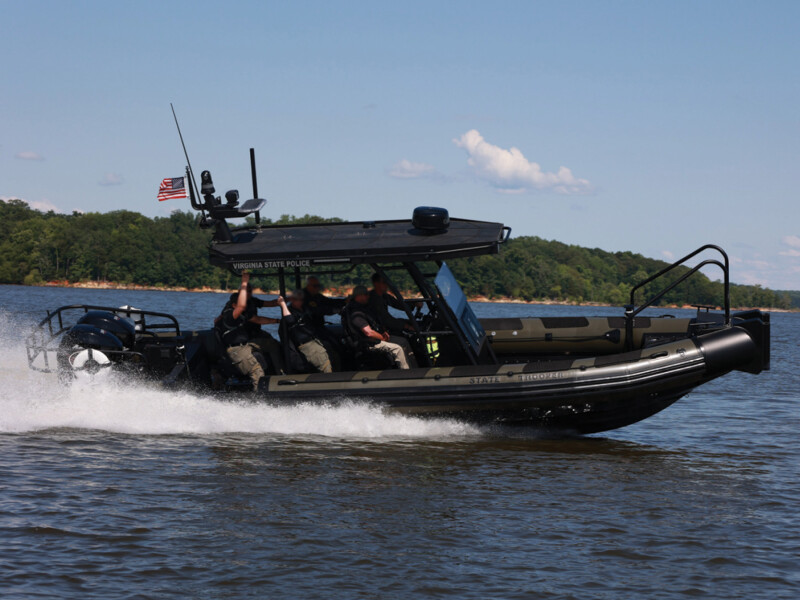
OCEAN CRAFT MARINE
Ocean Craft Marine brings more than two decades of RIB experience through its Dubai-based parent company, Asis Boats, which has supplied military and rescue craft to about 80 countries. The Navy MAC is the company’s first major U.S. contract vehicle.
The company is establishing domestic production through a new South Carolina facility, expected to open within 12 to 16 months, while using an existing Florida operation in the interim. The South Carolina build-out will include aluminum fabrication capability, positioning the company for the aluminum vessel MAC contract Navsea is expected to issue next, which representatives described as even larger in scope than the RIB contract.
CEO Roy Nouhra said the company has an international footprint, established global service network, mature supply chain, and operational experience supporting boats worldwide.
“The fact that we sell to 80 countries around the world means you have experience in shipping, servicing, and supporting,” Nouhra said. “The true life-support of the vessel. And these Navy boats are going all around the world.”
Ocean Craft Marine expects its 9.5-meter (31') RIB to be a leading contender for task orders that let contractors propose their own designs. Ryan Salus, the company’s business development director, said the platform has been configured for missions including firefighting, search and rescue, boarding operations, diving support and explosive ordnance disposal.
“An overarching goal of Project Perfect Storm” — a collaborative boatbuilding innovtion project led by Ocean Craft Marine — “was to help influence the mindset of this Navy procurement where they’ve been owning these designs for several decades,” Salus said. “It was to prove to them that industry and the innovation that’s occurred over the last several decades has passed them by.”
That influence is visible in the MAC’s design-open provisions, which will allow builders to propose new hull concepts rather than build to legacy government drawings, Nouhra said. “We have a proven superior vessel that has stood the test of international waters, and we are now bringing that to the U.S. for all domestic and homeland defense uses,” he said.
For Nouhra, the award is personal. “To take care of the U.S. Navy operators, for me, that’s the biggest thing I could achieve.”
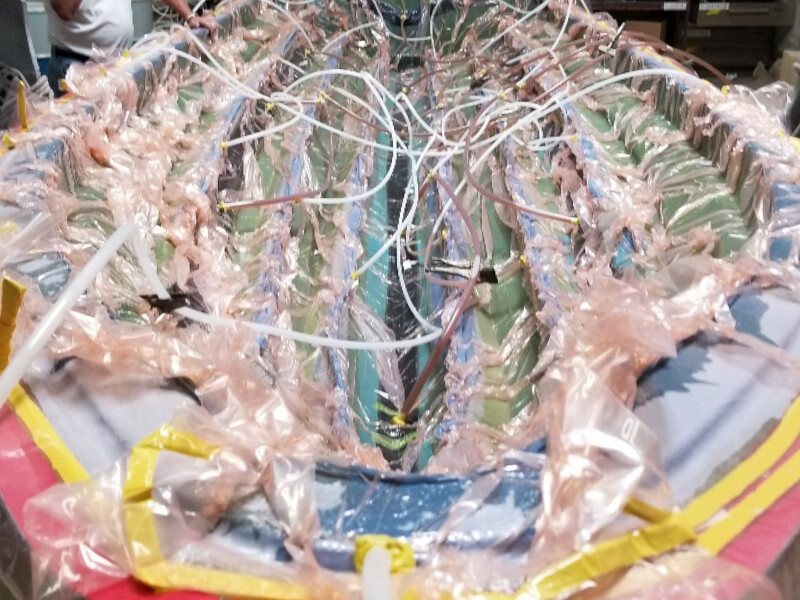
STRUCTURAL COMPOSITES
Structural Composites Inc. (SCI) occupies a unique position among the eight awardees as it is not a production boatbuilder in the conventional sense. Its president and co-founder, Scott Lewit, describes SCI’s role in the MAC as something more foundational: “the boatbuilding center of excellence” and “the developmental arm of the IDIQ.”
Lewit started the company in 1987 out of Florida Tech, where he earned degrees in oceanography and ocean engineering before working in Panama City supporting Navy SEAL teams and underwater vehicle programs. SCI’s Prisma preform technology, developed in the 1990s to replace wood and core materials with foam preforms that function like structural Legos, is now used by 76 OEM boatbuilders.
SCI’s path to the Navy RIB market ran through a Universal Studios stunt-boat contract requiring a craft that could launch up a ramp, pass through a wall of fire and “belly-flop” into the water without injuring performers. That work led to a suspended deck concept, a floating, shock-decoupled crew platform, that SCI later brought to combatant craft development.
In 2009, SCI won a Small Business Innovation Research Program contract to develop an advanced RIB, combining its shock-mitigating structure with outboard power at a time when the Navy’s shipboard RIBs were largely powered by diesel inboards. The result, an 8.5-meter (28') prototype with twin 225-hp Evinrude E-TEC outboards, weighed 3,600 lbs. fully rigged and reshaped the program’s direction.
The company also developed CoCure, a proprietary resin coating and adhesive that allows composite structures to flex without the gel coat cracking, reducing weight while improving durability, Lewit said. After the technology was commercialized through a partnership with trailer manufacturer Wabash, the company incorporated it into a Navy rapid innovation fund project pairing its shock-mitigating hull designs with heavy-fuel propulsion systems.
Lewit sees the IDIQ as a platform for continuous modernization: a pathway toward “tri-mode” boats that can operate manned, remotely piloted or autonomously, and a potential conduit for composite metal-hybrid hull technologies that the military has not yet deployed.
“We don’t want to have a boat that’s branded Structural Composites,” he said. “We want to support the ecosystem.
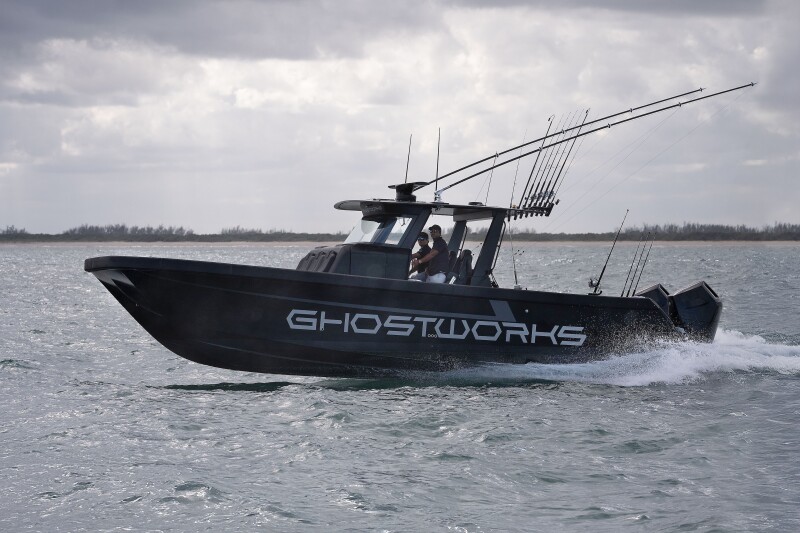
GHOSTWORKS MARINE
Ghostworks Marine, Holland, Mich., is one of the boatbuilders included in the Navy's MAC that's not known traditionally as a RIB builder. The company specializes in advanced composite construction and innovative hull forms for defense, commercial and recreational vessels.
"Ghostworks isn't a traditional RIB builder, and I think that worked in our favor," said Patrick Coughlin, senior commercial operations director. "We specialize in unique hull forms and advanced composite construction, and Navsea wrote this IDIQ intentionally broadly."
Coughlin said the company sees the contract as an opportunity to support both near-term RIB production and future fleet modernization while bringing geographic diversity to the Navy's industrial base through its Michigan workforce and supply chain.
"We're helping the Navy meet an urgent near-term requirement, but we're also positioned to improve the performance of current and future craft and give our sailors the safest, most effective vessels possible," he said.
Although Ghostworks will build to Navy-specified hull designs, naval architect Jaye Falls said the company will apply its composite manufacturing expertise by optimizing laminate schedules around its resin infusion process.
"The goal is the same on every vessel: consistent, superior laminate structural properties at minimum weight, with less manual rework and finish repair," Falls said.
Looking ahead, Coughlin said the competitive task-order structure will require Ghostworks to remain flexible while providing an opportunity to showcase capabilities beyond RIB production.
"The marketplace approach presents an interesting challenge: we have to plan for multiple demand scenarios," he said. "But our build processes and in-house engineering team let us respond to task orders with real flexibility."
Falls said the company's composite expertise traces back to the America's Cup and The Ocean Race, where lightweight construction methods were refined before being adapted for military and commercial vessels. "The history of this company is one of constant adaptation," he said. "We look forward to applying that same spirit to designing, engineering, and building for the operators who depend on these craft."
