



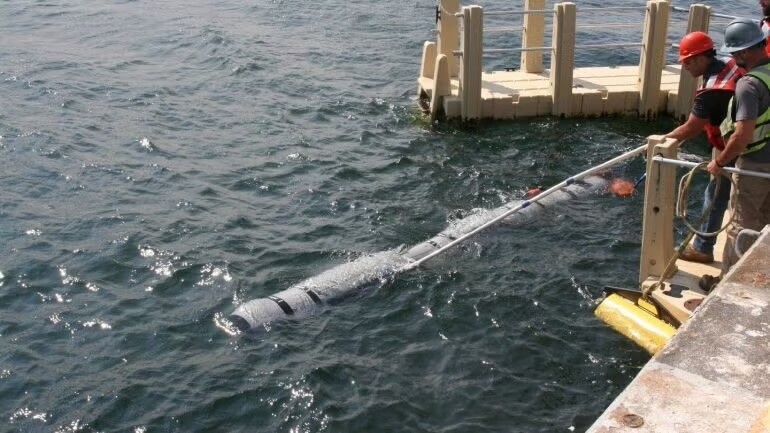
The U.S. Navy announced the successful retrieval of a REMUS 620 unmanned undersea vehicle (UUV) during testing at a full-scale Virginia-class submarine torpedo-tube and shutterway fixture at Seneca Lake, N.Y. The exercise marks a key milestone in the Navy’s ongoing effort to advance the launch and recovery of autonomous undersea vehicles from submarine torpedo tubes.
According to the Navy statement, the test was a collaborative effort involving the Naval Undersea Warfare Center Division Newport (NUWC Newport), Huntington Ingalls Industries (HII), and the Woods Hole Oceanographic Institution (WHOI). The trial demonstrated the REMUS 620’s ability to autonomously navigate, communicate, and dock with a Shock and Fire Enclosure Capsule loaded into the submerged fixture. The vehicle also performed a reverse “swimout” launch and separation maneuver.
The joint team achieved the result less than seven months after integrating WHOI’s “Yellow Moray” torpedo-tube launch and recovery technology into the larger REMUS 620 system, developed by HII. The “Yellow Moray” capability is already operational aboard the Virginia-class submarine USS Delaware (SSN 791), where it represents the Navy’s first submarine-deployed uncrewed undersea vehicle program.
“This successful docking validates the research and development investments and efforts of HII, specifically the REMUS 620 engineers working in close cooperation with our WHOI teammates,” said Duane Fotheringham, president of unmanned systems for HII’s Mission Technologies division. “We leveraged WHOI’s previous three years of TTL&R work, lessons learned, and expertise to greatly accelerate our progress in successfully getting to this important milestone.”
The Navy noted that the REMUS 620 can be deployed not only from submarines but also from small crewed or uncrewed surface vessels, amphibious ships, surface combatants, and helicopters. Designed as a modular medium-class vehicle, the REMUS 620 can also serve as a platform for launching and operating smaller uncrewed systems or underwater payloads.
According to HII, the vehicle offers up to 110 hours of endurance and can travel 275 nautical miles on a single battery charge, giving it the range and persistence needed for extended undersea operations.
In March 2024, HII’s Mission Technologies division received a second international order for the REMUS 620 from an undisclosed Indo-Pacific customer, reflecting growing global demand for medium-class UUVs capable of performing long-duration missions such as mine countermeasures, intelligence gathering, and seabed mapping.
