



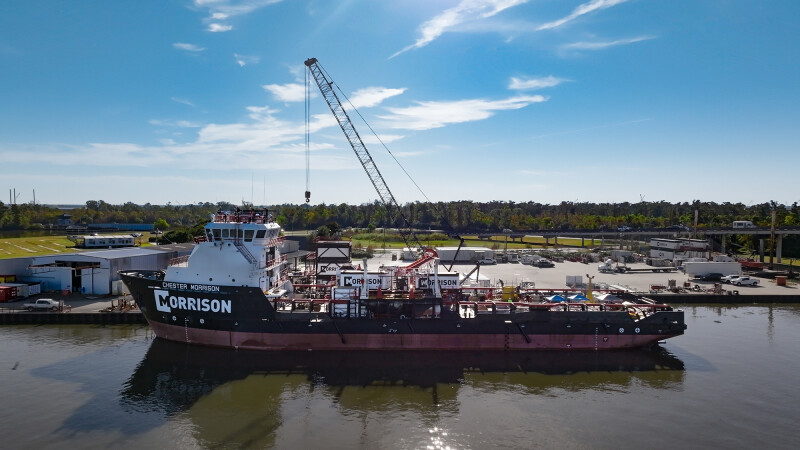
Morrison, Houma, La., has been a key player in the offshore diving and pipeline sector in the Gulf of Mexico for 40 years. For the last 20, the company has focused on establishing itself as a leader in diving, especially deepwater dives.
Recently, the company acquired a 260' Jones-Act-compliant vessel with dynamic positioning (DP) capabilities. Named after the company’s founder, the Chester Morrison will be the flagship of the Morrison dive-support fleet and the first equipped to hold position without needing a mooring system. Morrison’s other vessels use four- and eight-point moorings with anchors and winches to hold station offshore.
“There is currently only one other dynamic-position dive asset that is Jones Act compliant in the market,” said Nick Gregory, director of business development for Morrison, which is based in the U.S. with locations in Guyana, the West Indies, and Mexico. He explained that the acquisition resulted from client requests to take on projects requiring a vessel with DP. “The investment demonstrates our dedication to the industry and clients and was well worth the leap,” said Gregory.
He said that once Morrison management decided to purchase a boat with DP capabilities, the team determined the size and configuration, including the number of bunks and deck spaces, needed. They reviewed the offshore supply vessel market and chose a ship that was work-ready and Jones-Act-compliant, avoiding the need to change flag states. The Chester Morrison meets the Association of Diving Contractors International and International Marine Contractors Association (IMCA) standards. It also has a self-propelled hyperbaric lifeboat (SPHL).
The steel-hulled vessel was refitted at two sites: Bollinger Shipyards’ facility in Amelia, La., and Morrison’s headquarters in Houma, where third-party contractors were brought in to perform some of the upgrades. In late November, the structural work had been completed, and the team was finishing the integration of a 35-ton telescopic boom crane. The bulk tanks were removed, and a 16-person saturation diving system was added, as was the moonpool for the diving bell deployment. Following sea trials scheduled for December and a topside inspection, Morrison hoped to have the vessel operational early in the new year.
While boats now in the Morrison fleet are limited to working at about 1,000' below the surface, the Chester Morrison will give the team the ability to work at greater depths.
Gregory explained that oil majors such as Shell, Chevron, and ExxonMobil require contractors to meet top-tier IMCA standards. This includes the presence of the SPHL on board for redundant support in case something goes wrong with the dive bell. Because decompression from a 700' dive takes eight days, the SPHL lets divers remain pressurized at depth in containment. The Chester Morrison also has a remotely operated underwater vehicle (ROV) because some customers prefer pipeline work to be performed by a machine rather than by a diver. ROVs can work at 3,000' to 4,000' depths, and Gregory said the company uses work-class ROVs that can perform complex tasks and inspection-class units that primarily provide visual aids.
Cubic capacity of the Chester Morrison is 2,520 gt. The vessel has a 60' beam and 4,932 sq. ft. of deck space. Power is provided by two Caterpillar 3608 diesels producing a total of 6,780 hp. Inboard transmissions with 4.3:1 gears turn a pair of 4-bladed propellers. Three Caterpillar 3406 (960-kW) serve as primary generators. The DP system consists of Beier IVCS 4000 DP-2 equipment linked to Wartsila Cyscan AS laser-based, Kongsberg radar-based, and Kongsberg hiPAP 452 acoustic referencing. Two 2,400-hp Brunvoll bowthrusters and a pair of 1,200-hp units in the stern hold the ship in place in DP mode.
Diving-specific equipment includes a DNV-certified saturation diving system that can support up to 16 divers. The three-person diving bell complies with IMCA guidelines, and there is a three-man hyperbaric rescue chamber. The SPHL can carry 18 divers.
