



Deck machinery has always had to perform heavy work in tough conditions. Vessel operators still expect reliability, but manufacturers are also dealing with limited deck space, weight restrictions, changing electrical systems, labor concerns, and equipment that often has to be designed around a specific boat and job.
Winches, cranes, drives, and handling equipment are all being shaped by the same pressures, with manufacturers working to add capability without creating new problems for vessel layout, weight, or power systems.
SPACE AND WEIGHT
At Markey Machine LLC, Seattle, much of the company’s recent development work has centered on ship-assist and escort winches, according to Scott Kreis, vice president of sales and engineering.
“There’s never enough room on the bow of a tugboat for a winch,” Kreis said. “It’s always very, very tight up there.”
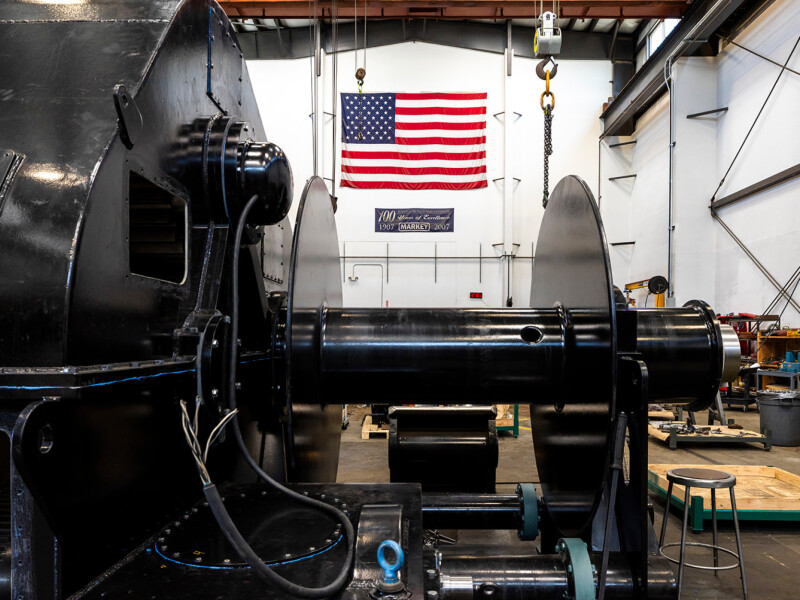
Markey supplied 200-hp Agile Class III escort winches for Signet Maritime Corp.’s tugboats Signet Sirius and Signet Capella. The systems include multiple speed ranges, water-cooled slip brakes, and Markey render/recover controls. Markey also supplied 450-hp Agile escort winches for HaiSea Marine’s HaiSea Kermode and HaiSea Warrior.
Kreis said reducing the physical size and weight of the equipment was a central part of the design work.
“The Agile winch system was developed for shortening that fore-aft dimension and saving weight,” he said. “It’s not sexy, but that is really a concern when it comes to operators and to naval architects who are supporting operations.”
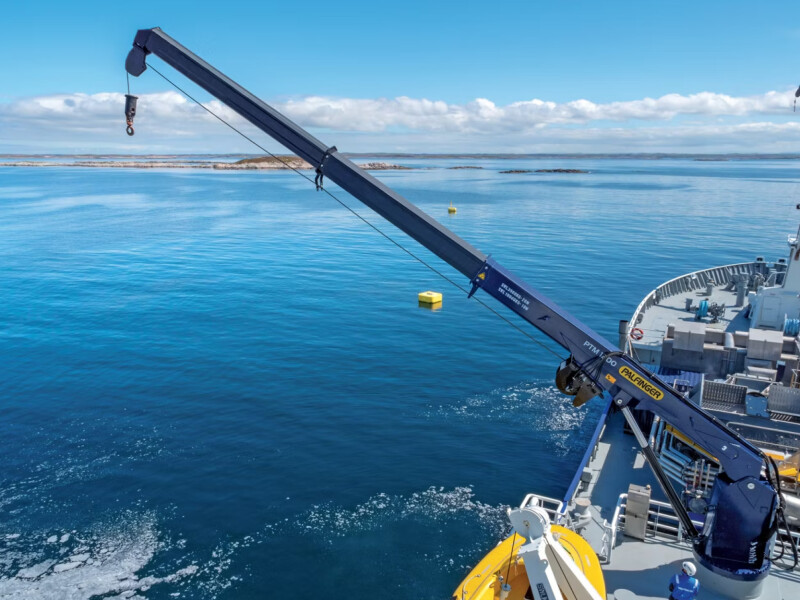
Palfinger Marine, Salzburg, Austria, developed its new foldable knuckle-boom crane with workboats in mind, particularly those serving the aquaculture industry. Aquaculture operations are moving into exposed locations and using larger cage systems, including submerged concepts that require equipment capable of handling loads at extended reach.
“Vessel operators need cranes with high load capacity at high outreach while maintaining a moderate weight,” Klaus Schreiber, vice president of sales and service for marine and special solutions at Palfinger, said in written responses. “Typically, such tasks require a much heavier crane, which is often not practical.”
Palfinger’s new PFM 1200 reaches more than 85' and can handle close to 4,400 lbs. at maximum outreach in winch configuration. Bergen Hydraulic AS in Norway ordered the first unit for Frøy Akvaressurs AS’ service vessel Frøy Fighter, replacing an existing Palfinger PK 150002 M.
The replacement adds outreach while retaining the existing mounting interface.
“For existing vessels, this means that, for example, the PK 150002 M models that have been in service for many years can be replaced with a PFM 1200, which provides an additional 5 meters (16'5") of outreach,” Schreiber said.
BUILT FOR THE JOB
Standard model numbers do not always mean standard equipment.
Kinematics Marine Equipment Inc., Arlington, Wash., sells established lines of winches and deck gear, but Scott Atkinson, vice president, said customers frequently ask the company to adjust those products for a vessel or operation.
“The truth is that we do customize quite a lot,” Atkinson said. “Although we have standard lines that people like to order from us, we quite often make small changes in the design or dimensional footprint.”
Kinematics is also hearing from operators trying to keep older equipment working. Atkinson said requests for parts and support for the former KPL utility winch line have increased during the past year. The line was previously spun off and sold, and Kinematics is now negotiating to reacquire it.
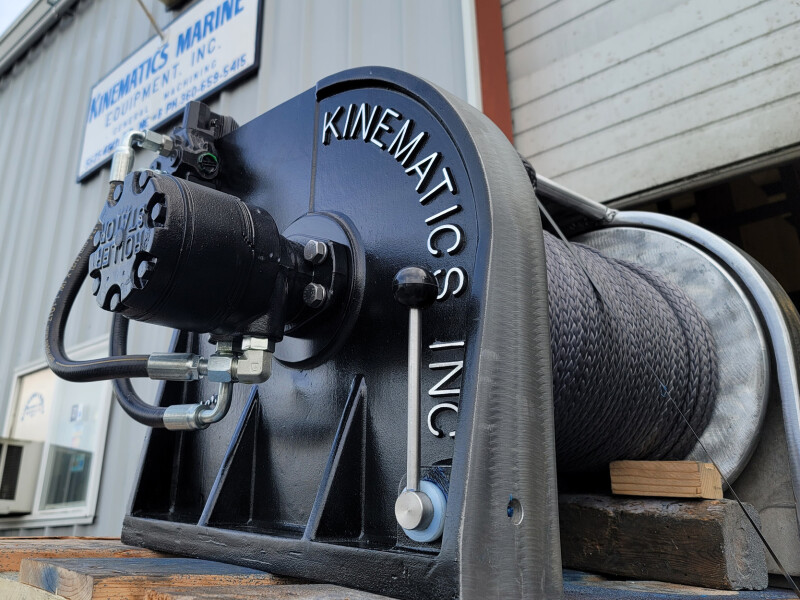
“The KPL line was essentially a utility winch line, popular in a number of workboat and other marine applications,” Atkinson said. “Customers are remembering that in seeking to keep older KPLs going, or in seeking to obtain replacements.”
Kinematics is active in both retrofit and rebuild work as well as new construction. Research vessels are one current area of interest, with the company bidding winches for three newbuild projects, though details of those projects remain confidential.
Markey similarly starts many projects with existing designs and changes them to suit the boat. Kreis said a winch developed for one vessel may be repeated across a series, while individual customers may ask for changes such as a level wind, different brake drum material, or an integrated warping head or capstan.
“Markey is a custom winch manufacturer, always has been,” Kreis said. “That’s not to say we don’t sell the same model more than once.”
POWER AND CONTROL
Increasingly, electrical architecture is becoming part of the deck machinery discussion. The shift to electric drives means power supply, controls, and efficiency must be planned together with the equipment itself.
Markey’s Auto Select Auto Backup system, or ASAB, allows variable frequency drives to provide power and control to multiple winches. Kreis used a hypothetical six-winch installation to explain it. Four variable frequency drives (VFD) could serve six electric mooring winches, with any drive available to operate any of the winches. If all four drives are available, four winches can run at once. If one VFD goes down, the remaining three drives can still operate any three winches.
“We’re optimizing space and redundancy by actually using fewer drives than there are winches,” Kreis said.
Equipment manufacturers also must coordinate those systems with the vessel early in the design process.
“The winch systems these days are just, they’re so integrated with the vessels,” Kreis said. “It’s really something that needs to be worked on” closely with the naval architect.
Battery-electric tugs have added another power configuration. Conventional electric winches generally receive AC power from a vessel switchboard. Battery systems operate on DC power, and some early e-tug projects converted DC to AC before sending it to the winch.
Markey now supplies hawser winch systems that can accept approximately 900 to 1,000 volts DC directly from the vessel’s DC switchboard.
“We are now involved in projects that really are pure DC, supplied by the DC bus, supplied to and dealt with within the winch system as DC,” Kreis said. He called it “the most efficient means” of powering the winch for those projects.
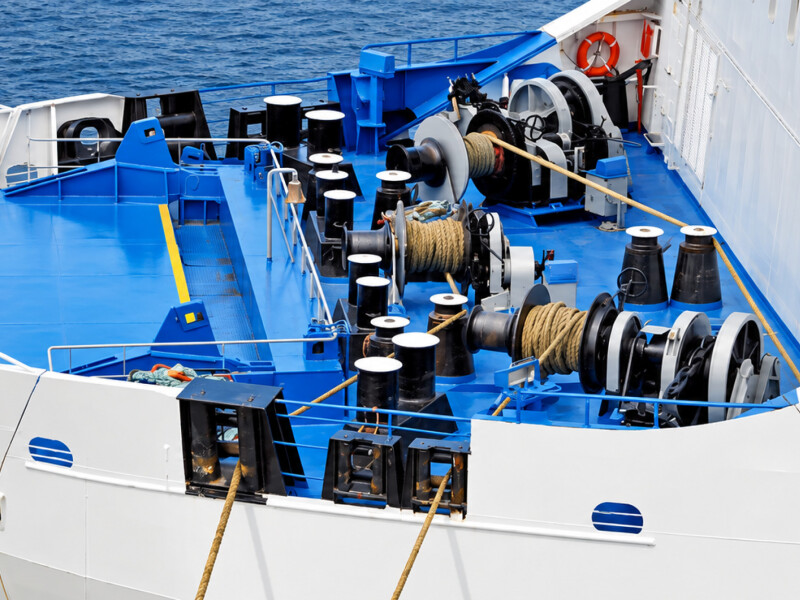
ABB Marine & Ports, part of ABB Ltd., Zurich, works on the electrical side of the equation, supplying drives, motors, and control technology used by winch manufacturers.
Mikael Holmberg, segment sales manager for cranes and winches, said customers are asking for equipment suited to marine conditions, support with motor sizing, different hardware for different winch applications, and software with winch functions built into ABB’s ACS880 drive platform.
ABB is also seeing growing retrofit work on existing winches.
“Another opportunity for growing business is retrofitting old electrical winches, moving from three-speed DOL motors to VSD single-speed motor control,” Holmberg said.
Holmberg also sees changes coming in electrical braking as well as in the way energy is used when winches operate in motor and generator modes.
“One thing is how the electrical energy is used and shared in electrical motor controls,” he said.
FEWER HANDS ON DECK
Technology development does not always mean adding a complex new system or layer.
Atkinson said he expects vessel operators will continue to seek equipment that reduces manual handling, in part because of ongoing labor availability challenges.
“Finding people to work aboard has become increasingly difficult for a number of operators,” he said. “I think there’s going to be more demand for automation.”
Atkinson pointed to rollers at the stern or bow that can take some net handling out of the crew’s hands. Level winds can serve the same purpose when line is being wound onto a drum.
“Our deck machinery is popular because it reduces the amount of line- or net-handling by hand, in this way also addressing safety requirements,” he said.
