



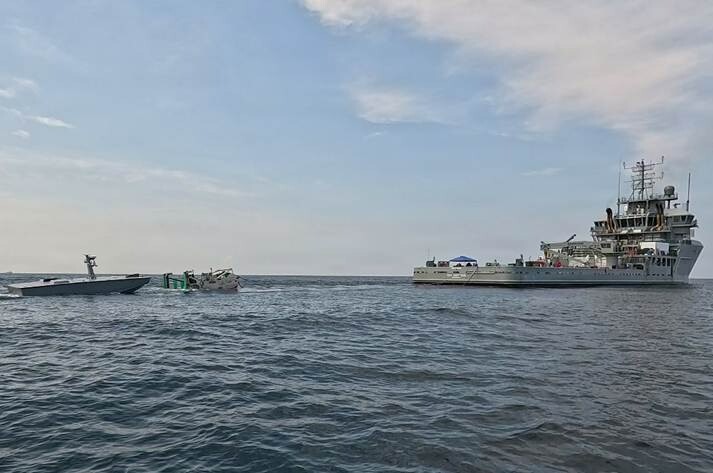
Maritime Tactical Systems Inc. (Martac) and the U.S. Navy have completed an at-sea refueling demonstration involving a Navy-owned Devil Ray T38 unmanned surface vessel (USV).
During the August demonstration off Joint Expeditionary Base Little Creek-Fort Story, Va., the T38 was repeatedly captured, refueled and released while underway. Martac described the event as the first fully autonomous refueling of a USV at sea.
The team used Sealartec’s autonomous replenishment-at-sea system, including a towable capture and connection device deployed behind the training support vessel USNS Vindicator (TSV 5). The robotic system captured the USV and established the connection needed to transfer fuel.
The participants conducted dozens of complete capture, refueling and release cycles, along with pier-side testing. Approximately 400 gals. of fuel were transferred. The system completed about 100 connection cycles during the demonstration and the days leading up to it, according to Martac.
The Navy’s Naval Air Warfare Center Weapons Division Blue Water Instrumentation program owns the T38 used in the demonstration. The program selected the vessel following market research focused on stability and endurance.
The T38’s catamaran hull provides a stable platform for range instrumentation and helps maintain the alignment required for the refueling system to capture and connect with the vessel, Martac said.
“Working directly with our industry partners allowed us to bring the platform, control systems, operators and engineers together as one integrated team,” Spencer Holloway, director of the Blue Water Instrumentation program’s Future Capabilities Office, said in a statement. “We could make changes, test them on the water and iterate quickly based on what we observed.”
The demonstration was sponsored by U.S. Fleet Forces Command, Naval Surface Warfare Center Dahlgren Division and Naval Surface Warfare Center Carderock Division. The Littoral Combat Ship Mission Modules Program Office and the Navy’s Portfolio Acquisition Executive for Robotics and Autonomous Systems provided contracting support.
The participating organizations moved the project from its initial concept to an on-water demonstration in seven months, according to Martac.
At-sea refueling could allow USVs to remain deployed longer without returning to port, extending their operating range and reducing their dependence on crewed support vessels.
Martac said its next goal is autonomous refueling between unmanned vessels. The company’s 82' Leviathan T82, scheduled for delivery in spring 2027, is being developed as a medium unmanned workboat with a cruising range of 4,000 nautical miles. Martac plans to configure the vessel to serve as an at-sea tanker for compatible USVs.
