



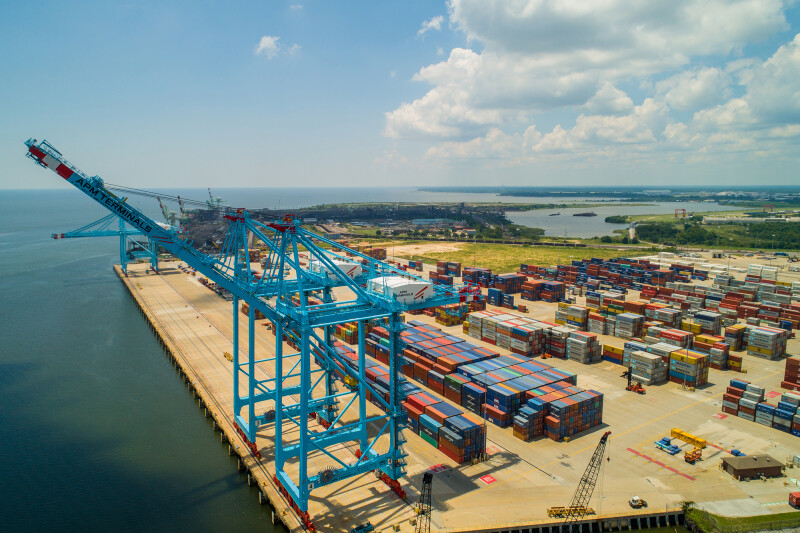
The U.S. Department of Transportation's Maritime Administration (Marad) has announced $488,628,000 in funding for American ports, shipyards, and maritime infrastructure under the Port Infrastructure Development Program (PIDP), the latest move in the Trump administration's broader push to reassert U.S. maritime dominance.
The grants are intended to improve cargo loading and unloading operations, streamline supply chain movements, modernize port infrastructure and operations, and support the seafood industry, Marad said in a press release.
"The Trump Administration is getting back to basics and investing hard-earned American dollars in restoring the nation's maritime dominance," said U.S. Transportation Secretary Sean P. Duffy. "We're refocusing on what matters – revitalizing our ports with the latest technology and infrastructure to keep our economy humming."
Marad Administrator Stephen M. Carmel added, "Thanks to President Trump and Secretary Duffy, we are investing in much-needed port infrastructure that will strengthen our supply chains. America's ports fuel our economy, bolster domestic energy, and cut costs for hardworking families, making them worthy of taxpayer investment."
The announcement fits within a wider maritime policy agenda the administration has been advancing since President Trump signed Executive Order 14269, "Restoring America's Maritime Dominance," in April 2025. That order directed the creation of a Maritime Action Plan and set out to counter China's commanding position in global shipping and shipbuilding. The U.S. currently constructs less than 1% of commercial ships globally, while China is responsible for roughly half. The White House released its long-awaited Maritime Action Plan in February 2026, laying out a comprehensive strategy aimed at reversing decades of decline in U.S. shipbuilding and restoring domestic maritime industrial capacity.
The PIDP, which was authorized by Congress as part of the National Defense Authorization Act for Fiscal Year 2010, is a competitive, discretionary grant program that funds projects improving the safety, efficiency, or reliability of cargo movement at coastal seaports, inland river ports, and Great Lakes ports. The Bipartisan Infrastructure Law provided $2.25 billion for the program over five years from 2022 to 2026.
Eligible capital projects span a wide range of port needs. These include marine terminal equipment for loading and unloading goods; highway or rail infrastructure, intermodal facilities, freight intelligent transportation systems, and digital infrastructure; operational improvements including port resilience projects; environmental and emissions mitigation measures; and port and port-related infrastructure supporting seafood businesses, such as facilities for processing, cold storage, and the loading and unloading of commercially harvested fish and fish products. Security infrastructure upgrades, such as enhancements to video security, access control, and alarm systems, and transport management improvements to loading and unloading operations are also eligible.
The PIDP's revised grant criteria introduce new priorities for projects located in Qualified Opportunity Zones, those incorporating innovative technology, and projects that support national multimodal freight goals.
Qualified Opportunity Zones are economically distressed communities where new investments may be eligible for preferential tax treatment, a concept originating from the Tax Cuts and Jobs Act of 2017. The administration's Maritime Action Plan separately proposes creating up to 100 Maritime Prosperity Zones modeled on the Opportunity Zone concept to attract private capital to port and shipbuilding communities, though that program has not yet been enacted into law.
At least 25% of the total funding — $122,157,000 — is reserved for small projects at small ports. The federal cost-share for PIDP grants is generally 80%, though the Secretary of Transportation may raise that contribution for projects in rural areas or small projects at small ports. Eligible applicants include port authorities, state and local governments, indigenous Tribal nations, counties, and other qualifying entities.
Applications must be submitted by June 27, 2026.
