



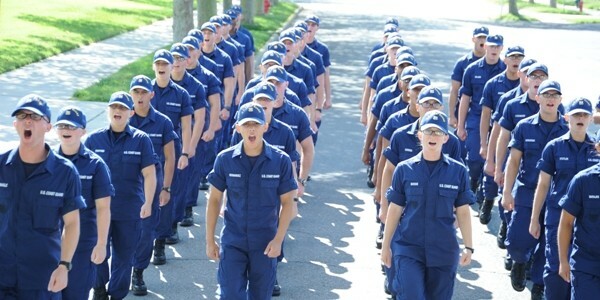
The Coast Guard announced May 7 it has awarded a contract valued at up to $400 million to Whiting Turner Contracting Company for the design and construction of long-anticipated new facilities at the Coast Guard Training Center (TRACEN) Cape May, N.J.
It’s the largest shoreside construction award “in Coast Guard history and is part of a broader effort to modernize the service’s only accession point for enlisted personnel,” according to a statement from the Coast Guard headquarters.
Located at the southern tip of the New Jersey Shore, the Cape May center can train more than 5,000 recruits annually and has a substantial year-round population of staff and young families in government housing, a stone’s throw from the upscale Cape May city resort.
Coast Guard officials say the planned facility enhancements are funded through the Working Families Tax Cut Act (WFTCA), “which includes historic investments to upgrade training facilities and infrastructure, and annual appropriations. The Coast Guard will use this funding to solidify TRACEN Cape May as the nation’s premier location for developing military enlisted members.”
“This marks a historic milestone in modernizing Training Center Cape May and developing the next generation of Coast Guardsmen” said Master Chief Petty Officer of the Coast Guard Phil Waldron, a former Recruit Company commander. “By improving living spaces and facilities we are not only bettering the quality of life for recruits, staff and their families, but also enhancing our Service readiness and ensuring the Coast Guard is able to meet the future demands of the Nation.”
Up to 5,500 recruits can cycle through training now, and when new barracks are complete that number could increase to more than 8,000 annually by 2030. The planned projects include:
· Construction of barracks buildings to accommodate 8,000 recruits annually.
· Demolition and disposal of abandoned steam trenches and building foundations.
· Temporary facilities with utilities and C5IT connections.
· Relocation of electrical duct banks and transformers.
· Demolition of two existing barracks, James and Healy Halls.
· Construction of a new VIP review stand, grandstands with cantilevered shading, and a new parade path.
· Construction of a new multi-purpose training facility housing seamanship training, an indoor graduation space, an indoor track, and a new drill hall.
· Construction of a new galley.
· Construction of a new fire station, replacing a building from the 1920s with new, modern, state-of-the-art ventilation systems that allow all fire apparatus to be stored together and indoors.
Projects will specifically focus on berthing, messing, instruction, and life safety improvements for recruits and staff. The Coast Guard says it is “taking advantage of funding that enables investments previously deferred due to budgetary constraints. Contracted work will be conducted in phases to minimize interruption to recruit training.”
“This investment marks a historic milestone in modernizing our facilities and ensuring we are fully prepared to develop the next generation of Coast Guardsmen while maintaining the highest standards,” said Capt. Amanda Lee, the commanding officer at Cape May. “By improving infrastructure and quality of life, we are not only strengthening our workforce but also enhancing our readiness and ability to carry out critical missions that protect the nation’s maritime interests.”
