


Long valued for their versatility and reliability, aluminum landing craft are a go-to workboat option for government agencies, universities, island owners, environmental groups, oil spill responders, and others who rely on the shallow-draft, bow-loading design to deliver people, vehicles, and equipment to remote or unimproved shorelines.
“A lot of people think they don’t need one until they go in one,” said Ian Gracey, founder of Silverback Marine, Tacoma, Wash. “Just about everybody that we bring in one says, ‘Wow, this is like going in a pickup truck for the first time.’”
In the Pacific Northwest, long a hub for aluminum workboat construction, builders continue to refine the concept with custom designs balancing speed, payload capacity, and easy maintenance. On the East Coast, Maine’s Lyman-Morse is among several yards expanding into the segment as regional demand grows for purpose-built aluminum landing craft without the cost of cross-country shipping.
MUNSON BOATS
Munson Boats, Burlington, Wash., designs and constructs each of its builds to order, ranging from 23' utility boats to 65' landing craft. The company’s six-person design department handles all engineering in-house.
“We are the world leader when it comes to the production of high-speed aluminum landing craft,” said Garrett Martin, business development manager at Munson. The yard delivers roughly 50 vessels per year, serving a broad mix of customers. Martin said about one-third of deliveries go to government operators, one-third to commercial customers, and one-third to private clients.
Government clients include the U.S. Air Force, which uses Munson-built landing craft to retrieve test equipment and paratrooper gear, the Army Corps of Engineers, which “buy a huge number of workboats from us for anything from hydroelectric dam maintenance to whatever other projects they have going on,” Martin said.
Munson’s also built numerous boats for the National Park Service and U.S. Forest Service, ranging in size from 28' to over 50'. “We’ve built more in the 28- to 32-foot range than anything else, but different areas have different requirements,” Martin said.
Each landing craft features a signature bow door system, which Munson designs and assembles in-house. “We have three different methods for opening the bow door,” Martin explained. “Electric over hydraulic rams. We have 316 stainless steel hydraulic rams and an electric over hydraulic pump. We do an electric winch … and then we use a Thern 316 stainless steel mechanical hand-crank winch built here in America.
“The hand-crank winch is self-braking,” he said. “You unlock the bow door. You start cranking. The bow door goes down. You let go, it stops. You crank it the other way, it goes up.”
Munson manufactures many of the critical parts itself. “We make our own bow door locks, our own donuts that we use as a locking mechanism,” Martin said. “We’ve gone out. We’ve had the composite bearings made that go inside of the hinges for the bow doors. We’re assembling all that in-house.”
For operators in demanding conditions, hydraulic systems offer added rigidity. “When you have the hydraulic ones, it’s absolutely rigid,” Martin said. “So for that, you can have a nice solid platform to walk out on over the water. It’s not going to flex with wave action. And if you’re deploying or retrieving divers and stuff, there can be some serious advantages to that.”
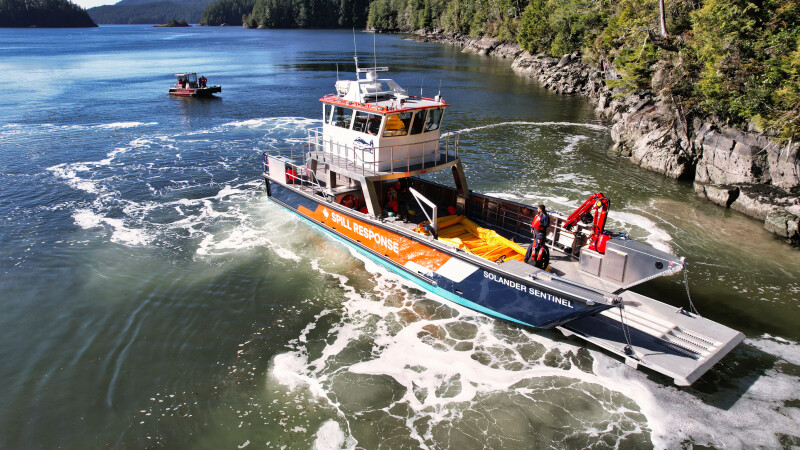
Among Munson’s recent builds is a 52'x16' spill response landing craft for Western Canada Marine Response Corp., powered by twin 750-hp Scania diesels with HamiltonJet waterjets and joystick controls. “That is a stunningly capable machine,” Martin said. “We’ve built [a number] of these from 2020 basically up to 2024.” The vessels carry 20,000 lbs. of cargo and use a full hydraulic system for skimmer and spill response gear.
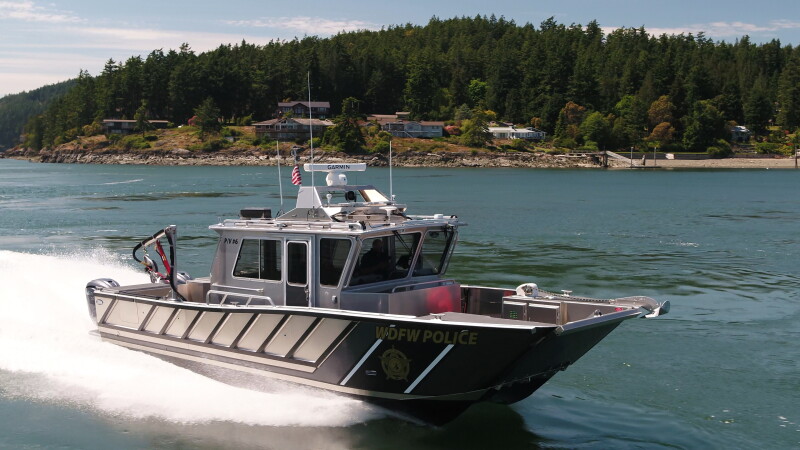
Another notable delivery this year was a 36'x13’ catamaran landing craft for the Washington Department of Fish and Wildlife powered by twin 450-hp Yamaha XTO outboard engines. “We hold the patent on the Packat catamaran, which is a wet tunnel design,” Martin said. “It gives you more buoyancy, which also lends itself to extra stability and cargo capacity (6,000 lbs.).”
SILVERBACK MARINE
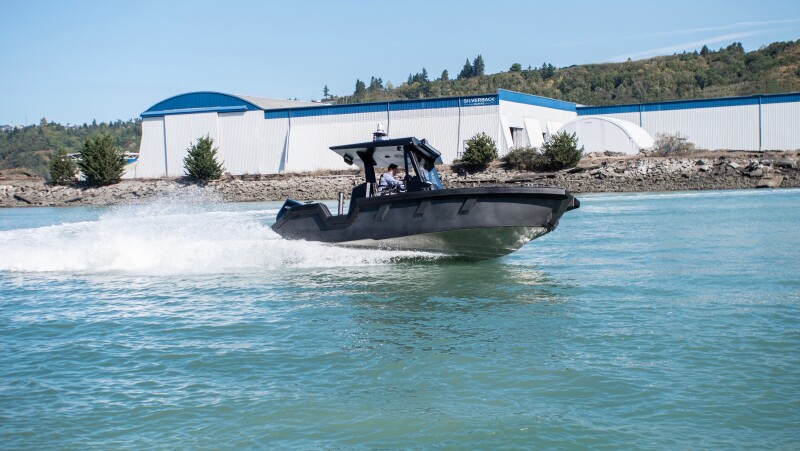
Silverback Marine founder Ian Gracey said a landing craft’s straightforward appearance often belies its practicality. “They’re totally function-driven,” he said. “You can pull equipment onto the deck, dive off it, or use it as a mobile platform. It’s a very practical design.”
Silverback builds a mix of aluminum workboats including landing craft, mini tractor tugs, and dive boats. Gracey said landing craft account for about 60% of the company’s annual output, averaging 12 to 14 boats each year.
“Fire and rescue, environmental and research, and law enforcement are steady markets,” he said. “Landing craft also make sense for tender operations.”
The Pacific Northwest remains a core region for Silverback builds, but Gracey said deliveries are expanding to Alaska, the Northeast, and inland waterways. “Anywhere with rocky beaches or shallow access points tends to be a good fit,” he said. “We’re also seeing growth in river jet applications and in waterfront construction work for bridges.”
One of Silverback’s recent projects is a 22'x8.5' aluminum patrol vessel for the New Mexico State Park rangers, designed as a hybrid between a traditional patrol boat and a landing craft.
“In a traditional police boat, you’re climbing up on the bow and jumping down into the mud,” Gracey said. “What we did here gives them the functionality of a landing craft without the wide bow.”
The vessel includes a narrow personnel-access bow door, twin shock-mitigating seats, and a single Mercury 425-hp outboard. It also integrates PeteStep hull technology, the first installation of its kind in North America. During trials, the vessel reached 45 mph and is scheduled for delivery in October.
Gracey said the best way to understand the platform’s capability is through direct experience.
“Find a builder and take one out,” he said. “Beach it, drive it, use it to load equipment. Once you’ve operated one, you understand why the design works in so many roles.”
LYMAN-MORSE
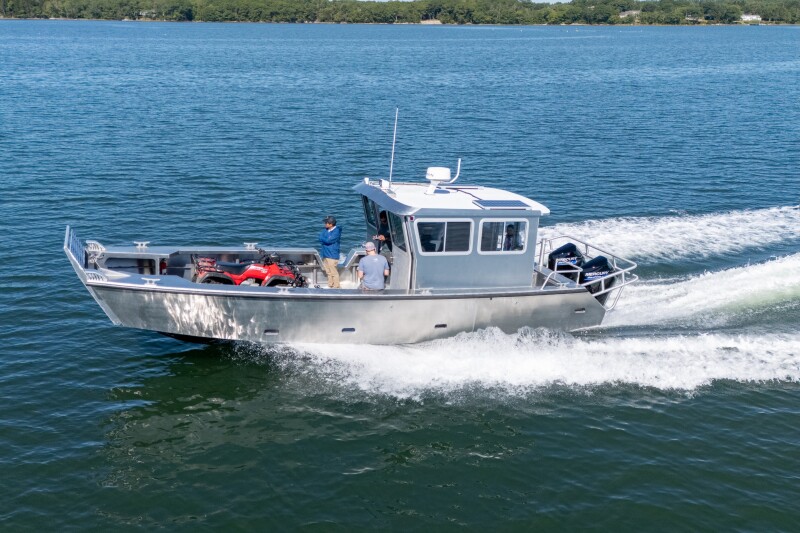
Lyman-Morse, Thomaston, Maine, best known for nearly five decades of custom yachtbuilding on Maine’s mid-coast, has carved out a new foothold in the commercial market with a growing line of aluminum landing craft.
According to Jonathan Egan, who heads the yard’s workboat division, Lyman-Morse currently has four landing craft under construction including a 20-footer for local fishermen, two 28' models, and a 38' vessel for the Thunder Bay Island Lighthouse Preservation Society in Alpena, Mich. The 38' vessel has a 9,000-lb. payload capacity, which is being built so the society can haul a tractor and building materials out to the island to maintain the lighthouse grounds,” Egan said.
The Thunder Bay vessel features a longer bow door and removable ramps to reach shallow beachheads, along with interior modifications requested by the volunteer crew, such as folding tables, handrails, and step access tailored for an older demographic. The boat will be powered by twin 300-hp Yamaha outboards with digital throttle and shift.
Egan said customization remains the division’s biggest selling point. “Customers come to us because we’ll change whatever they want — extra side doors, different cabin layouts, or alternate hulls. That flexibility, plus our location in the Northeast and shorter build times, are what set us apart.”
Egan noted that while aluminum workboats dominate on the West Coast, few builders in New England focus on them. “It seems like people are starting to wake up to aluminum on the East Coast,” he said. “There’s a real niche here, and we’re winning bids against West Coast yards because shipping adds at least $10,000 to bring a boat east. Customers appreciate having a builder within driving distance for service and warranty support.”
Recent deliveries include a 28' fire-rescue landing craft for Anderson County, S.C., and a 24' landing craft for the town of Wolfeboro, N.H., followed by a 28' version for the local electric cooperative that serves Lake Winnipesaukee’s island residents. “These boats scream,” Egan said. “The Anderson County one did 60 miles an hour with twin 250s.”
From its fabrication shop between the Thomaston and Camden yards, the company sees continued momentum. “We’ve got half a dozen new inquiries right now,” Egan said. “It really feels like a growing entity within Lyman-Morse. We’ve always been boatbuilders — but this is a new chapter.”
HARD DRIVE MARINE
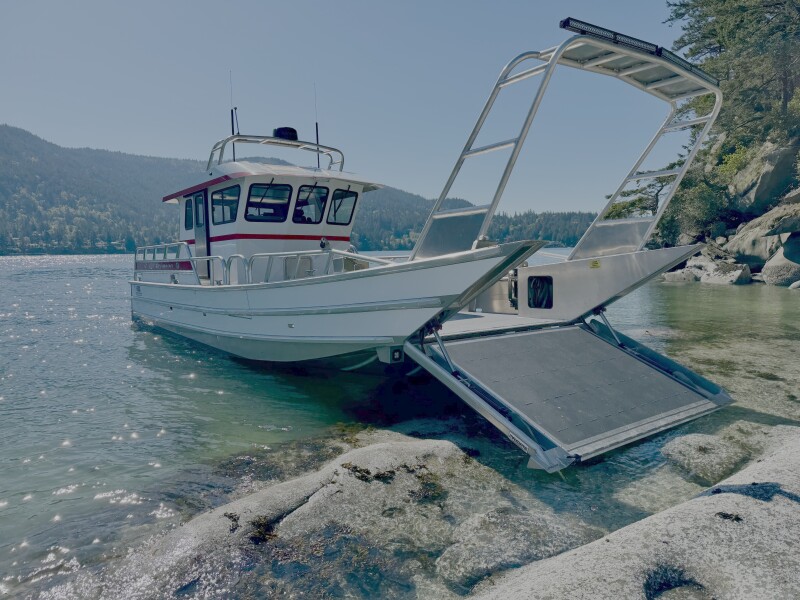
Hard Drive Marine, Bellingham, Wash., has maintained a steady production of aluminum landing craft through a mix of industrial, community, and research-focused builds. Over the past six months, the company has delivered five new boats to locations spanning from Alaska to the Caribbean and the South Pacific. Recent builds include a 30'x10' flat-bottomed landing craft delivered to the island of Yap in Micronesia, used to transport construction equipment for airstrip development on remote islands.
“That boat had to be as simple as possible,” said Hard Drive Marine owner Tom Day. “They’re 1,000 miles from nowhere, so they didn’t want any technology that could strand them. It’s operated by a standard trailer winch for the door. No hydraulics, no complexity.”
Two 44'x12' models were delivered to Kodiak, Alaska, and a nearby mainland village. One features a fixed cabin, while the other is outfitted with Hard Drive Marine’s modular Jax Cab — a removable aluminum enclosure that can be repositioned or detached depending on mission needs. Both vessels are powered by triple 300-hp Suzuki dual-prop outboards.
“The dual-prop design is key for landing craft,” Day said. “When you’re working close to the beach, you need strong reverse thrust to get off. In Alaska, with those huge tidal swings, it’s critical.”
Day said nearly every Hard Drive Marine landing craft now features the company’s patented Max Gate system which acts as a mechanical push-off aid to help vessels dislodge from soft beaches.
“Every boat we build has a Max Gate,” Day said. “People who’ve been stuck on the beach before know how big a deal it is. The gate’s spikes push you back into the water, and combined with the dual props, you can free yourself even with a falling tide."
The company’s other innovation, the Max Helm, offers flexibility for operators who prefer an open deck layout. The helm can be repositioned along the deck or to one side, freeing space for cargo or specialized equipment.
“Our most popular model is the 40'x11', typically built without a cabin,” Day said. “With the Max Helm, you can move freight or gear anywhere on deck without obstruction. For lodges and operators in short-season or warmer climates, it’s a perfect setup.”
Hard Drive Marine is constructing another 44'x12' Jax Cab model like its Kodiak build, scheduled for delivery within the next several months.
