



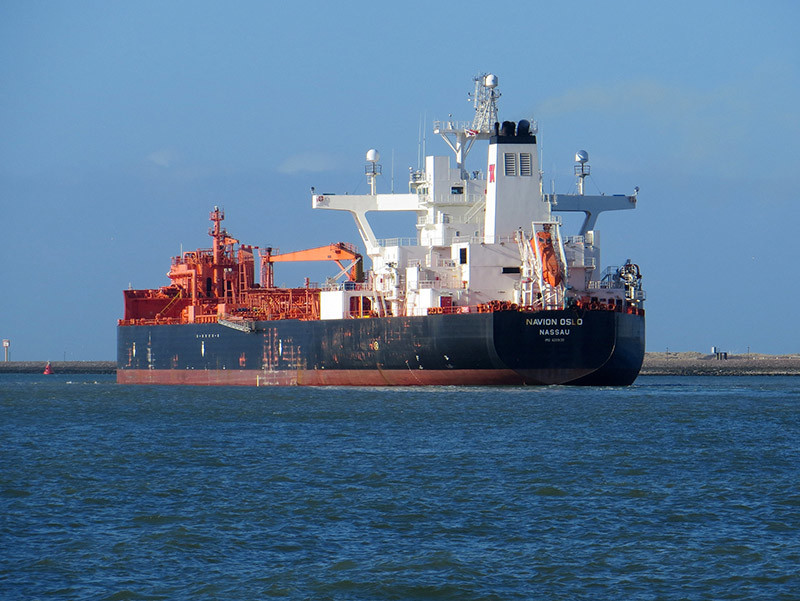
Foreign corporations earning income from coastwise shipments under the Jones Act waiver must report that income to the Internal Revenue Service and cannot claim tax exclusions normally available for international shipping, according to new IRS guidance.
The guidance applies to foreign-flag vessel operators carrying cargo between U.S. ports under the waiver. The original waiver took effect March 17 for 60 days, followed by a 90-day extension beginning May 18. A second 90-day extension began Aug. 17.
The IRS said income earned from transporting cargo between U.S. ports is not derived from the international operation of ships and therefore does not qualify for the gross income exclusion under Section 883 of the Internal Revenue Code or treaty benefits tied to international shipping.
Foreign corporations earning that income must report it on Form 1120-F, the U.S. Income Tax Return of a Foreign Corporation. Whether an operator ultimately owes U.S. federal income tax will depend on its taxable income and applicable deductions.
Maritime attorney Charlie Papavizas of Winston Taylor LLP said the IRS action is better understood as a reminder of an existing obligation than the creation of a new one.
“I don’t know if it was a clarification as much as it was a reminder,” he said. “If you’re deriving income from a service provided inside the United States, you have to anticipate that you might have to pay taxes on that.”
The distinction, Papavizas said, is that the waiver allows foreign vessels to engage in domestic commerce that would normally be prohibited under the Jones Act.
“Foreign vessel owners and operators are used to carrying product from Houston to Europe or from Europe to Houston and thinking, ‘We’re in the United States all the time, and we don’t pay taxes like a U.S. taxpayer on our income,’” he said. “That’s because those were international voyages. Now they’re on coastwise interstate commerce voyages.”
For U.S.-flag operators, the guidance addresses one of the compliance differences they have raised since foreign vessels were allowed into coastwise trades under the waiver.
Sam Norton, CEO of Overseas Shipholding Group, Tampa, Fla., said domestic operators have viewed the arrangement as a “free rider effect,” with foreign-flag vessels entering a market normally reserved for Jones Act operators without facing some of the same obligations imposed on U.S. companies.
“I’ve referred to it as a free rider effect,” Norton said. “Foreign-flag vessels can come in and operate within the marketplace that is usually defined by the Jones Act without complying with other laws that have not been waived.”
Norton said the tax liability itself is unlikely to erase the broader cost difference between U.S.- and foreign-flag operations.
“On the raw dollars and cents, it doesn’t move the needle much,” he said. “It moves it a little bit.”
The larger practical effect, Norton said, may be the compliance burden. Foreign shipping companies accustomed to international trades may have to establish procedures or hire outside advisers to determine taxable income, make federal filings, and assess whether additional state tax obligations apply.
For companies not structured to handle U.S. tax compliance, Norton said those costs and administrative demands could factor into whether a waiver voyage is worth pursuing.
“The compliance costs that will now be imposed upon them, just the administrative costs, could be a deterrent,” Norton said. “It will reduce the number of available tankers that would be interested in pursuing voyages under the Jones Act.”
