


Government efficiency has been a hot topic lately. While some would say those terms are mutually exclusive, certain Coast Guard boat programs are demonstrating otherwise.
By evaluating all classes of working vessels through its In-Service Vessel Sustainment (ISVS) program, the Coast Guard determines what maintenance and upgrades are necessary to keep its fleet functioning. Equipment upgrades and improved maintenance processes allow vessels to operate more cost-effectively, sometimes even beyond their expected service life. Understanding these options also helps determine when it is necessary for vessels to be replaced.
There are two categories of mission-effectiveness improvement projects in the Coast Guard’s recapitalization and sustainment strategy: Major Maintenance Availability replaces old unsupportable systems so that vessels can work effectively during their design service life. Service Life Extension Programs (SLEP) are a cost-effective way to keep vessels in service beyond their intended service life.
The 47 Motor Lifeboat (47 MLB) SLEP is a prime example of the benefits of extending the service life of a surface asset. I was able to see firsthand how this project works by observing the refit work in action, and test running 47 MLBs both before and after their refits.
THE BOATS
The workhorses of surf operations, 47 MLBs are an essential tool for surfmen performing search, rescue, towing, and recovery operations even in extreme conditions. The boats’ proven performance, including self-righting, whether knocked down or rolled 360°, their ability to work in 50-knot winds, 30' seas, and 20' surf, and their all-aluminum construction make them good candidates for SLEP. The problem is not the vessels’ inherent capabilities; it is that after 20-25 years of rigorous service, their systems are aging, and maintenance costs and downtime are rising.
Through careful assessment of the 117-boat 47 MLB fleet, the Coast Guard determined that a major overhaul of the fleet is the most cost-effective way to maintain mission readiness. The 47 MLB SLEP is intended to extend the vessels’ service life an additional 20 years with projected operation through 2047, eliminating the need for designing and building a replacement vessel now.
In 2019, the Coast Guard awarded a $191 million fixed-price contract to Birdon America Inc., Denver, for detailed design and service life extension work to refurbish 107 boats over a 10-year delivery period. The work is being completed in two facilities, one on each coast. Birdon’s West Coast operations in Bellingham, Wash., where I visited, can have five boats in production simultaneously. A new $5.5 million, 32-acre facility that opened in 2024 on the East Coast in Portland, Conn., can handle seven boats at once and includes a marina.
BEFORE: 47 MLB-BRAVO
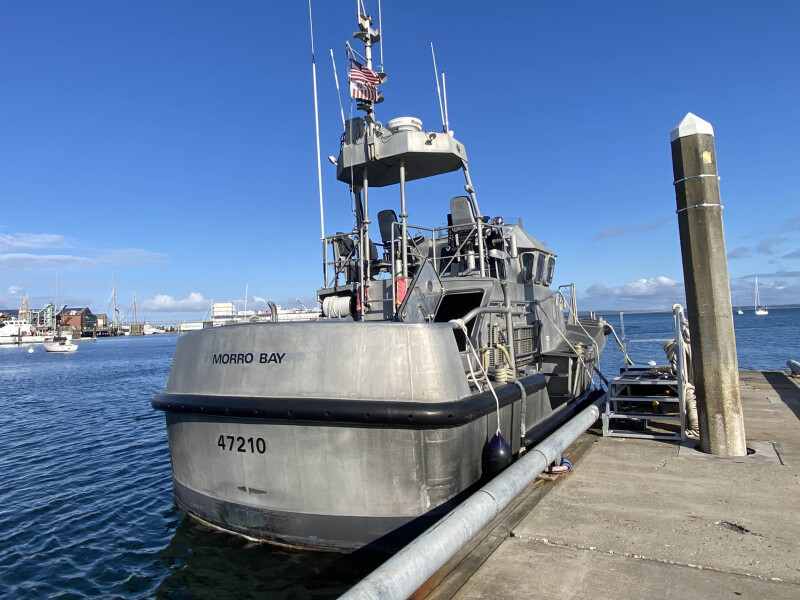
At the Birdon facility in Bellingham, a 47 MLB-Bravo (an original before SLEP) sat on the dock. The boat had just come up from Morro Bay, Calif., on its own bottom, and both original Detroit Diesel 6V92TA DDEC-IV, 435-hp engines were functioning, but not optimally.
Birdon test driver Uriah Beverage warned, “She runs, but seems to have some oil pressure issues, so I am not sure how well she will perform.”
I walked around inspecting the boat as we prepared for departure. The side stripes were faded, with the red looking pink in the morning light. The deck appeared sound, but the nonskid is tattered with missing patches. Exterior seats where we would run our test were torn. Knobs and buttons on control surfaces, including the throttles, were well worn. Paint has peeled off the steering wheel, and uneven caulk sealed its base. The vessel’s interior had a similar feeling. Floor covers, soft surfaces, and anything that was regularly touched or handled was visibly worn, but the aluminum hull, decking, and stringers did not appear corroded or damaged. The engine room was a bit dreary with the pale green Detroits slightly oily but seemingly well cared for.
Underway, we ran from idle to wide-open throttle in set increments. At 1,850 rpm, we averaged 20.1 knots at 36 gph, yielding a calculated range of 187 nautical miles (nm). (I measured the range with a 10% reserve. Without the reserve range, it would be over 200 nm, even with the Coast Guard’s 95% fill level for ullage). These engines should be able to run at 2,100 rpm, but on this old girl, 2,060 rpm is the maximum. At wide-open throttle, speed peaked at 23.9 knots.
To assess the handling of the vessel, I first tried the joystick control to port, but it wouldn’t work, so I moved to the starboard helm. I made a few tight turns, completing a 360 in 2.5 boat lengths. Performing a figure eight at 1,800 rpm, speed dropped off a few knots, but the boat pushed through the maneuver even though the steering seemed strained. We sliced through our own wake effortlessly, which was as expected for a surf boat. Unfortunately, those were the only waves we had to play with. I wanted to perform a high-speed stop and jockeyed the throttles to further assess maneuverability, but a misfire alarm sounded, forcing us to head back. The Bravo test clearly demonstrated the precarious condition many old 47 MLBs are in.
AFTER: 47 MLB-CHARLIE
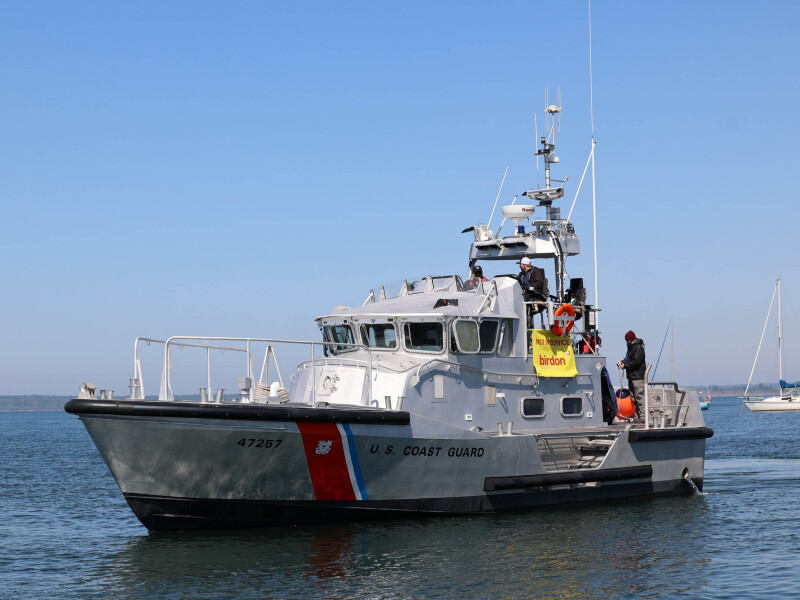
Walking down the same dock where I tested the Bravo, a newly refurbished 47 MLB-Charlie sparkled like a new boat in the sunshine. Gleaming paint from her red, white, and blue stripes and perfectly laid nonskid belie her 22+ year age. This is not the same boat we tested as a Bravo. It takes six to nine months for each to be completed, but having seen several of the old boats in various stages, the transformation is incredible.
Looking around before our sea trial, things have changed significantly. New Shoxs seating adorned the open bridge, and the Raymarine SINS (scalable integrated navigation system) is so new that the plastic protector film is still in place. Below decks, the survivor’s compartment was completely refurbished. In the engine room, the brilliant white new Cummins QSC8.3-M engines gently idled, notably quieter than the old Detroits. One of the few ways I could tell the boat is not new was the slightly worn, but still fully functioning, windows in the interior pilothouse, which the Coast Guard opted not to replace.
On the water, we ran the boat test in nearly the exact spot and similar conditions as the previous sea trial. At 2,300 rpm, we cruised at 21.25knots using 33.9 gph, delivering a range of 210 nm. This was 2.1gph better fuel economy than the Bravo and 23 nm more range. We averaged 24.6 knots at 2,600 rpm while using 42.6 gph, using 3.4 gph less fuel, and going 1.3 knots faster than the old boat. Top speed was 27.5 knots with the higher-revving Cummins engines. The Charlie came up to speed faster and was noticeably quieter than the Bravo, although decibel readings were similar. I attribute that to the fact that our dB meter was outside under the dash, and likely affected by the wind.
Taking the controls, I tried the joystick to port and then moved to the wheel. Maneuverability was greatly improved over the Bravo, turns at 2,200 rpm, 20 knots, were tighter, around a boat length, with minimal speed loss. Effort at the wheel is minimal, and with only 2.5 turns from side to side, steering was noticeably responsive.
The most impressive feature was the throttles/controls developed in partnership between Cummins and Glendinning Products. Not only are these controls waterproof to IP67 (submerged 1 meter for 30 minutes), but they have a rollover controller that returns the engines to neutral and idle if the boat rolls past 110°, and they are programmed to allow shifting from hard ahead to hard astern. I ran the boat up to speed and then conducted a high-speed stop, throwing the throttles into reverse. The 40,000-lb. boat stopped on a dime without lurching or stalling. Enthralled by this capability, I jockeyed the throttles and turned some quick donuts and then spun rapidly back the other way. Fast, tight maneuverability is instantaneous. Sometimes, a quick pop into neutral and then back down ensured reengagement of the gear when shifting rapidly. The ease and speed of control were incredible. Knowing the conditions these vessels operate in and the types of rescues and towing they are designed to handle, I understand why the surfmen need these capabilities.
Testing the boats before and after their upgrades revealed that Birdon and the Coast Guard have managed to teach an old dog a new trick. These aging vessels now perform like new.
In terms of government efficiency, this program is saving taxpayers a significant amount of money. While refurbishment costs vary depending on each vessel’s condition, dividing the $191 million contract by the 107 boats upgraded through SLEP yields an average cost of $1,785,047 per vessel. Designing, testing, and building an entirely new lifeboat would cost far more. Additionally, there would be further expenses for retraining surfmen on a new platform and decommissioning the 47 MLBs when they’re retired.
Repair, Refit, Restore
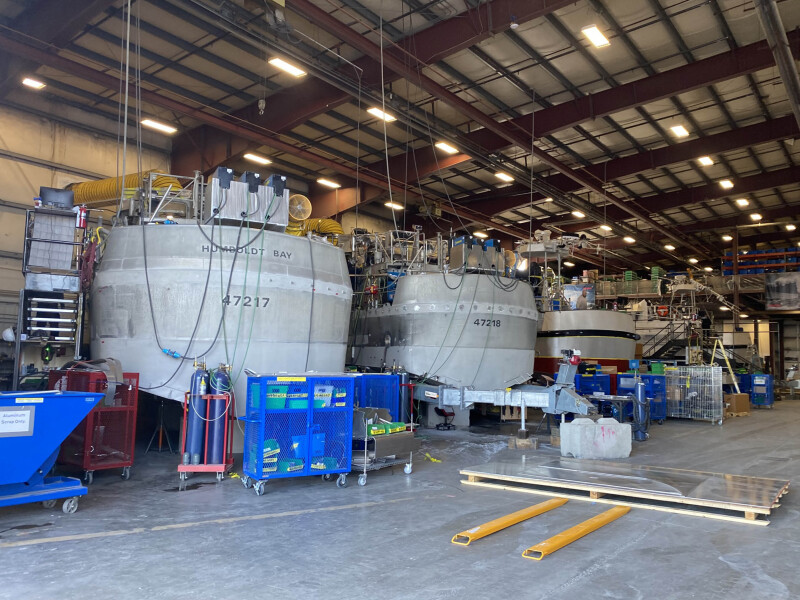
While touring the Bellingham facility with Birdon Production Manager Jesse Scott, the transformation from worn-out Bravo boats to newly commissioned Charlie models was on display. The process begins with each boat being hauled out and carefully positioned in a custom cradle designed to measure its balance points — a critical factor for self-righting vessels. Next, the boats enter the first fabrication bay, where they are essentially gutted. Workers remove engines, gears, seating, and onboard systems, leaving only reusable elements such as insulation and wire bundles. Once stripped, the vessel moves into an enclosed area for preliminary sandblasting, which removes old paint and exposes the underlying surface for inspection. A planned foredeck replacement follows, and Birdon conducts thorough testing of the 5456 marine-grade aluminum hull, replacing sections as needed — most often around the exhaust and keel.
Pointing under one of the vessels, Scott explained, “Our base work line items include replacing the stern tubes, struts, and rudders.”
Back in the main building, four boats, ranging from raw to fully finished, were neatly lined up side by side. In the second fabrication bay, a gutted vessel with its deck plates removed was undergoing welding. The third boat, with welding completed, had moved into the installation bay. Its hull had been coated with an epoxy barrier, the signature red, white, and blue stripes painted, and Coast Guard emblem decals applied. New rub rails for the fendering system had been installed. These now use a quick-bond adhesive instead of welded studs, making them easier to remove and replace while the vessel is in service. On this boat, the buoyancy box — which supports the radar and other antennas — had been remounted after being removed for renovation and rewiring. Inside, the engines were in place, and technicians were connecting electronics and other equipment.
“We have a very comprehensive parts tracking system because there are over 4,000 individual components that go into the boats,” said Scott. “We track every part, which once received, is assigned to a work order. It takes about 210 work orders to get the boat built. We use a software program for work instruction tracking, which is built into our quality system, with quality checks at strategic points.”
The last vessel in the shop was complete and being inspected and quality checked before it would be sent back to the measurement cradle for final balancing. Since the new Cummins QSC 8.3 530-hp turbo diesels are around 2,000 lbs. lighter than the old engines, epoxy-coated steel plate ballast was installed to maintain the center of gravity and self-righting capabilities. The measurement cradle determines if further ballast adjustments are needed. Once the final balance is documented and compared to the initial measurements, the 47 MLB-Charlie will launch for approximately a month of in-water testing before being turned over to the Coast Guard for delivery.
