



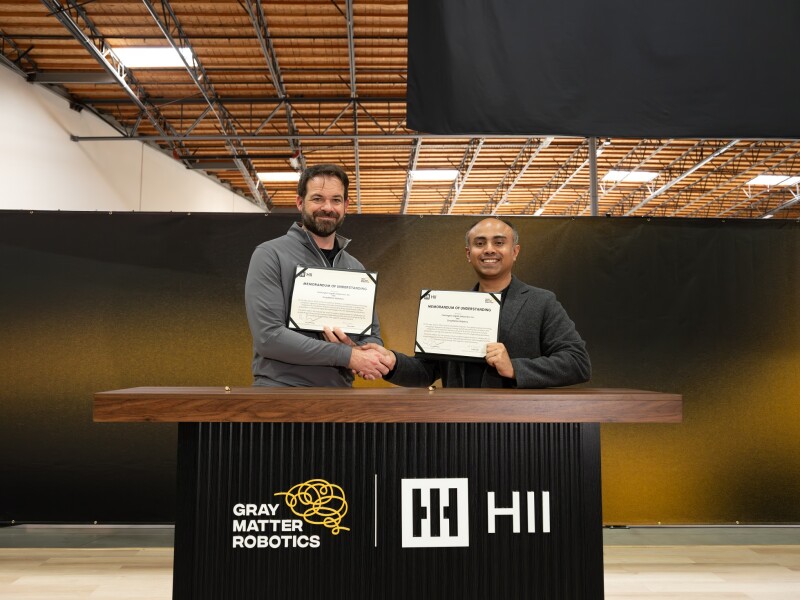
Huntington Ingalls Industries has signed a memorandum of understanding with GrayMatter Robotics, Carson, Calif., to evaluate the use of artificial intelligence-driven robotic systems in shipbuilding, with a focus on increasing production throughput and supporting workforce demands.
Announced April 6, the agreement outlines collaboration across several areas, including autonomous shipbuilding capabilities, integration of robotics with existing production technologies, workforce training, and scaling of unmanned system manufacturing.
The companies will examine how GrayMatter’s “physical AI” systems that are designed to perform labor-intensive industrial tasks can be applied to shipyard operations such as surface preparation, coating, and inspection. These processes, which include sandblasting, grinding, and painting, remain largely manual and require strict adherence to quality and safety standards.
HII said the effort aligns with its broader push to improve shipbuilding efficiency. The company reported a 14% increase in throughput in 2025 and is targeting an additional 15% gain in 2026. The potential integration of AI-enabled robotics would support those goals by automating repetitive work while maintaining production quality.
The collaboration will also tie into HII’s High-Yield Production Robotics (HYPR) initiative, which focuses on incorporating advanced automation into shipyard workflows. Officials said AI-enabled systems could help reduce rework, improve material efficiency, and shorten delivery timelines for U.S. Navy vessels.
Executives from both companies attended the signing ceremony at GrayMatter Robotics’ headquarters in California, where demonstrations highlighted the application of AI-driven robotic systems in fabrication environments. The systems are designed to adapt to the variability typical of shipyard production, where no two work surfaces are identical.
Despite advances in automation, much of U.S. shipbuilding remains dependent on skilled labor. HII said AI technologies are intended to augment and not replace the workforce by handling repetitive or physically demanding tasks, allowing tradespeople to focus on higher-skill work.
The agreement comes as shipbuilders face increasing pressure to expand capacity and deliver vessels more quickly to meet naval demand, while also addressing workforce constraints across the maritime industrial base.
