



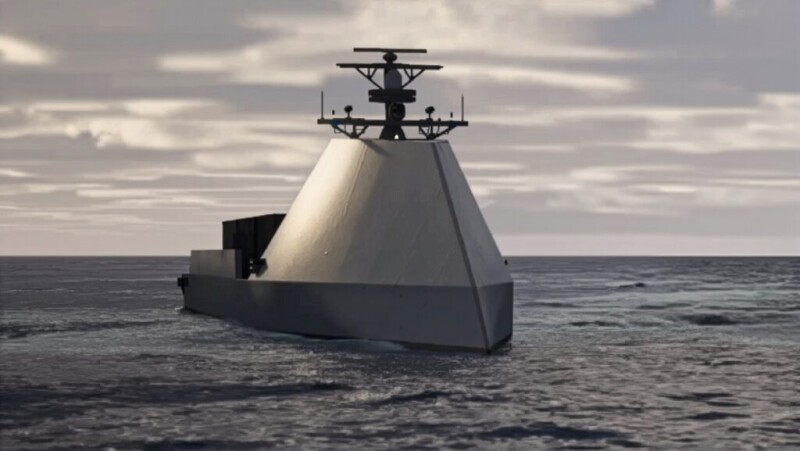
Defense shipbuilder HII, Newport News, Va., announced plans to expand its unmanned surface vessel manufacturing capabilities with an upgraded assembly facility in Louisiana and a new industrial robotics program aimed at transforming how the company builds its Romulus family of USVs.
The company has released plans for an enhanced Romulus assembly facility at Breaux Brothers Enterprises in New Iberia, La., alongside the introduction of its High-Yield Production Robotics initiative, known as HYPR. Together, the two efforts are designed to move Romulus production from prototype construction to repeatable, large-scale manufacturing, HII said.
The upgraded Breaux Brothers facility is configured for serial production of Romulus vessels ranging from roughly 20' to 190' in length. The expanded layout incorporates automation, advanced tooling, and standardized workflows intended to support high-rate production across multiple vessel variants. A Romulus prototype is currently under construction at the site.
"Romulus is engineered from the outset for scale," said Andy Green, president of HII's Mission Technologies division. "By pairing a purpose-built assembly line with automation and strong industry partnerships, we are driving predictable production outcomes and lowering the cost of unmanned surface vessels. This positions us to deliver capability faster and at volumes aligned with fleet needs."
The HYPR initiative will bring robotic welding, automated material handling, and digital quality assurance systems into the production environment. HII plans to conduct proof-of-concept demonstrations with multiple partners in 2026, with a full-scale pilot program targeted for early 2027.
"HYPR applies next-generation industrial robotics to shipbuilding processes that have traditionally been labor-intensive and difficult to automate," said Eric Chewning, executive vice president of maritime systems and corporate strategy at HII. "For v, this means fewer labor hours per hull, greater schedule predictability, and a manufacturing model that can scale efficiently as volumes increase."
HII said it is working with Breaux Brothers and naval architecture firm Incat Crowther to align vessel design, production tooling, and facility layout.
Driven by battlefield lessons from Ukraine and growing competition with China, the U.S. Navy has been accelerating plans to deploy uncrewed surface vessels, and a growing mix of new and established defense contractors is racing to build the industrial capacity to meet that demand.
The Romulus family is designed to serve the Navy, Marine Corps, joint forces, and allied customers across a range of missions, including intelligence collection, mine countermeasures, strike operations, and unmanned system deployment, HII said. The vessels are built around HII's Odyssey autonomous control system and incorporate technologies from Shield AI, Applied Intuition, and C3.ai.
